Lalgarh Palace
Lalgarh Palace
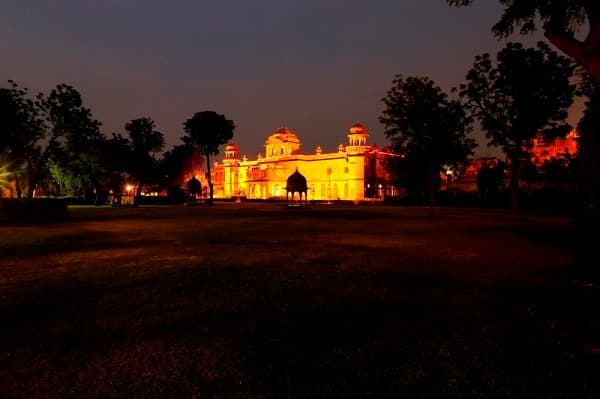
Built for Maharaja Ganga Singh around 1902, Lalgarh Palace blends Rajasthani, Mughal, and colonial architecture. Two museums, red sandstone jalis, and an intact historical setting 3 km from Bikaner's city center.
Lalgarh Palace rises to the north of Bikaner, constructed at the turn of the 20th century for Maharaja Ganga Singh. Built in red Rajasthani sandstone, it seamlessly merges Rajasthani, Mughal, and European architecture into a cohesive whole. Today, part of the palace has been converted into a heritage hotel; another section houses two museums. It remains one of the few Bikaner palaces accessible to the public without being entirely privatized.
Practical Information at a Glance
- Access: approximately 3 km north of Bikaner's city center, reachable by rickshaw or taxi.
- Admission: interior museums charge an entry fee; gardens and the exterior façade are freely visible from the road.
- Recommended duration: 1 to 2 hours for the museums and exteriors.
- Dress code: smart casual recommended in museum areas.
What to See
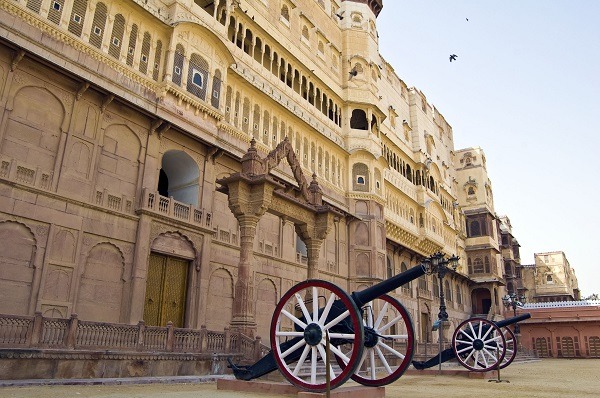
The main façade strikes with its intricately carved jalis (pierced stone lattice screens), domes, and colonnaded galleries. The local red sandstone gives the entire structure a warm hue characteristic of Bikaner. The interior gardens, though less dramatic than those at Jodhpur, offer a serene setting.
Two museums occupy a wing of the palace:
- Shri Sadul Museum: collections of photographs, weapons, hunting trophies, and personal artifacts from Bikaner's royal family.
- Anup Library Museum: ancient manuscripts, including texts in Sanskrit and Persian, testament to the maharajas' scholarly patronage.
History and Context
Maharaja Ganga Singh (r. 1887–1943) commissioned the palace from British architect Samuel Swinton Jacob, who had already designed several buildings across Rajasthan. Construction began around 1902. Ganga Singh was a pivotal figure in Bikaner's history: he modernized the state, attended the Paris Peace Conference in 1919, and developed the local railway network. The palace takes its name from his father, Lall Singh.
Following independence, the royal family converted part of the building into a hotel—the Laxmi Niwas Hotel—while keeping the museums open to the public.
Highlights of Your Visit
Red Sandstone Jalis
The pierced stone screens running across the façades rank among Bikaner's most elaborate. They filter light and create shadow patterns inside the galleries. Take time to study the floral and geometric motifs up close.
The Shri Sadul Museum
Period photographs show Ganga Singh alongside world figures—George V, Lloyd George—offering a measure of Bikaner's political influence in the early 20th century. Collections of weapons and royal garments complete the picture.
Anup Library
Less frequented than the main museum, this library preserves rare manuscripts. For those interested in Rajasthan's intellectual heritage, it's a worthwhile detour.
Photography Tips
Morning light (before 10 a.m.) is ideal: it strikes the east façade directly and brings out the red sandstone's color. In late afternoon, the west façade glows in turn. Avoid midday, when light is harsh. Jalis photograph beautifully in backlighting to reveal their patterns. Check photography restrictions inside the museums before bringing out your camera.
Location and Access
The palace lies in Bikaner's northern district, a reasonable distance from the old town and Junagarh Fort. Rickshaws and taxis are the most convenient means from the city center. Bikaner railway station connects well to Jaipur, Jodhpur, and Delhi, making Bikaner a logical stop on a Rajasthan circuit.
Nearby Attractions
- Junagarh Fort — 16th-century fortress at Bikaner's heart, with interior palaces and weapons collections.
- Karni Mata Temple (Deshnok) — temple famous for its sacred rats, roughly 30 kilometers south of Bikaner.
- Kote Gate Bazaar — bustling old-town market, ideal for spices and local crafts.
Frequently asked questions
Yes. The Shri Sadul and Anup museums are accessible to outside visitors for an entry fee. The hotel occupies a separate wing.
October to February offers pleasant temperatures (59–77°F / 15–25°C). Summer (April–June) is very hot, with peaks exceeding 104°F (40°C). Bikaner's camel festival typically takes place in January.
Allow 1 to 2 hours to tour both museums and photograph the exteriors. Combined with Junagarh Fort, plan for a full half-day.
Rules vary by room. Inquire at the entrance; some manuscript collections are protected against flash photography.
Start with Junagarh Fort in the morning (it draws larger crowds), then head to Lalgarh in early afternoon. Finish in the old-town bazaar at sunset.
Photos
Interested in this visit?
We can include it in your personalised itinerary.