Tabo Monastery
Tabo Monastery
Founded in 996 CE in the Spiti Valley, Tabo Monastery houses thousand-year-old frescoes and stucco sculptures of rare refinement, set in a timeless high-altitude landscape.
Tabo is a village in the Spiti Valley, Himachal Pradesh, at more than 3,000 meters elevation. Its Tibetan Buddhist monastery, founded in 996 CE, stands as one of the oldest continuously active monastic complexes in the Himalayas. Its rammed-earth temples house frescoes and stucco sculptures of remarkable finesse, comparable to those of Ajanta. The site draws Tibetan pilgrims, art historians, and travelers seeking solitude in equal measure.
Practical information at a glance
- Access: Tabo sits on National Highway NH-505 between Kaza and Rekong Peo (Kalpa). The road is open weather permitting, typically June through October.
- From Kaza: approximately 47 km by Spiti road; local buses and shared jeeps available.
- Dress code: modest attire required inside temples; remove shoes before entering.
- Recommended duration: 2 to 3 hours for the monastic complex; one night on-site recommended to experience the tranquility.
- Elevation: approximately 3,050 m — allow acclimatization time if arriving from lower altitudes.
What to see
The complex comprises nine temples, four stupas, and several residential buildings for monks. The main temple, called the Dukhang (assembly hall), preserves 10th-century frescoes in remarkable condition. The stucco sculptures depict life-size bodhisattvas with finely modeled details. A troglodytic cave carved into the cliff face overlooking the village once served as a meditation retreat.
History and context
The monastery was founded in 996 by the monk-translator Rinchen Zangpo, sent by King Yeshe-Ö to spread Buddhism throughout the region. This movement of the "second diffusion" of Tibetan Buddhism made Tabo a center of learning and the translation of Sanskrit texts. The Dalai Lama presided over the Kalachakra ceremony at Tabo twice—in 1983 and 1996, during the monastery's millennium celebration.
Highlights of your visit
The Dukhang frescoes
10th-century murals cover the entirety of the interior walls. Their pigments—ochre, lapis lazuli blue, lead white—have endured a thousand years with striking intensity. The muted interior light requires a moment for your eyes to adjust before distinguishing the intricate mandalas and narrative scenes.
The stucco sculptures
Arranged in rows within side chapels, these bodhisattva figures sometimes reach two meters in height. The modeling of faces and hands reflects a distinctly Kashmiri influence, marking a departure from later classical Tibetan style.
The meditation caves
Above the village, cells carved into clay-rich rock once served as monk retreats. Some remain in active use. Access is by foot along a steep trail; the view across the Spiti Valley from this vantage point rewards the effort.
Etiquette and visiting rules
- Remove your shoes before entering each temple.
- Photography inside temples is generally prohibited or requires permission — check with resident monks.
- Speak softly; monks are praying or meditating at all times.
- Circumambulate stupas clockwise (pradakshina).
- Ask permission before photographing monks or residents.
Photography tips
Morning light illuminates the monastery's white facade and ochre mountains beyond. Late afternoon's raking light accentuates the relief of the stupas. Outside, the contrast between rammed-earth walls and the intense high-altitude sky is striking. Avoid flash indoors, even if photography is permitted.
Location and access
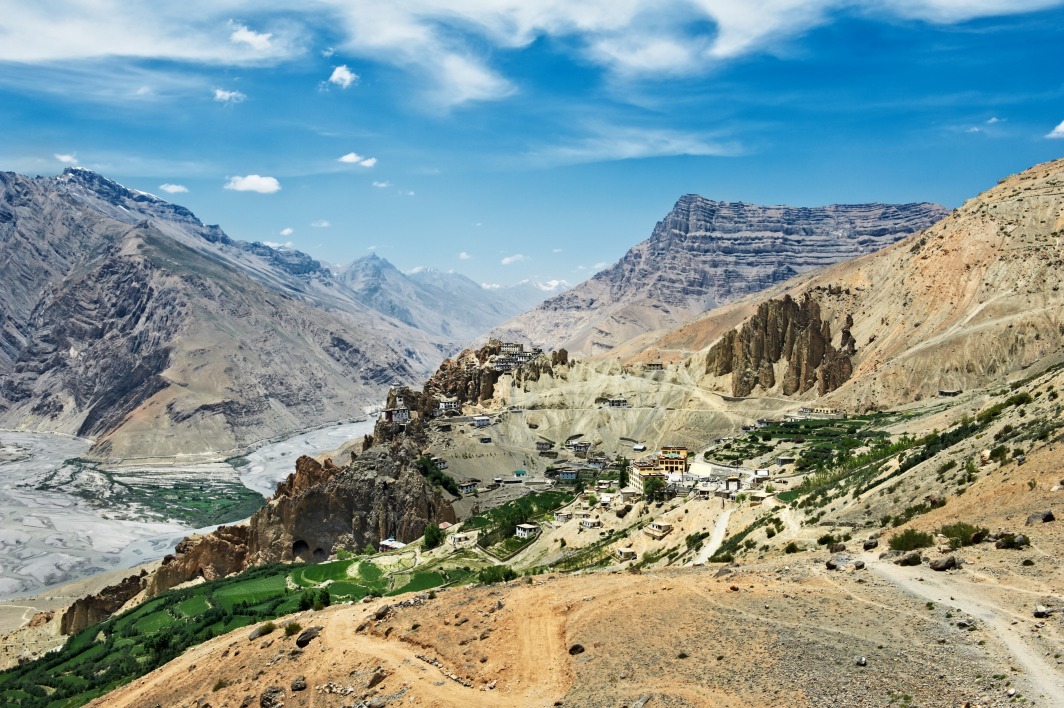
Tabo lies in the Spiti Valley, approximately 47 km east of Kaza, the district headquarters. The road traces the Spiti River through a barren, high-altitude landscape. The nearest airport is Bhuntar (Kullu), several hours away by road. In summer, state buses connect Shimla to Kaza via Tabo. A shared jeep from Kaza takes about an hour and a half depending on road conditions.
The village is accessible for people with reduced mobility in the lower sections of the complex, though caves and certain secondary temples require climbing unmarked stairs or trails.
In the surrounding area
- Kaza — administrative capital of Spiti, departure point for valley excursions.
- Ki Monastery — fortress monastery perched on a rocky spur, one of Spiti's largest.
- Dhankar Monastery — former palace-fortress converted to monastery, with a glacier-fed lake accessible on foot.
- Pin Valley — national park home to snow leopards and Himalayan ibex.
Frequently asked questions
The Spiti road is generally passable from June to October. July–August is peak season; June and September offer lighter crowds and often stable conditions.
Foreign nationals must obtain an Inner Line Permit (ILP) for certain zones near the border. Verify current requirements with Indian authorities before departure, as regulations may change.
Interior photography is generally restricted to protect the artworks. Always ask permission from resident monks; rules may vary by chapel.
Allow two to three hours to tour the main temples and stupas. If you wish to climb to the meditation caves, add another hour.
The village offers guesthouses and a few modest hotels. The monastery also maintains pilgrim rooms, subject to availability. Book ahead during peak season.
Tabo fits naturally into a Shimla–Spiti–Manali circuit. From Tabo, Kaza (47 km) provides access to Ki and Dhankar monasteries. Most travelers dedicate five to seven days to the entire valley.
Photos
Want to discover this destination?
Our local advisors design your tailor-made trip.