Orchha Fort Complex (Raj Mahal, Jahangir Mahal, Sheesh Mahal)
Perched on a rocky island ringed by the Betwa River, Orchha's palaces—Raj Mahal, Jahangir Mahal, Sheesh Mahal—reveal 16th-century Bundela architecture in a remarkably unspoiled setting, far removed from India's well-trodden tourist circuits.
Orchha, a small town in Madhya Pradesh founded in the 16th century, is home to a remarkably well-preserved palatial complex on a rocky island ringed by the Betwa River. The complex comprises several palaces—Raj Mahal, Jahangir Mahal, and Sheesh Mahal—built by Bundela rulers between the 16th and 17th centuries. Their architecture blends Rajput traditions with Mughal influences in an almost deserted setting, removed from the crowds of India's major tourist circuits.
Quick Reference Guide
- Entry: Paid site managed by the Archaeological Survey of India (ASI); combined ticket covering main palaces and cenotaphs
- Recommended duration: 2 to 3 hours for the main complex; a full day to include cenotaphs and Ram Raja Temple
- Dress code: Respectable attire recommended; cover shoulders and knees to access the adjacent Ram Raja Temple
- Access: Orchha is about 15 km from Jhansi, connected by road; Jhansi has a railway station on the Delhi-Mumbai and Delhi-Chennai lines
- Accessibility: Limited access due to ancient staircases and uneven ground
What You'll See
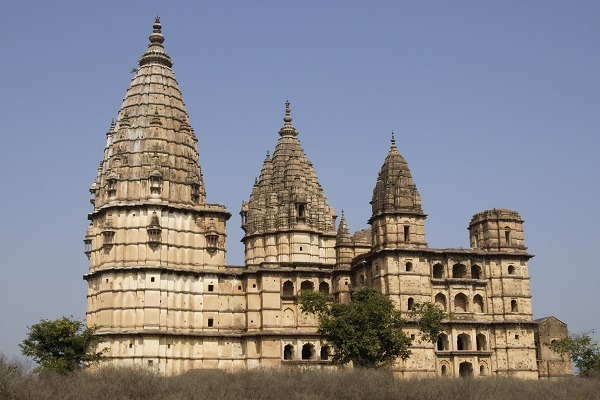
The Raj Mahal (royal palace, 16th century) retains vibrant wall paintings depicting mythological scenes and geometric patterns. The Jahangir Mahal, built to host Mughal Emperor Jahangir, impresses with its scale and overhanging balconies. The Sheesh Mahal, now converted into a state heritage hotel, offers unobstructed views of the Betwa River and cenotaphs.
History and Context
The Bundela dynasty founded Orchha in 1501 under Rudra Pratap Singh. The town reached its peak under Bir Singh Deo (1605-1627), an ally of Mughal Emperor Jahangir. It was he who commissioned the Jahangir Mahal to honor the imperial visit. After the Bundela decline in the 18th century, Orchha was gradually abandoned in favor of Tikamgarh, which explains the exceptional state of preservation of its monuments, never modernized or overrun by crowds.
Highlights of Your Visit
Raj Mahal and Its Frescoes
The interior rooms of Raj Mahal house 17th-century frescoes among the finest preserved in Madhya Pradesh. Depictions of Vishnu, Krishna, and scenes of the Bundela court cover ceilings and walls in ochre, blue, and green tones still clearly visible.
Jahangir Mahal
This multi-story palace, built in local sandstone, blends Mughal domes with Rajput chhatris. The central courtyard and upper terraces offer panoramic views of the entire complex and the river below.
Cenotaphs of the Betwa
Along the riverbank, a row of chhatris (cenotaphs) dedicated to Bundela rulers forms a striking architectural tableau, particularly striking at sunrise and sunset. Access is on foot from the fort.
Ram Raja Temple
Unique in India, this temple treats Ram as a reigning king: the deity receives an honor guard from the state police. The building, originally a palace, is woven into Orchha's urban fabric and remains an active place of worship, heavily frequented by local pilgrims.
Etiquette and Visiting Rules
- Remove your shoes before entering Ram Raja Temple.
- Photography is prohibited inside the main sanctum of Ram Raja Mandir.
- Maintain quiet and respectful behavior in active worship spaces.
- ASI palaces permit photography; check specific restrictions at the entrance.
Photography Tips
Golden morning light is ideal for photographing the cenotaphs from the Betwa riverbank. Jahangir Mahal lends itself to low-angle shots from the central courtyard in late morning. Late afternoon light bathes the Sheesh Mahal terraces in warm rays, providing natural framing for the chhatris.
Location and Access
Orchha is located in Niwari district, Madhya Pradesh. The nearest town with major railway connections is Jhansi (Uttar Pradesh), approximately 15 km away. Auto-rickshaws and taxis operate from Jhansi. Orchha is also accessible from Khajuraho by road, allowing you to combine both destinations in a Madhya Pradesh circuit. The palatial complex sits at the heart of Orchha, within walking distance of the main bazaar.
Nearby Attractions
- Khajuraho Temples — ensemble of medieval temples on the UNESCO World Heritage list, a few hours' drive away, essential for understanding Chandela architecture.
- Gwalior Fort — monumental fortress overlooking the city of Gwalior, accessible from Jhansi by train.
- Panna National Park — tiger and leopard reserve on the banks of the Ken River, ideal to combine with Khajuraho.
Frequently asked questions
The dry season, October to March, offers pleasant temperatures. Avoid the monsoon (July-September) for travel, though the lush vegetation around the Betwa is spectacular.
Yes. The road between Orchha and Khajuraho is manageable in half a day. Plan two nights in Orchha and two in Khajuraho to explore both sites without rushing.
For the ASI palaces, respectable attire suffices. For Ram Raja Temple, shoulders and knees must be covered, and shoes must be removed at the entrance.
Photography is generally permitted in ASI-managed palaces. It is prohibited inside the sanctum of Ram Raja Temple. Check signage at each monument's entrance.
Budget half a day for the three main palaces. A full day allows you to add the Betwa cenotaphs, Ram Raja Temple, and Lakshminarayan Temple.
Access is challenging: ancient staircases, uneven stone floors, and lack of adapted facilities in most monuments. Exterior areas and cenotaphs are more accessible.
Interested in this visit?
We can include it in your personalised itinerary.