Lake Vembanad
Lake Vembanad
India's largest body of water, Lake Vembanad spans 96 km of backwaters across Kerala: kettuvallams, Kuttanad rice fields, Kumarakom sanctuary and Ramsar site.
Lake Vembanad stretches for nearly 96 kilometres across southwestern India and is the country's largest body of water. At the heart of Kerala's backwaters, it combines rice field landscapes, lakeside villages, bird sanctuaries and enduring navigation traditions. The town of Alappuzha serves as the main gateway for travellers.
Why visit Lake Vembanad
Covering roughly 2,000 km², Lake Vembanad is both India's longest lake and Kerala's largest. It crosses the districts of Alappuzha, Kottayam and Ernakulam and takes different names by region: it's called Punnamada Lake at Alappuzha and Kochi Lake in the Cochin area.
The lake is fed by several rivers, including the Pamba, Meenachil, Muvattupuzha and Achenkovil. The Thanneermukkom Bund dam separates its saltwater, close to the sea, from its freshwater, which irrigates the rice fields of Kuttanad, known as Kerala's "rice granary". This region displays a rare agricultural feature: rice is cultivated below sea level.
Its network of canals, estuaries and lagoons shelters fish, shrimp, migratory birds and mangroves. The site is recognized as a wetland of international importance under the Ramsar Convention and has been a Ramsar site since 2002. The lake is also a cultural space: each year in August, during the Onam festival, the Nehru Trophy Boat Race draws snake boats and thousands of spectators to its shores.
History
Vembanad was formed by ocean currents and sediment accumulation. For centuries, it served as a trading route linking the hinterland to Malabar Coast ports, through which spices and rice passed.
In the 19th century, under the former Travancore kingdom, extensive land reclamation operations (kayal nilam) were carried out in the lake's southern section to expand rice cultivation and combat food shortages. In 1976, the Thanneermukkom dam's commissioning divided the lake into two sections, one freshwater and one brackish, permanently transforming its ecological balance.
Urbanisation and port developments reduced its surface area in the 20th century: 290 km² in 1917, 213 km² in 1990. The lake remains, however, central to Kerala's agricultural and fishing economy.
What to see and do at Lake Vembanad
Sailing in a kettuvallam
Kettuvallams are former cargo boats converted into houseboats, complete with cabins, lounges and terraces. A cruise, lasting a few hours or as an overnight stay, allows you to pass coconut palms, rice fields and fishing villages. Meals served on board typically feature local Kerala cuisine and produce.
Exploring Kuttanad by canoe
For a shorter outing, canoe or small local boat trips venture into the narrow canals that houseboats cannot navigate. You pass through Kuttanad hamlets, where daily life unfolds on the water and rice grows below sea level.
Kumarakom Bird Sanctuary
On the lake's eastern shore, the Kumarakom sanctuary protects a wetland of around 15 hectares. You can observe egrets, herons, kingfishers, ibis, cormorants and, in winter, migratory birds like Siberian cranes. Early morning boat trips through the mangroves offer the best viewing opportunities.
Pathiramanal Island
Its name means "the sand of midnight". Accessible only by boat, this small island is surrounded by mangroves and harbours a rich birdlife. It's a pleasant stop for a walk or picnic in the middle of the lake.
Traditional fishing
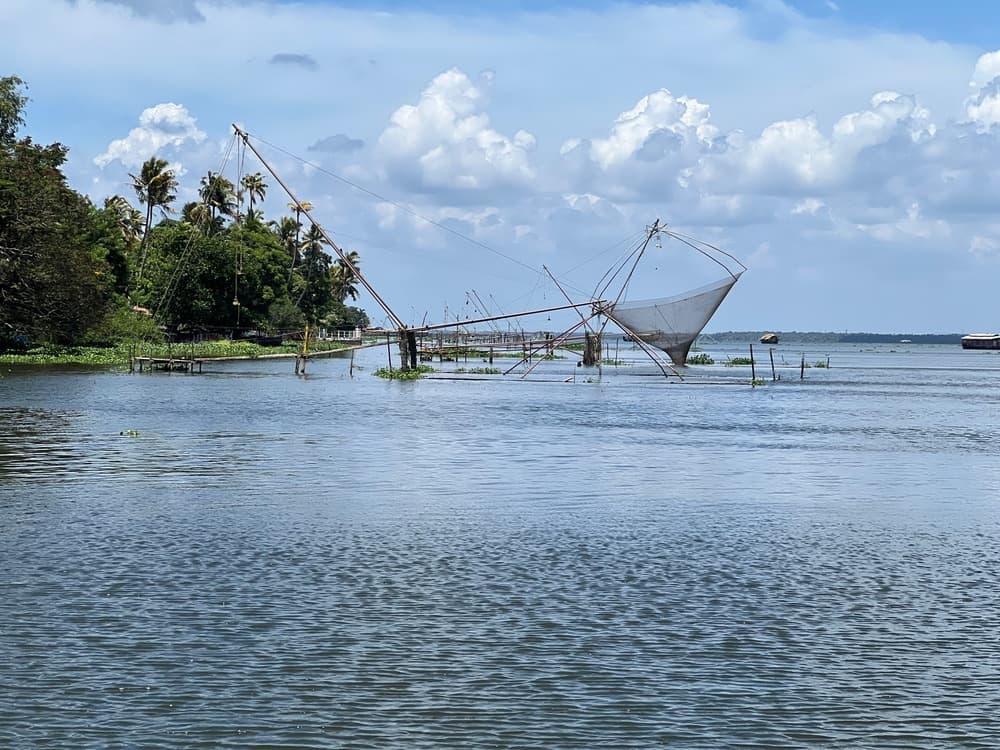
The lake sustains many fishing communities. By visiting their villages, you'll see Chinese fishing nets and bamboo traps in use as they have been for generations. Some accommodations and cruises offer the chance to join fishermen on early morning outings.
Nehru Trophy Boat Race
Each year in August, the lake hosts the Nehru Trophy Boat Race, a competition of snake boats (chundan vallam) that forms part of Onam festivities. Crews, sometimes numbering over a hundred rowers per vessel, compete on Punnamada Lake to the sound of traditional chants.
When to visit
The dry season, from November to March, remains the most pleasant: temperatures range between 25 and 32°C and skies are usually clear, ideal for cruising. April and May are hot and humid. The monsoon, from June to September, brings heavy rains but also lush vegetation and lower rates. August remains popular for the snake boat race during Onam.
How to get there
- By air: Cochin's international airport (Kochi) is the nearest; expect around 80 km to the lake's main southern embarkation points.
- By train: Kottayam and Alappuzha stations are well-served from major cities across southern India.
- By car or bus: roads connect Kochi, Alappuzha and Kottayam, with regular public services.
- By boat: from nearby backwaters, inland navigation services reach the lake's main jetties.
Practical information
- Book houseboats in advance during high season (December-January) and around Onam.
- Pack light clothing, sun protection, insect repellent and a windbreaker for early morning outings.
- Binoculars are useful at Kumarakom and on Pathiramanal Island.
- Cruise rates vary widely depending on season, boat quality and duration; compare several operators before booking.
Nearby
Lake Vembanad is typically visited from Alappuzha, the departure point for most backwater cruises. To extend your India itinerary, Bandhavgarh National Park and Alchi Monastery offer striking contrasts to Kerala's lake landscapes. Further south in Kerala, Anjengo Fort evokes the colonial past of the Malabar Coast.
Frequently asked questions
Frequently asked questions
It is renowned for its houseboat cruises (kettuvallam), landscapes of rice fields and palm trees, its biodiversity recognised by the Ramsar Convention and the Nehru Trophy snake boat race held each August.
It combines freshwater and saltwater. The section near the sea, towards Kochi, is brackish; the interior area, towards Kottayam and Alappuzha, is fresh. The Thanneermukkom dam, commissioned in 1976, limits saltwater intrusion.
Yes, Lake Vembanad has been listed as a Ramsar site since 2002. It is Kerala's largest wetland and one of India's most extensive.
The lake harbours fish, shrimp, amphibians and numerous waterfowl: egrets, herons, kingfishers, ibis, cormorants, and in winter migratory birds such as Siberian cranes. Mangroves also serve as nurseries for crustaceans.
Allow at least one day for a houseboat cruise or canoe trip. To combine Alappuzha, Kumarakom and Pathiramanal Island, two to three days are preferable.
Planning your trip
Lake Vembanad fits naturally into a southern India itinerary. To build your stay around the backwaters and other facets of the subcontinent, consult our India journeys.
Interested in this visit?
We can include it in your personalised itinerary.