Golconda Fort
Golconda Fort
Perched on a granite outcrop west of Hyderabad, Golconda Fort concentrates eight centuries of history, a fascinating acoustic system and sweeping views across the Deccan.
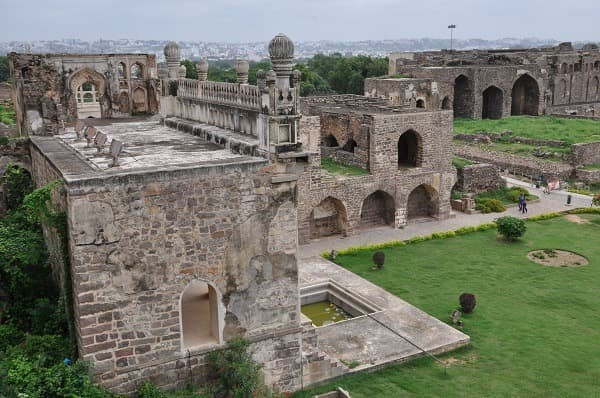
Golconda Fort dominates Hyderabad from a granite outcrop roughly ten kilometres west of the city centre. Built between the 14th and 17th centuries, it served as the capital of the Qutb Shahi sultanate before falling to Aurangzeb in 1687. Its eight-kilometre ramparts, ruined palaces and unique acoustic system rank it among the Deccan's best-preserved historical sites.
Quick Reference Guide
- Admission: Paid entry (differential rates for Indian residents and foreign visitors) — check current rates with the Archaeological Survey of India.
- Closure days: Open daily; the site closes in the evening after the sound and light show.
- Recommended duration: 2 to 3 hours for a complete tour, longer if attending the night-time spectacle.
- Sound and light show: Evening performances in Hindi and English — confirm timings on-site as they vary seasonally.
- Dress code: No strict restrictions, but comfortable shoes are essential for the irregular stone staircases.
- Accessibility: Limited — the climb to the upper citadel involves numerous uneven, unmodified steps.
What You'll See
The fort comprises four concentric ramparts, eight monumental gateways and eighty-seven bastions. The Fateh Darwaza entrance gateway houses the famous acoustic system: a handclap beneath its vault echoes all the way to the citadel summit nearly a kilometre away. At the top, the Baradari pavilion commands panoramic views over Hyderabad and the nearby Qutb Shahi tombs.
History and Context
Golconda began as an earthen fortress of the Kakatiyas in the 14th century. The Qutb Shahi sultans transformed it into a granite and limestone palace-citadel between 1518 and 1687. The region then controlled the global diamond trade — the famous Koh-i-Noor and Hope diamonds originated here. Aurangzeb's eight-month siege ended the Qutb Shahi dynasty and brought the Deccan under Mughal rule.
Highlights of Your Visit
The Fateh Darwaza's Acoustic System
Beneath the main gateway's vault, a handclap produces an echo audible from the throne room at the summit. This device served to alert guards against intrusion. Local guides demonstrate the effect at every visit.
The Climb to the Upper Citadel
The ascent up granite-cut staircases progressively reveals ruined palaces, water reservoirs and mosques. At the top, the Baradari pavilion and Ibrahim Mosque allow you to grasp the full extent of the fortified complex.
The Sound and Light Show
In the evening, illuminated ramparts host a spectacle narrating the history of the Qutb Shahi sultanate. The site's natural acoustics enhance the dramatic impact of the production.
Reservoirs and Hydraulic Engineering
The fort possessed a network of terracotta pipes carrying water to the royal apartments at the summit. Several cisterns and fountains remain visible, testifying to remarkable hydraulic mastery for the era.
Photography Tips
Morning light is ideal for photographing ramparts and bastions without backlighting. From the citadel summit, framing the Qutb Shahi tombs to the north-west works particularly well in late afternoon. The sound and light show offers opportunities for long-exposure shots, though a tripod is necessary. Photography is permitted throughout the site.
Location and Access
The fort stands roughly 11 km west of Hyderabad's city centre in the Golconda district. Reach it by auto-rickshaw, taxi or ride-sharing apps from the city centre or Banjara Hills. The nearest metro station is Ibrahim Bagh (Orange Line), several kilometres from the site — complete the journey by rickshaw. Parking is available at the main entrance.
In immediate proximity, the Qutb Shahi Tombs can be visited in combination with the fort.
Nearby Attractions
- Qutb Shahi Tombs — burial grounds of the Golconda sultans, several hundred metres north of the fort, recently restored by the Aga Khan Trust.
- Charminar — iconic monument of old Hyderabad, roughly fifteen kilometres east, in the heart of the historic bazaar.
- Salar Jung Museum — one of Asia's largest private collections of art and antiquities, on the Musi riverbanks.
- Mecca Masjid — grand 17th-century Mughal mosque near the Charminar.
Frequently asked questions
October to February brings mild temperatures and makes the climb to the citadel pleasant. Avoid April to June when Deccan heat regularly exceeds 40°C.
Plan 2 to 3 hours to explore the ramparts, climb to the citadel and return. If attending the evening sound and light show, set aside a full half-day.
Yes, both sites are adjacent. Visit the tombs early at opening, then move straight to the fort. Finish with the evening sound and light show for a complete day.
Accredited guides offer their services at the main entrance. A guide knowledgeable in Qutb Shahi history greatly enriches the experience, especially for understanding the fort's acoustic and hydraulic engineering.
The site works well for children above a certain age, but the climb involves numerous high and irregular steps. Bring plenty of water and closed-toe shoes for the whole family.
Yes, photography is free throughout the site. No particular restrictions apply to cameras or smartphones.
Photos
Interested in this visit?
We can include it in your personalised itinerary.