Akbar the Great's Tomb (Sikandra)
Akbar the Great's Tomb (Sikandra)
At Sikandra, Akbar the Great's tomb blends red sandstone and white marble across five levels within a garden inhabited by deer. A major Mughal site, more serene than the Taj Mahal, 10 km from Agra.
At Sikandra, roughly ten kilometres northwest of Agra, the tomb of Akbar the Great marks the burial place of the third and most powerful Mughal emperor. Built between 1605 and 1613, the mausoleum blends Hindu, Islamic, Buddhist and Christian architecture—a direct reflection of Akbar's policy of religious tolerance. Surrounded by an expansive garden traversed by free-roaming deer, the site offers a more peaceful atmosphere than the nearby Taj Mahal.
Practical information at a glance
- Admission: paid entry; differentiated rates for Indian residents and foreign visitors (Archaeological Survey of India)
- Suggested duration: 1 to 1.5 hours
- Dress code: modest attire recommended; shoes must be removed to access the burial chamber
- Access: National Highway NH19 (formerly NH2) Agra–Delhi; accessible by auto-rickshaw, taxi or bus from Agra
- Wildlife: deer and monkeys roam freely in the garden—please do not feed them
What to see
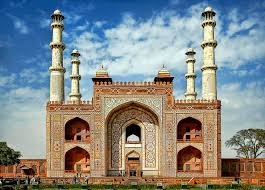
The complex is organized around a charbagh (four-part garden) crossed by pathways lined with cypresses. The grand southern entrance gate, the Buland Darwaza of Sikandra, is adorned with white mosaics set against red sandstone and four slender white minarets. The tomb itself rises across five levels: the first four in red sandstone, the uppermost—housing the open-air cenotaph—in finely carved white marble.
History and context
Akbar (1542–1605) initiated construction of his own tomb during his lifetime, a common practice among the Mughals. Upon his death, his son Jahangir continued and modified the plans, notably replacing the originally planned central dome with an open terrace. This architectural decision remains debated by historians. The site was pillaged by the Jats in the 18th century; the British undertook its restoration in the 19th century.
Highlights of the visit
The southern gate (Buland Darwaza)
Tall and imposing, this main entrance concentrates the site's most refined decoration: white marble inlays set into red sandstone, Quranic calligraphy and geometric patterns. The four white minarets flanking it have become the emblematic image of Sikandra.
The five-level tomb
Each floor features an arcaded gallery. The topmost level, in white marble and open to the sky, houses the upper cenotaph inscribed with the 99 Names of Allah. The actual burial chamber, beneath ground level, is austere and dimly lit; Akbar's remains lie here.
The garden and wildlife
Dozens of axis deer (chital) wander freely through the charbagh. Early morning, before the visitor crowds arrive, brings a particularly tranquil atmosphere. Rhesus monkeys occupy the areas around the northern gate.
Etiquette and visiting rules
- Remove your shoes before entering the underground burial chamber.
- Speak quietly inside the tomb.
- Do not feed the deer or monkeys.
- Photography is permitted in the garden and on exterior levels; check restrictions inside the burial chamber with the on-site guardian.
Photography tips
Morning light (shortly after opening) is ideal: the rising sun illuminates the south façade of the great gate and accentuates the contrast between red sandstone and white marble. To capture the entire tomb, step back along the garden's central pathway. Deer in the foreground add depth to images. Avoid midday, when light is harsh and shadows unforgiving.
Location and access
Sikandra lies on the Agra–Mathura road, approximately 10 km from Agra's centre. From the Taj Mahal or Agra Fort, allow 20 to 30 minutes by taxi depending on traffic. Auto-rickshaws serve the site from Agra Cantt station. Agra has no metro; taxi or tuk-tuk remain the most convenient options. Wheelchair access is available at garden level, but interior stairs within the tomb are not suitable for wheelchairs.
Nearby attractions
- Taj Mahal — The world's most celebrated mausoleum, roughly 10 km to the southeast.
- Agra Fort — UNESCO-listed Mughal fortress, about ten kilometres from Sikandra.
- Fatehpur Sikri — Abandoned imperial city founded by Akbar, approximately 40 km west of Agra.
- Itmad-ud-Daulah's Tomb — A small white marble mausoleum, often called the "Baby Taj", on the Yamuna riverbank.
Photos
Interested in this visit?
We can include it in your personalised itinerary.