India-Pakistan Border
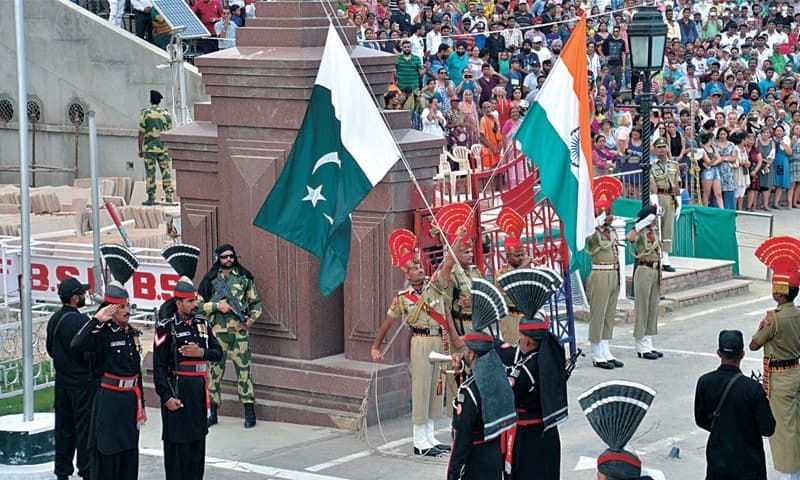
The atmosphere is festive every evening at Wagah, the only border crossing between India and Pakistan that can be crossed by road. Following a martial demonstration, Indian and Pakistani soldiers lower their respective flags to the cries and patriotic songs of a crowd that has come from across India to cheer its soldiers.
The atmosphere is festive every evening at Wagah, the only border crossing between India and Pakistan that can be crossed by road. Following a martial demonstration, Indian and Pakistani soldiers lower their respective flags to the cries and patriotic songs of a crowd that has come from across India to cheer its soldiers. Coverage from this village in northern Punjab.
India-Pakistan border, 35 kilometers west of Amritsar, a Monday evening in September. The small Wagah border post trembles beneath the roars of a frenzied crowd. "Hindustan zindabad! Hindustan zindabad! Vande Matram!" ("Long live India! Long live India! Glory to the nation!") No, rest assured, this is not yet another border dispute, much less new anti-Muslim riots, but rather the flag lowering ceremony.
In 1947, during Partition, the village of Wagah was divided in two. Since then, Indian and Pakistani soldiers have gathered each evening before their respective supporters for this ceremony. Chest puffed out, eyebrows furrowed, and fists clenched, the soldiers execute an intimidating parade rhythmed by the sharp orders of officers. For nearly 40 minutes, they march in full dress uniform with thunderous boot stomps and salutes.
In the stands, it's time to celebrate. Tourists, Indian and foreign alike, crowd into the vast amphitheater facing the barriers. Women on one side and men on the other, each cheers their hearts out for their soldiers. Flags, an announcer exhausted by a distorted microphone, nationalist slogans—nothing is missing. It's a true stadium atmosphere!
The situation takes a comic turn when spectators rush in clusters down the aisle to gesticulate to Bollywood film music. Chest-thumping and defiant, the excited young men loudly jeer the opposing camp. With stands nearly empty, the Pakistani neighbor struggles to keep up. Between the roars, Parmod Sengupt, very much a fair player, explains: "It's normal, they're in the middle of Ramadan." For Sanjeev Kadir, a Border Security Force soldier, "there has been a significant decline in the number of Pakistani visitors. The internal political situation has something to do with it."
On the Indian side, the daily ceremony attracts tourists from across the country. In one of the many vans that shuttle people from Amritsar, passengers from New Delhi, Bangalore, and Bihar are packed together. Samir Kumar, 27, a student from Calcutta, has his eyes fixed on the soldiers. "I came for exams in Amritsar, and it would have been unthinkable not to stop by here. Every Indian knows about this ceremony, and it's natural to come and support our soldiers." This festive patriotism goes hand in hand with commerce. The entrance to the zone is swarming with street vendors: DVDs of the ceremony, CDs of patriotic songs, chips, and even beers—everything is fair game for tourists!
At 6:30 p.m., a brief handshake between officers from both camps closes the parade. Once again, the ceremony will have played its role as catharsis in the tense relations between India and Pakistan. But in the current context, its effectiveness seems rather illusory. Less than three kilometers to the south, in the small village of Attari, memories of the riots that pitted Sikhs and Hindus against Muslims during the 1947 Partition remain very much alive. Baldev Singh, a Sikh farmer, states plainly: "Pakistanis are dangerous people. We must fight them..."