In the Footsteps of the Ancient Inde-Tibet Road
Before India's independence in 1947, the Hindustan Tibet Highway was the main trade route between India and Tibet. The border has since been closed following the Sino-Indian war of 1962, but the road remains passable on the Indian side. Discover.
Before India's independence in 1947, the Hindustan Tibet Highway was the main trade route between India and Tibet. The border has since been closed following the Sino-Indian war of 1962, but the road remains passable on the Indian side. A discovery awaits.
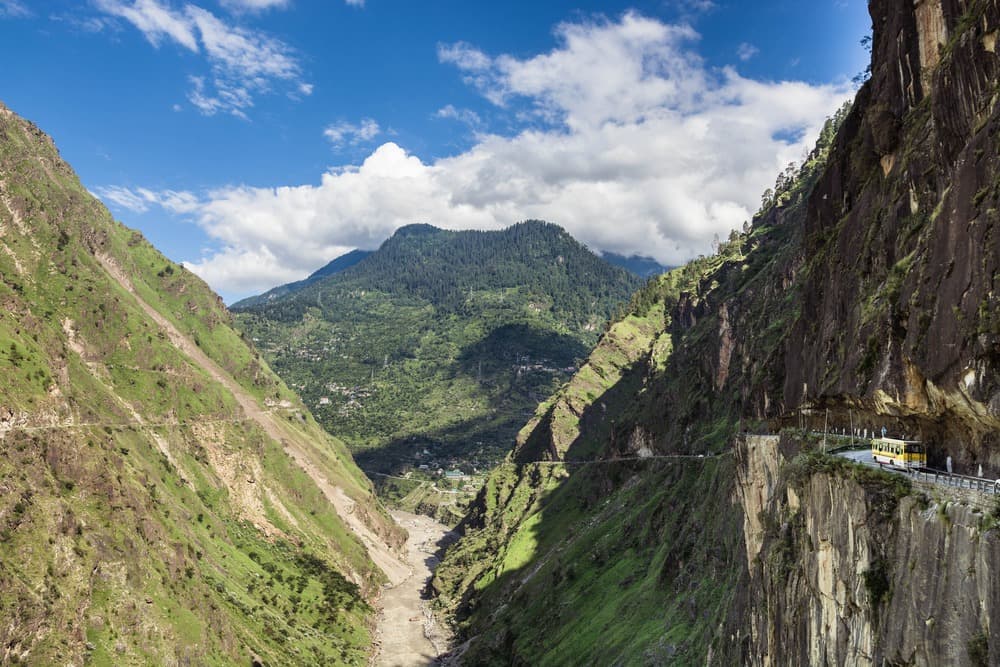
Himachal Pradesh has always been a strategic state for India's cultural and commercial relations with Tibet, Central Asia, and Kashmir. The Hindustan Tibet Highway crosses the southern part of the state, connecting the Kinnaur valley to the Tibetan capital of Lhassa. Despite its altitude, this unique trade route was renowned for being passable in all weather conditions, whether under snow or during monsoon. Starting from Rampur, at the entrance to the Kinnaur valley, it passes through Puh, in the heart of the valley, then through the Shipki La pass (5669 m), at the border, before finally reaching Lhasa on the other side.
Today, the India-China crossing is no longer permitted at this location, except for a few special authorizations. Until 1991, the Kinnaur valley was even completely closed to foreigners due to its sensitive proximity to the Chinese border. You can now travel through this region with a tourism permit, issued in the transit town of Rekong Peo. The ancient great trade route crosses the Kinnaur valley, along the Sutlej river, to reach the Spiti valley at the far east of Himachal Pradesh.
Wonders line the edges of this road that winds between Himalayan slopes. Just 30 kilometers from the city of Rampur, on the heights, sits the village of Sarahan. Located at 1920 meters altitude, this former capital of the Bushar Empire is home to the oldest temples of Himachal Pradesh. Built eight centuries ago, they represent some of the finest examples of wooden architecture in the state. You can also attempt to climb Bashal Peak, located eight hours' walk from the village.
Continuing along the great road, still following the Sutlej, you will arrive at the Sangla valley. Renowned as the most beautiful valley in all the Himalayas and still overlooked by tourists, this region is a true feast for the eyes. Along a small river below, mountains with dizzying slopes rise up, clinging to traditional villages with old wooden houses on stilts. After the village of Sangla, you can continue to the very end of the valley to reach Chitkul, a small remote village perched at 3450 meters altitude. Many hiking trails depart from here to reach the snow-capped peaks that grandly close off the end of the valley.
After this stop, following the road towards the Spiti valley, lies the strategic city of Rekong Peo. The small village of Kalpa is located nine kilometers further on, at 2960 meters altitude. It is pleasant to rest here for a few days while admiring the snow-capped peaks of Kinner Kailash. Kalpa is known as the winter residence of the god Shiva, who came here to meditate. The village is home to a unique blend of Hindu temples and Buddhist monasteries.
To complete this journey along the Hindustan Tibet Highway, you can continue your route towards the Spiti Valley, Nako Lake, or Kibber, renowned as the highest village in the world... The months of May and June are the most pleasant for visiting the region, so do not hesitate and come enjoy the fresh mountain air!