Northern India: Mythical Cities to Discover
Boasting some of the world's oldest cities, Northern India offers the chance to immerse yourself in the ancient history of Hinduism and Buddhism. Along the Ganges, from Rishikesh to Varanasi and through the three cities of the Indian Golden Triangle, we invite you to discover the mythical cities of Northern India.
Boasting some of the world's oldest cities, Northern India offers the opportunity to immerse yourself in the ancient history of Hinduism and Buddhism. Following the Ganges from Rishikesh to Varanasi, passing through the three cities of the Indian Golden Triangle (Delhi, Agra and Jaipur), we take you on a journey to discover the mythical cities of Northern India. A journey that will mark your spirit forever, as the discoveries are both astounding and rich in emotion....
Delhi, the Capital of India

The capital of India and the country's largest metropolis, the city of Delhi is also regarded as one of the world's great historic capitals. Once the seat of the Delhi Sultanate, the Mughal Empire and the Maratha Empire, it possesses a rich past that has shaped the city over the centuries. The result is an impressive array of architecture and countless historic sites that make the city a veritable open-air museum.
The city is divided into two parts. On one side, Old Delhi, which represents India's history through its historic buildings and perpetual chaos where every street corner reveals India's mythical secrets. On the other, New Delhi, which houses the seat of government and institutional buildings.
What to Do and See in Delhi?
Among the must-see sites to visit in Delhi, we can mention:
- The Red Fort (also called Lal Qila): the Red Fort was the residence of the Mughal Empire in the 17th century;
- Humayun's Tomb and its incredible Mughal architecture;
- The Qutub Minar minaret: the tallest in India and the 3rd largest in the world;
- The Jama Masjid: the largest mosque in India;
- The India Gate war memorial;
- The Lodi Gardens: gardens housing the tomb of Mohammad Shah, the tomb of Sikandar Lodi, Sheesh Gumbad and Bara Gumbad;
- Dilli Haat: an open-air market where you can find artisanal creations and street food;
- Agrasen ki Baoli: a stepped well and ancient water reservoir;
- The Lotus Temple: a temple open to all beliefs regarded as the "Mother Temple" of South Asia;
- The ruins of Tughlaqabad Fort: built by the founder of the Tughlaq dynasty;
- Bangla Sahab Gurudwara: the largest Sikh temple in New Delhi;
- Gandhi Smriti: the last residence of the Father of the Nation, now transformed into a museum;
- Jantar Mantar: an astronomical observatory built by Jai Singh II...
Agra, the City of the Famous Taj Mahal

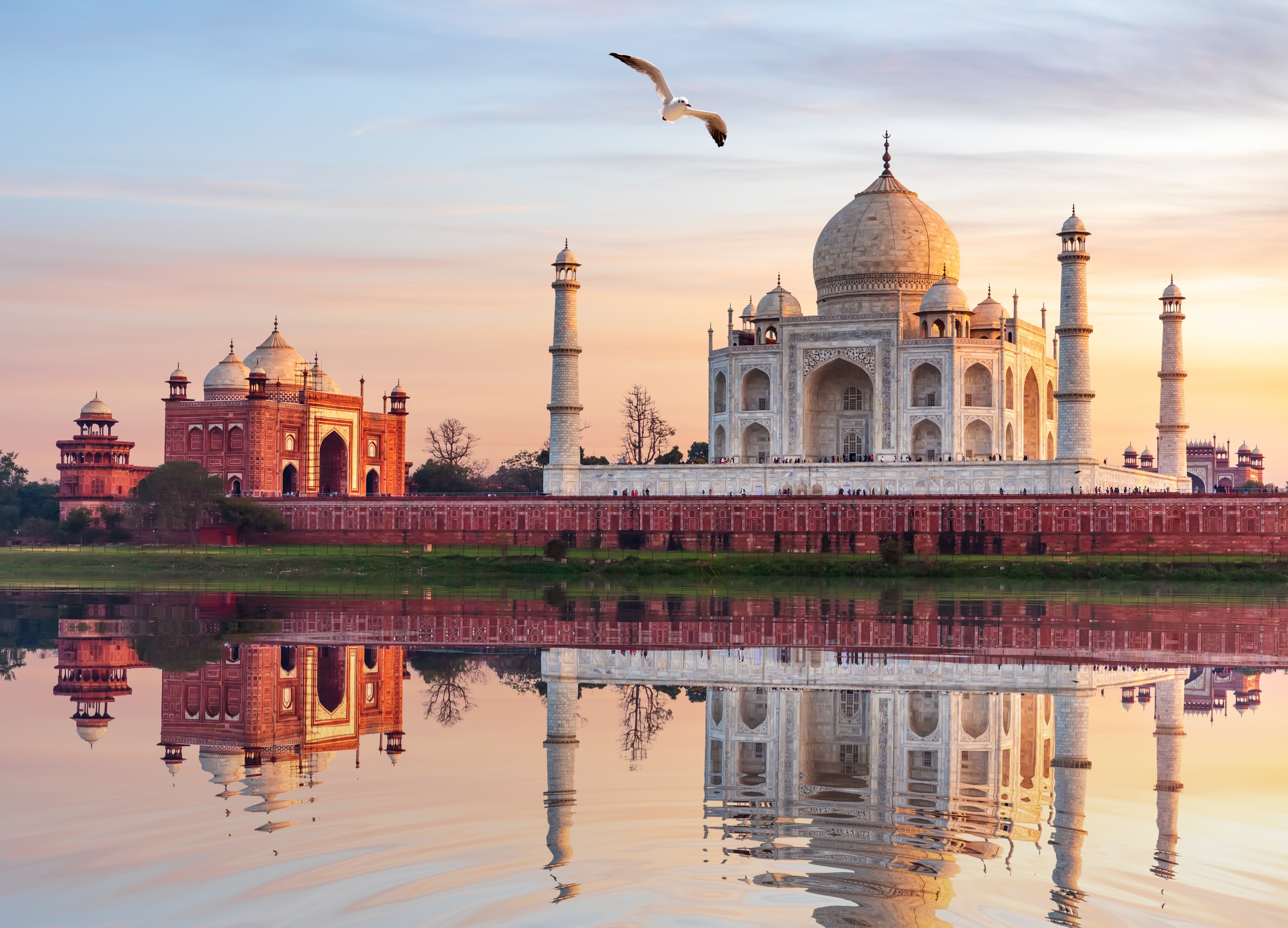
It's impossible to conceive a journey to Northern India without visiting the city of Agra. And for good reason—it is home to the emblematic monument of the country and one of the world's most celebrated structures: the Taj Mahal. This mausoleum was built at the behest of Mughal emperor Shah Jahan in memory of his wife Mumtaz Mahal, who died giving birth to their fourteenth child. Constructed entirely by hand over 16 years, this funeral palace is one of the Seven Wonders of the World.
Beyond the Taj Mahal, the city of Agra is home to countless invaluable architectural and historic structures, most of which are inscribed on the UNESCO World Heritage List. It is also part of the Indian Golden Triangle with the cities of Delhi and Jaipur.
The Indian Golden Triangle is named this way because of the nearly equilateral triangle shape formed by the three cities.
What to Do and See in Agra?
Among the must-see sites to visit in Agra, we can mention:
- The Taj Mahal: symbol of India and eternal love, it is considered the country's most beautiful structure;
- Agra Red Fort: an imposing red sandstone fortress built in the 16th century that once housed the ceremonial and political center of the Mughal State. It contains several palaces, mosques and museums;
- Itimad-ud-Dhaula: a mausoleum built in 1628 that houses the remains of Mirza Ghias Beg. It is often called the Baby Taj as it is considered the precursor to the Taj Mahal;
- The Tomb of Akbar the Great: built in 1613 in honor of Akbar the Great, one of the most important rulers of the Mughal empire;
- Jama Masjid: one of the largest mosques in India;
- The Tomb of Mariam-uz-Zamani: which houses the remains of Jodha Bai, the favorite wife of Mughal emperor Akbar;
- Chini ka Rauza: a mausoleum with colored tiles erected in honor of Allama Afzal Khan Mullah, the prime minister during the reign of Shah Jahan;
- Agra Markets: Kinari Bazaar, Sadar Bazaar, Taj Mahal Complex and Raja Mandi.
Jaipur, the Pink City

Located in the heart of the Aravalli hills, in the Rajasthan region of which she is the capital, the city of Jaipur is one of the three jewels that make up the Indian "Golden Triangle." Built in 1727, it owes its name to its founder: Maharaja Sawai Jai Singh II, the ruler of Amer. Despite being constructed at a breathtaking pace, it was the first urbanized city of its time. Indeed, its architecture is ultra-planned: its avenues all cross perpendicularly.
It is home to numerous palaces, forts, gardens and is nicknamed "the Pink City" because of the color of its monuments, which shape the city and give it a romantic atmosphere despite the hustle and bustle of urban life. One thing is certain: a stay in Jaipur never leaves anyone indifferent!
The city of Jaipur was entirely repainted pink in 1876 to receive the Prince of Wales of that time: Prince Albert. The maharaja ordered architects to repaint the entire city of Jaipur in pink, as this color is a symbol of welcome.
What to Do and See in Jaipur?
Among the must-see sites to visit in Jaipur, we can mention:
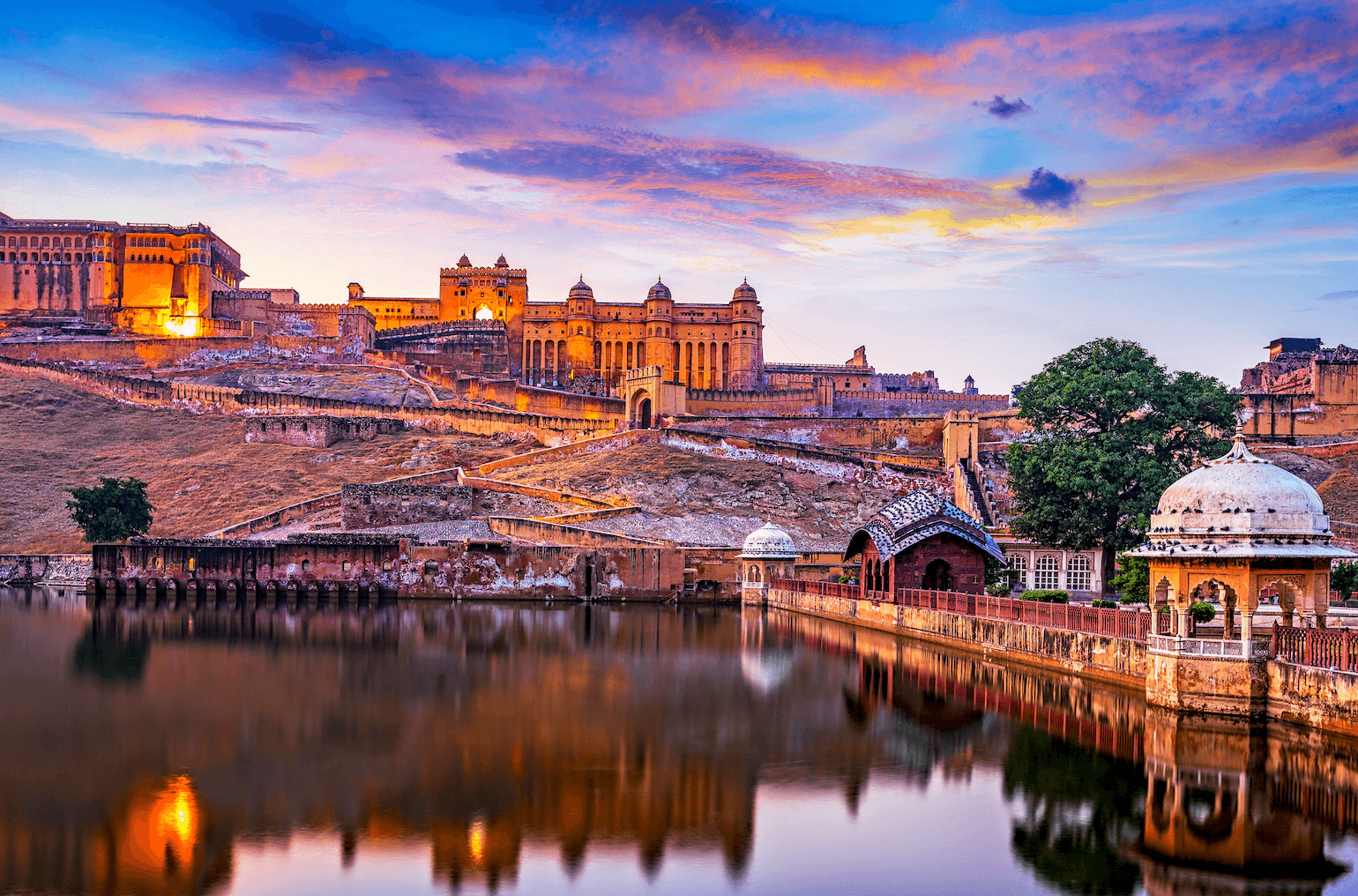
- Amber Fort: overlooking the city of Jaipur and surrounded by Lake Maotha, it is one of the finest masterpieces of Mughal architecture;
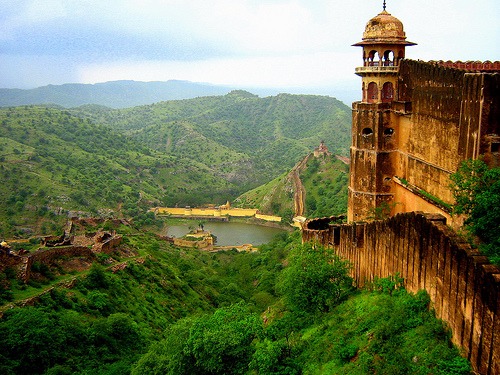
- Jaigarh Fort: located above Amber Fort and connected to it by an underground passage, it served to protect the fort and the royal family. It houses the world's largest cannon on wheels;
- The City Palace (or Chandra Mahal): this gigantic complex houses several palaces (including Chandra Mahal and Mubarak Mahal), courtyards and gardens, and a museum. Once the main residence of Jaipur's royal family, it still houses a section reserved for the current maharaja and his family;
- The Palace of Winds (or Hawa Mahal): part of the City Palace, this architectural gem is characterized by an incredible façade with 953 small windows;
- The Monkey Palace (or Galta Ji): located 10km from the city, the site comprises a series of ancient temples, built in a narrow crevice of the mountains;
- Yantra Mandir (or Jantar Mantar): an astronomical observatory built by Jai Singh II...
Varanasi, the Sacred City of Shiva

Formerly called Benares, the city of Varanasi is among the world's oldest cities. It is also a sacred city that is one of the seven holy cities of India. Known as "the City of Shiva," it is built on the banks of the Ganges, a river that symbolizes the hair of Shiva. As a major center of Hinduism, it welcomes a million pilgrims each year seeking blessing and enlightenment. These pilgrims use the famous Ghats, these stairs leading to the blessed waters of the Ganges where they make ablutions and offerings, and bathe to purify themselves.
Be prepared: you can observe rituals and ceremonies on the banks of the Ganges, but you should be ready—you will see the deceased during funeral processions, particularly at Manikarnika Ghat. Offering a true cultural shock, the city of Varanasi will mark your journey and your spirit forever.
According to Hindu tradition, dying in Varanasi and being cast into the Ganges allows for "moksha"—that is, breaking the cycle of reincarnation to attain Nirvana directly.
What to Do and See in Varanasi?
Among the must-see things to do and see in Varanasi, we can mention:
- The Ghats leading to the Ganges where all Hindus come to bathe in the blessed water;
- The Ganga Aarti ceremony: a ceremony in honor of the goddess Ganga held every evening at the Dasaswamedh Ghat (the main Ghat) at sunset. You can admire it from the Ghats or on a boat excursion on the Ganges;
- Scindia Ghat and its submerged temple: built by the Scindia dynasty, this ghat is revered by Hindus because Agni, the God of Fire, is said to have been born there. It houses a half-submerged temple dedicated to Shiva;
- Kashi Vishwanath Temple: a temple dedicated to the God Shiva, known as the "Temple of Gold" because of its spire and dome covered in gold;
- Durga Mandir Temple: a temple dedicated to the goddess Durga dating from the 18th century;
- Bharat Mata Temple: a temple inaugurated by Mahatma Gandhi in 1936, featuring a relief sculpture of undivided India carved in marble;
- Kathawala Nepali Temple: a temple built at the initiative of the king of Nepal, exiled to Varanasi in the 19th century;
- The Alamgir Mosque: a mosque built in the 17th century by Mughal emperor Aurangzeb;
- The Bhelupura neighborhood: this is where all the Varanasi silk weavers can be found, as Varanasi is considered the silk capital;
- Ramnagar Fort: built in the 18th century, it was once the residence of the Maharaja of Benares;
Sarnath, a city not to miss during a stay in Varanasi:
Located just 10 km north of Varanasi, don't miss the city of Sarnath. A major center of Buddhism, this is where Buddha is said to have delivered his first sermon.
Rishikesh, the Yoga Capital

The city of Rishikesh is one of the mythical cities to discover in India. Nestled on the foothills of the Himalayas, the city is located 250 km by road from Gaumukh, where the Ganges originates. With a sacred dimension, the city is known as "the gateway to the Land of the Gods." Many legends are associated with it. Like Varanasi, the city welcomes thousands of pilgrims in its temples and on the Ghats. You can notably attend Ganga Aarti, these daily ceremonies honoring the goddess Gange.
Beyond its religious dimensions, the city is a spiritual destination where yoga and meditation have been practiced for centuries. Known as the yoga capital, Rishikesh is the best place to practice yoga in India. Many ashrams offer classes.
A little anecdote...
The city of Rishikesh became world-famous in the sixties when it hosted the Beatles. They stayed there for 2 months in 1968 to participate in a transcendental meditation workshop alongside master Maharishi Mahesh. This stay even inspired them to write the White Album. Other celebrities, such as Mia Farrow and the Beach Boys, were also among the visitors attracted by the city's spirituality.
What to Do and See in Rishikesh?
Among the must-see things to do and see in Rishikesh, we can mention:
- The Iron Bridges of Lakshman Jhula and Ram Jhula: these suspension bridges offer the opportunity to admire the scenes of pilgrims coming to bathe in the sacred waters of the Ganges;
- Triveni Ghat: it is on this Ghat that you can notably observe the Hindu ritual of Ganga Aarti;
- Trayambakeshwar Temple: a temple dedicated to the god Shiva. It is one of the twelve jyotirlingas where the genealogical records of Trimbakeshwar Hindus, in Maharashtra, are preserved;
- Bharat Mandir Temple: with over a thousand years of history, it is the city's oldest temple;
- The Neelkanth Mahadev Temple: nestled in a forest, it is one of India's most sacred Shiva sanctuaries;
- Yoga and meditation classes;
- Maharishi Mahesh Yogi Ashram: this is where the Beatles came to learn transcendental meditation;
- Neer Garh Waterfalls;
- Rajaj National Park: which is home to a significant colony of Asian elephants, primates, and a few Bengal tigers...
Visit Haridwar
Take advantage of your visit to Rishikesh to travel to the city of Haridwar, one of the seven sacred cities of Hinduism. A major pilgrimage site, Vishnu is said to have left his footprint there. In any case, many pilgrims come each year, as tradition holds that the faithful who bathe in the Ganges at Haridwar see their sins erased and can escape the cycle of reincarnations.
To Go Further...
Discover our must-see tour of Northern India to discover these mythical cities. Is this your first trip to India? Discover our advice for choosing Northern or Southern India.