Thattekad Bird Sanctuary
Thattekad Bird Sanctuary
Thattekad Bird Sanctuary, on the banks of the Periyar River in Kerala, is one of India's richest ornithological sites, with over 300 species including several endemic to the Western Ghats.
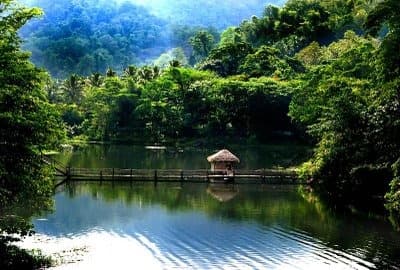
Thattekad Bird Sanctuary lies in Ernakulam district, Kerala, on a peninsula formed by the north and south arms of the Periyar River. Salim Ali, India's legendary ornithologist, described it as the richest bird sanctuary in the Indian peninsula. A mix of tropical rainforest, riparian zones, and plantations welcomes over 300 bird species, many endemic to the Western Ghats.
Quick Facts
- Admission: Paid entry (managed by Kerala's Forest Department)
- Best season: October to March — migratory birds present, lighter vegetation
- Recommended duration: Half a day to full day depending on observation intensity
- Attire: Neutral colors (khaki, green, beige), closed-toe shoes, insect repellent essential
- Access: Nearest town is Kothamangalam; Ernakulam (Kochi) is about 60 km away
What You'll See
The sanctuary is home to iconic Western Ghats species: the Sri Lanka Frogmouth, Malabar Grey Hornbill, Malabar Trogon, and Crimson-backed Sunbird. The Periyar's banks attract kingfishers, herons, and egrets. The dense forest also harbors nocturnal species such as the Brown Fish Owl.
History and Context
The sanctuary was officially established in 1983. Its name is linked to Salim Ali, who conducted ornithological studies here from the 1930s onward and helped establish the site's ecological importance. The forest belongs to the Western Ghats transition zone, a UNESCO World Heritage Site.
Highlights of Your Visit
Sunrise Observation
The early morning hours are most active. Birds sing, feed, and move before the heat sets in. A local guide helps identify species difficult to spot in the dense forest canopy.
Boat Crossing on the Periyar
A canoe journey between the two banks of the Periyar offers a different vantage point for observing water birds and wooded banks. It's one of the few places to spot the Sri Lanka Frogmouth in its natural habitat.
Forest Trails
Several marked trails traverse the tropical rainforest. Vegetation changes rapidly depending on proximity to the river, creating varied micro-habitats and thus a diversity of species within a small area.
Photography Tips
Golden morning light (6–8 a.m.) is ideal. A telephoto lens (400 mm minimum) is recommended for forest species. Avoid light-colored clothing that startles birds. The nocturnal, cryptic Sri Lanka Frogmouth is easier to photograph in early morning when still roosting.
Location and Access
Thattekad is about 60 km east of Ernakulam (Kochi), accessible by road via Kothamangalam. The nearest railway stations are Aluva or Ernakulam; from there, a taxi or local bus serves Kothamangalam, then Thattekad. Accessibility for visitors with reduced mobility is limited due to unarranged forest trails. Local ornithological guides offer guided tours departing from the sanctuary.
Nearby Attractions
- Fort Kochi — historic quarter of Kochi, roughly 70 km away, featuring Chinese fishing nets and colonial architecture.
- Munnar — hill station in the Western Ghats, about 100 km away, renowned for tea plantations and alpine wildlife.
- Eravikulam National Park — habitat of the Nilgiri tahr, accessible from Munnar.
Frequently asked questions
October to March. The dry season offers better forest visibility and the presence of migratory birds alongside permanent residents.
A local guide is not mandatory but highly recommended. Forest species are difficult to locate without a trained ear, and guides know where rare species are found.
Yes. Kochi is about 60 km away. Half a day suffices for Thattekad; you can leave Kochi early morning, visit the sanctuary, and return by evening.
Choose neutral colors (khaki, green, beige), closed-toe shoes, and long sleeves. Insect repellent is essential, especially in the wet season.
Yes, provided children are comfortable walking in silence. Trails are accessible, but observation requires patience and discretion.
Photos
Want to discover this destination?
Our local advisors design your tailor-made trip.