Sanchi
Sanchi
Sanchi is home to India's oldest intact stone stupa, erected under Emperor Ashoka in the 3rd century BCE. Its four sculptured gateways rank among the masterpieces of ancient Buddhist art.
Sanchi is a Buddhist archaeological site in Madhya Pradesh, roughly 50 kilometres northeast of Bhopal. Perched atop a forested hill, it shelters India's oldest intact stone stupa, erected under Emperor Ashoka in the 3rd century before the Common Era. Inscribed as a UNESCO World Heritage site, the complex concentrates stupas, monasteries, and sculptured pillars within less than a square kilometre — a rare density of monuments on such a modest hill.
Quick Practical Information
- Admission: Paid entry; different rates for Indian residents and foreign visitors (check current rates with the Archaeological Survey of India).
- Closure: The site is closed on Mondays.
- Recommended duration: 2 to 3 hours to explore the entire site at a leisurely pace.
- Access: Sanchi railway station on the Bhopal–Vidisha line; tuk-tuks and rickshaws available from the station to the site entrance.
- Dress code: No strict requirement, though respectful attire is appropriate for this sacred site.
- Accessibility: The main pathway is partially accessible, but the hill includes stairs; limited access for people with reduced mobility.
What to See
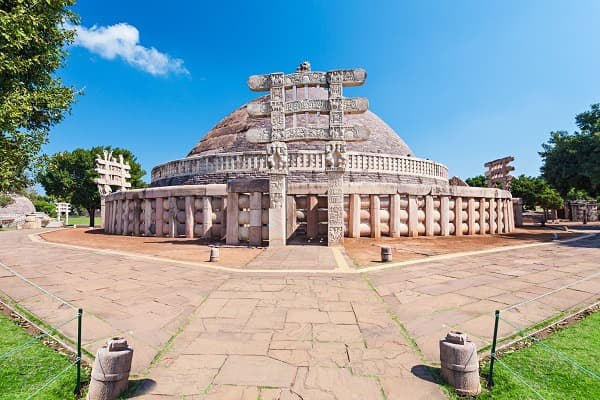
The Great Stupa (Stupa No. 1) dominates the site: a hemispherical dome of brick and stone measuring 36 metres in diameter, surrounded by a balustrade and four torana (ornate gateways) adorned with sculpture. These gateways, dating to the 1st century before the Common Era, recount the life of the Buddha and the Jataka tales in remarkably detailed bas-reliefs. Two smaller stupas, ruined monasteries, and an Ashoka pillar complete the ensemble.
History and Context
Emperor Ashoka, converted to Buddhism after the battle of Kalinga, commissioned the first stupa at Sanchi around 260 BCE to enshrine relics of the Buddha. Enlarged under the Shungas and Satavahanas, the site flourished until the 13th century, when it fell into abandonment beneath vegetation. British scholars rediscovered it in the 19th century; systematic excavations enabled its gradual restoration.
Highlights of Your Visit
The Torana of the Great Stupa
The four sculptured gateways are the site's masterpiece. Each facade tells a scene: the temptation of Mara, the first sermon, past lives of the Buddha. The Buddha is never represented as a human figure here — instead symbolised by a footprint, an umbrella, or a throne.
The Ashoka Pillar
Standing near the Great Stupa, this polished sandstone pillar bears edicts of Ashoka inscribed in Brahmi script. Its capital, crowned with four lions, is the direct model for India's national emblem. Only partially preserved, it remains among the best-conserved Ashoka pillars.
Stupa No. 3 and Its Relics
Smaller than the Great Stupa, Stupa No. 3 once contained the relics of two direct disciples of the Buddha, Sariputra and Maudgalyayana. Discovered in the 19th century, they were partly repatriated to Sri Lanka; a portion is preserved in the modern Buddhist temple situated below the main site.
The Sanchi Archaeological Museum
Located at the site entrance, this modest Archaeological Survey of India museum displays sculptures, capitals, and objects unearthed during excavations. A visit takes 30 to 45 minutes and usefully illuminates the site's chronology.
Etiquette and Visiting Protocols
- Circle the stupas clockwise (pradakshina), following Buddhist tradition.
- Do not touch the sculptures or bas-reliefs on the torana.
- Speak softly; the site remains an active place of pilgrimage.
- Photography is permitted on the open-air site; check for any restrictions within the museum.
Photography Tips
Early morning light (before 9 a.m.) is ideal for photographing the torana without backlighting. In late afternoon, golden light brings out the ochre sandstone of the Great Stupa beautifully. Position yourself at the base of the eastern or northern gateways to capture bas-relief details. Avoid midday: shadow cast by the sculptures becomes too harsh.
Location and Access
Sanchi lies approximately 46 kilometres northeast of Bhopal, capital of Madhya Pradesh. Sanchi railway station is served by several trains from Bhopal (journey time around one hour). By car or taxi from Bhopal, allow 45 minutes to an hour depending on traffic. The site of Vidisha, an ancient trading city linked to Sanchi's history, lies about ten kilometres away.
Nearby
- Bhopal — The capital of Madhya Pradesh offers lakes, tribal museums, and a lively old city, less than an hour's drive away.
- Vidisha — An ancient Mauryan and Gupta trading centre, home to the Udayagiri temple and nearby rock-cut caves.
- Udayagiri Caves — A complex of 5th-century Gupta caves roughly twenty kilometres away, featuring the celebrated Vishnu Varaha relief.
- Bhimbetka — UNESCO-listed rock shelters with rock paintings over 30,000 years old, approximately 45 kilometres south of Bhopal.
Frequently asked questions
The dry season, October through March, is most pleasant. Temperatures remain mild and the hillside vegetation is lush following the monsoon. Avoid May and June, which are extremely hot.
Yes. A single day allows you to explore Sanchi in the morning, then visit the Udayagiri caves and Vidisha in the afternoon, by car or taxi from Bhopal.
No. Sanchi archaeological site is closed on Mondays. Plan your visit accordingly, especially if travelling midweek.
A guide is not mandatory, but highly recommended to interpret the torana bas-reliefs. Licensed guides are available at the site entrance.
Photography is allowed across the open-air site. Check with the archaeological museum entrance, as it may apply specific restrictions.
Allow 2 to 3 hours for the main site and museum. If you wish to visit the modern Buddhist temple below the site as well, add another 30 minutes.
Photos
Want to discover this destination?
Our local advisors design your tailor-made trip.