Rumtse
Rumtse
The last village before Tanglang La pass, Rumtse is an authentic stopover on the Leh-Manali highway and the launching point for high-altitude treks across the Rupshu plateau toward Tso Moriri Lake.
Rumtse is a small high-altitude village nestled in the Indus Valley, Ladakh, at approximately 4,350 meters elevation. As the last settlement before Tanglang La pass on the Leh-Manali route, it marks a natural boundary between central Ladakh and Rupshu. The village serves as the departure point for treks across the Rupshu plateau and toward Tso Moriri Lake, far from mainstream tourist circuits.
Practical essentials at a glance
- Altitude: approximately 4,350 m — acclimatization in Leh is essential beforehand.
- Access: on the Leh-Manali national highway (NH-3); reachable by private or shared vehicle from Leh.
- Best season: June to September (road closed in winter).
- Recommended duration: one-night stopover or starting point for multi-day treks.
- Accommodation: a handful of village homestays; no conventional hotels.
What to see
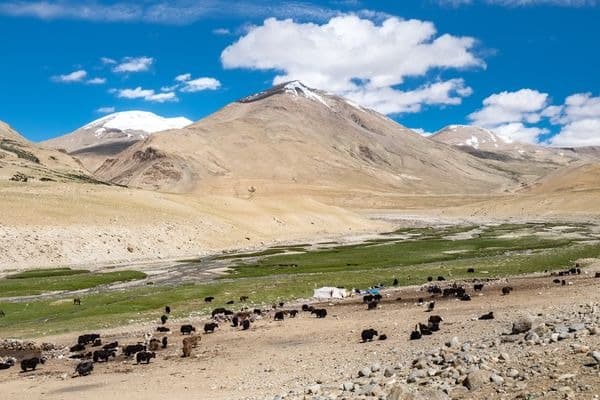
Rumtse is a traditional Ladakhi farming village: whitewashed rammed-earth houses, terraced barley fields, prayer wheels, and colorful prayer flags. A small Buddhist monastery overlooks the settlement. The surrounding landscape is stark and arid, with ochre cliffs and snow-capped peaks framing the valley.
History and context
Like most Ladakhi villages, Rumtse is inhabited by Ladakhis of Tibetan Buddhist heritage. Its position on the old caravan route linking Ladakh to Tibet and northern India long gave it significance as a trading waystation. Today, the village subsists primarily on small-scale agriculture and, increasingly, on trekking tourism.
Highlights
Starting point for the Rumtse–Tso Moriri trek
The Rumtse–Tso Moriri trek is one of Ladakh's most celebrated high-altitude itineraries. It traverses the Rupshu plateau over several days, crossing passes above 5,000 m, hot springs, and otherworldly landscapes before reaching Tso Moriri Lake.
Tanglang La pass
A few kilometers above the village, Tanglang La pass peaks at approximately 5,328 m. It is one of the world's highest motor roads. On clear days, the vista across surrounding Himalayan ranges is breathtaking.
Ladakhi village life
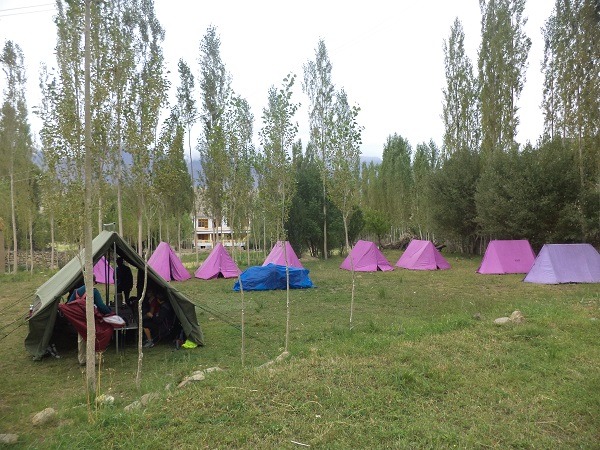
Rumtse offers authentic immersion in Ladakh's rural rhythms: inhabitants cultivate barley and peas, herding yaks and sheep. A homestay stay lets you witness the daily patterns of a high-altitude Buddhist community.
Etiquette and visiting guidelines
- Always ask permission before photographing residents or inside the monastery.
- Remove shoes before entering the monastery or a home.
- Spin prayer wheels and circumambulate chortens clockwise.
- Respect the terraced crops: do not cross through fields.
Photography tips
Early morning light is ideal for photographing white houses against ochre mountain backdrops. Colorful prayer flags make striking foreground subjects. At Tanglang La pass, midday light often yields the sharpest images, though wind can be intense.
Location and access
Rumtse lies on the Leh-Manali route, roughly 70 km south of Leh. Most travelers arrive by private vehicle rented in Leh, or by bus on the Leh-Manali route. No regular public transport serves the village directly. Acclimatization in Leh (at least two nights) is mandatory before ascending to this altitude.
Nearby attractions
- Tanglang La pass — one of the world's highest motor roads, a few kilometers above the village.
- Tso Moriri Lake — high-altitude lake on the Rupshu plateau, the endpoint of treks from Rumtse.
- Leh — Ladakh's capital and essential logistical hub before reaching Rumtse.
- Upshi — downstream village on the Leh route, checkpoint for Rupshu's restricted zones.
Frequently asked questions
June through September, when the Leh-Manali road is open. Outside this window, the village is difficult to reach and weather conditions are extreme.
Rumtse itself requires no special permit. However, to continue toward the Rupshu plateau and Tso Moriri Lake, an Inner Line Permit is mandatory for foreign nationals.
The standard itinerary takes five to seven days depending on pace and chosen variations. It is advisable to go with a local guide and full camping equipment.
The village offers a few homestays with local families—simple but welcoming. No conventional hotel exists. Advance booking during peak season is recommended.
Yes. At 4,350 m, acute mountain sickness is a real concern. Spend at least two nights in Leh before ascending, drink plenty of water, and climb gradually.
Want to discover this destination?
Our local advisors design your tailor-made trip.