Rizong Monastery
Rizong Monastery
Perched in an isolated canyon between Leh and Khalsi, Rizong Monastery is one of Ladakh's most austere Buddhist institutions. A place of silence and discipline, far from the usual tourist circuits.
Perched in an isolated canyon roughly twenty kilometres from Khalsi, Rizong Monastery is one of Ladakh's strictest Buddhist establishments. Founded in the 19th century, it belongs to the Gelugpa school and imposes rigorous discipline on its monks: absolute vegetarianism, abstinence from alcohol, near-total isolation from the world. This withdrawal makes it a place of rare silence, quite unlike the major tourist monasteries of the Indus Valley.
Quick facts
- Access: from Leh, take the Srinagar road (NH1) to Khalsi, then a track towards Uletokpo; the monastery is about 5 km on foot or by jeep from the village.
- Recommended duration: 1 to 2 hours on site, half a day including travel from Leh.
- Dress code: shoulders and knees must be covered; remove your shoes before entering prayer halls.
- Rules: active monastic community — speak softly, do not disturb services.
What you'll see
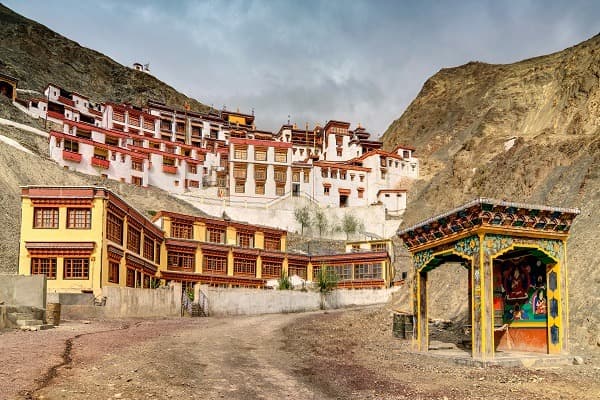
The monastery clings to an ochre cliff overlooking a ravine. White and red buildings stack across several levels. Inside, the main hall houses thangkas, Buddha statues and sacred texts. Just below, the Julichen convent houses Buddhist nuns — one of Ladakh's few active nunneries.
History and context
Rizong was founded around 1831 by lama Tsultim Nima, who sought to create a monastic community based on strict observance of the Vinaya (Buddhist code of discipline). Unlike Hemis or Thiksey, Rizong never sought to attract crowds. This commitment to isolation remains intact today.
Visit highlights
The main prayer hall
Dark and fragrant with incense, it preserves fine wall paintings and statues. Morning services, when monks recite texts in unison, offer a particularly contemplative atmosphere.
Julichen Convent
Located a few hundred metres downstream, this nunnery is part of Rizong. The nuns practise the same strict discipline. Visits are possible, respecting the enclosure's rules.
The canyon and approach path
The climb from Uletokpo follows a mountain stream hemmed between mineral walls. This walking route is an experience in itself: vegetation gradually disappears, giving way to the lunar landscape typical of Ladakh.
Etiquette and visiting rules
- Remove shoes before each prayer hall.
- Shoulders and knees must be covered for all visitors.
- Do not photograph monks or services without explicit permission.
- Avoid visiting during services unless invited to attend.
- The monastery is a living community: maintain silence in corridors and inner courtyards.
Photography tips
Morning light illuminates the monastery's white façade from the east — ideal for exterior views. The canyon below offers a striking frame with buildings looming overhead. Inside, photography is often restricted: always ask permission before using your camera.
Location and access
Rizong lies in the Indus Valley, between Leh and Khalsi. The main road (NH1) is paved to Khalsi; the track to Uletokpo is passable by jeep. From Leh, allow roughly two hours' travel. The site is not accessible by regular public transport: a hired jeep or taxi from Leh is the usual solution. Wheelchair access is difficult due to sloping paths and interior stairs.
Nearby
- Alchi Monastery — about twenty kilometres away, famous for its 11th-century murals, among Ladakh's oldest.
- Lamayuru Monastery — further west, one of Ladakh's oldest, set in a "moonland" landscape.
- Khalsi — town in the Indus Valley, starting point for Rizong and a stop on the Srinagar road.
Frequently asked questions
June to September, when Ladakh roads are open and weather is stable. Outside this window, access may be cut off by snow.
Yes: shoulders and knees must be covered for everyone. Also bring clean socks, as you'll remove your shoes at the entrance to prayer halls.
Yes. Alchi and Rizong are close to each other on the Khalsi road. One day by jeep from Leh allows you to visit both, with Lamayuru as an option if you start early.
It's often restricted in prayer halls. Always ask monks present for permission before photographing the interior or people.
Allow one to two hours on site. Add walking time from Uletokpo (about 5 km round trip) if you don't have a jeep to the monastery's base.
Photos
Want to discover this destination?
Our local advisors design your tailor-made trip.