Panaji (Panjim)
Panaji (Panjim)
Panaji, capital of Goa, blends colorful Portuguese colonial streets, baroque churches, and local life on the banks of the Mandovi. A cultural counterpoint to the state's beaches.
Panaji — often spelled Panjim — is the capital of the state of Goa, situated on the southern bank of the Mandovi River. A former Portuguese colonial town, it mingles wrought-iron balconied houses, baroque churches, and cobbled streets with vibrant local life. Less touristy than the state's northern beaches, it offers a more intimate glimpse of the Luso-Indian heritage that sets Goa apart from the rest of India.
Essentials at a Glance
- Access: approximately 30 km from Goa's international airport (Dabolim); taxis and buses connect the two. The nearest railway station is Karmali (Old Goa), a few kilometers away.
- Local transport: rickshaws, motorcycle taxis (pilots), and local buses serve the city; walking remains the best way to explore the Fontainhas neighborhood.
- Suggested duration: a full day for the historic center and Fontainhas; two days to combine with Old Goa.
- Dress code: modest dress required in churches (shoulders and knees covered).
- Best time to visit: November to February (dry season, pleasant temperatures).
What to See
The Latin Quarter of Fontainhas concentrates most of the architectural charm: ochre, pale yellow, and pale green houses with wooden shutters, Catholic oratories at every corner, and a preserved village atmosphere. The Church Square (Church Square), dominated by the Church of the Immaculate Conception, forms the civic and religious heart of the city.
The Mandovi waterfront offers a lively promenade, punctuated by casino boats and sunset cruises. The municipal market (Panaji Market) reveals local cuisine: fresh fish, spices, and cashews.
History and Context
Panaji became the capital of the Portuguese state of Goa in 1843, replacing Old Goa, which had been decimated by epidemics. The Portuguese left a lasting urban imprint: a grid plan, public fountains, neoclassical and baroque architecture. India incorporated Goa in 1961 following Operation Vijay. Since then, Panaji has retained a hybrid character, neither entirely Indian nor entirely European.
Highlights of a Visit
Fontainhas, the Latin Quarter
Listed as a state heritage site, this 19th-century neighborhood is the best preserved in Goa. Colorful facades, latérite stone staircases, and small chapels create a unique atmosphere. The House of Goa Museum (Casa Menezes Braganza) illustrates Luso-Indian bourgeois life.
Church of the Immaculate Conception
Built in 1541 and rebuilt in baroque style in the 17th century, this white church with a double staircase is one of Goa's most photographed religious buildings. It dominates the central square from a low hill, visible from much of the city center.
Mandovi Waterfront Stroll
The waterfront (Dayanand Bandodkar Marg) comes alive in the evening. Sunset cruises with Goan music (mando, dekni) depart from the main quay. The atmosphere is popular and festive, very different from the beaches.
Panaji Market and Local Gastronomy
The municipal market concentrates fish, vegetables, and spices. Local restaurants serve fish curry rice, xacuti, and bebinca (layered coconut dessert) — signature dishes of Goan cuisine.
Etiquette and Visiting Rules
- In churches, cover shoulders and knees; remove your shoes if requested at the entrance.
- Street oratories are private places of devotion: observe without touching or photographing discreetly.
- Avoid noisy visits during services (usually morning and late afternoon).
Photography Tips
The golden morning light (7 a.m.–9 a.m.) enhances the colorful facades of Fontainhas. Position yourself facing the Church of the Immaculate Conception from the base of the staircase for a classic framing. In the evening, reflections of lights on the Mandovi offer fine shots from the waterfront. Avoid flash inside churches.
Location and Access
Panaji occupies a peninsula between the Mandovi and Ourem Bay. The historic center is compact and walkable. Old Goa and its UNESCO-listed basilicas are about ten kilometers to the east, accessible by bus or taxi. The beaches of Calangute and Baga are approximately 15 km to the north.
Walking tours of Fontainhas are offered by several local operators and by the Goa Tourism Department — inquire at the tourist office located on the waterfront.
Nearby
- Old Goa — baroque basilicas listed by UNESCO, including the Basilica of Bom Jesus, which houses the relics of Saint Francis Xavier.
- Calangute — Goa's largest beach, lively, with numerous seafood restaurants.
- Dona Paula — headland at the confluence of the Mandovi and Zuari rivers, panoramic views of the two estuaries.
- Miramar — urban beach on the outskirts of Panaji, popular with locals in the late afternoon.
Frequently asked questions
From November to February, the dry season offers pleasant temperatures (25–32 °C) and minimal rainfall. Avoid the monsoon (June–September) if you wish to explore the streets on foot.
Allow two to three hours for a leisurely stroll through the Latin Quarter, with stops at facades and small art galleries. A half day is sufficient if you combine it with the Church of the Immaculate Conception.
Yes, easily. Spend the morning in Old Goa (basilicas, Cathedral of Saint Catherine) and the afternoon in Fontainhas and Panaji's waterfront. A taxi or local bus connects the two sites in less than 30 minutes.
Generally yes, but without flash and outside of religious services. Check the signs at the entrance of each church; certain areas (altars, sacristies) may be restricted.
Fish curry rice (fish curry in coconut milk and tamarind), xacuti (chicken or lamb with roasted spices), and bebinca (layered coconut cake) are the must-try dishes of Goan cuisine.
Dabolim airport is approximately 30 km to the south. Pre-paid taxis and public buses provide shuttle service. The journey takes between 45 minutes and an hour depending on traffic.
Photos
Attractions in Panaji (Panjim)
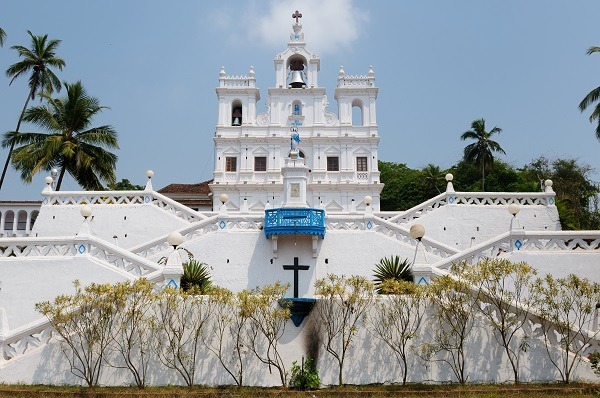
Church of Our Lady of the Immaculate Conception
Perchée sur une colline au centre de Panaji, l'église de l'Immaculée Conception affiche une façade baroque blanche et deux clochers emblématiques. Monument classé, lieu de culte actif et repère architectural de Goa depuis le XVIe siècle.
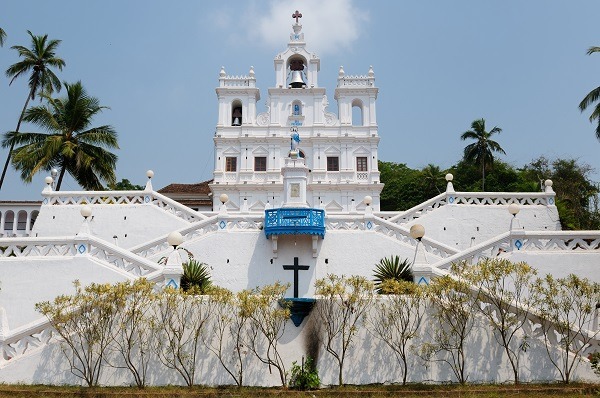
Church of Our Lady of the Immaculate Conception
Perchée sur une colline au cœur de Panaji, l'église de l'Immaculée Conception affiche sa façade baroque blanche face à la place principale. Symbole de l'héritage portugais de Goa, elle se visite en 30 minutes et se combine idéalement avec Old Goa.
Want to discover this destination?
Our local advisors design your tailor-made trip.