Mumbai
Mumbai
Mumbai concentrates UNESCO-listed Victorian architecture, rock-cut temples, thriving slums, and lively beaches on a peninsula facing the Arabian Sea. A city to discover neighborhood by neighborhood.
Mumbai is India's economic capital and most populous city, situated on a peninsula facing the Arabian Sea. Formerly Bombay, it brings together Victorian colonial quarters, some of the world's densest slums, a global film industry, and a gastronomic scene in perpetual ferment—all within a single frenetic rhythm. No other Indian city mixes such contrasts at such a relentless pace.
Practical Information at a Glance
Air Access: Chhatrapati Shivaji Maharaj International Airport (BOM), connected to the center by metro, taxi, and rickshaw.
Internal Transport: Suburban rail network (Western, Central, Harbour Line), expanding metro, black and yellow taxis, Ola/Uber.
Best Time to Visit: November to February — moderate heat, low humidity. Avoid the monsoon (June–September) for travel.
Dress Code: Covered clothing recommended in places of worship (temples, mosques, synagogues).
Recommended Duration: 3 to 5 days to cover the main neighborhoods and an excursion to Elephant Caves.
Accessibility: Limited in older quarters and suburban trains; high-end hotels and certain museums are better equipped.
What to See
Mumbai is best explored neighborhood by neighborhood. Colaba concentrates the Gateway of India, art galleries, and historic cafes. Fort and Churchgate line up UNESCO-listed Victorian façades. Dharavi is one of Asia's most active slums, traversed by circular economy circuits. Bandra and Juhu embody trendy Mumbai, with seafront promenades, restaurants, and Bollywood star residences.
History and Context
The original archipelago was ceded to Portugal in 1534, then gifted to the British Crown in 1661 as the marriage dowry of Catherine of Braganza. The East India Company quickly made it a strategic port. Progressive landfilling of the islands created the present peninsula over the 18th and 19th centuries. The boom in cotton, then textile trade, forged a merchant bourgeoisie of Parsi, Gujarati, and Marwari businessmen who financed the city's great institutions.
Highlights of the Visit
Gateway of India
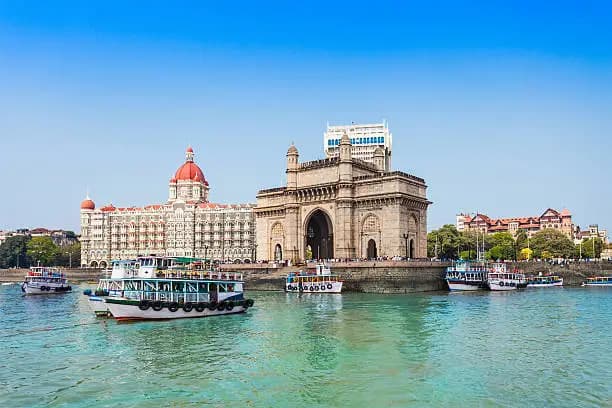
An arch of yellow basalt inaugurated in 1924 to commemorate the visit of George V, it opens directly onto the Arabian Sea. Ferries to Elephant Caves depart from this pier. The atmosphere peaks in late afternoon.
Victorian and Art Deco Quarter (UNESCO)
The ensemble inscribed in 2018 brings together Chhatrapati Shivaji Maharaj Station (formerly Victoria Terminus), the Prince of Wales Museum, the High Court, and several Art Deco buildings along Marine Drive. A walk on foot between Fort and Churchgate suffices to grasp the architectural coherence.
Marine Drive
This curved four-kilometer boulevard borders Back Bay. At night, streetlights form what Mumbaikars call the "Queen's Necklace." In the morning, hundreds of residents practice yoga and brisk walking here.
Elephant Caves
An hour by ferry from the Gateway of India, Elephant Island shelters Hindu rock-cut temples from the 5th–8th centuries, listed as a UNESCO World Heritage site. The central panel depicts Trimurti, the triple face of Shiva, nearly six meters high.
Dharavi
Often reduced to its cinematic portrayal, Dharavi is first and foremost a production hub: leather, pottery, plastic recycling, embroidery. Local agencies offer responsible tours led by guides from the neighborhood.
Dhobi Ghat
This open-air laundry, visible from Mahalaxmi railway station bridge, employs hundreds of dhobis who wash linens for hotels and residents across the city. The spectacle is striking early in the morning.
Photography Tips
Gateway of India: Golden light at dawn, before the surge of visitors. Frame from the pier to include boats.
CST Station: The façade is best lit in late afternoon. The interior is accessible; avoid rush hours for free movement.
Dhobi Ghat: Photograph from the public bridge above—access to the laundry itself is restricted to workers.
Marine Drive: After nightfall for the "Queen's Necklace"; at dawn for yoga silhouettes.
Elephant Caves: Photography is permitted in the caves; avoid flash on sculptures.
Location and Access
Mumbai occupies a peninsula on India's west coast, in Maharashtra State. The international airport is located in the Sahar district (Andheri), roughly 30 km from the historic center of Colaba depending on traffic. The suburban rail network is the fastest way to traverse the city north to south. The metro (operational and under-construction lines) progressively serves east-west axes. Ferries to Elephant Caves depart from the Gateway of India.
Nearby
Elephant Caves — UNESCO-listed Hindu rock-cut temples, an hour by ferry from Colaba.
Gateway of India — Iconic colonial-era monument, ferry departure point.
Chhatrapati Shivaji Maharaj Station — Victorian neo-Gothic masterpiece, UNESCO-listed.
Pune — University and cultural city in Maharashtra, about three hours by road or train.
Ajanta Caves — Exceptional Buddhist rock-cut paintings, accessible as a day trip from Mumbai by air or several hours by road.
Frequently asked questions
November to February offers the most pleasant conditions: moderate temperatures and low humidity. The monsoon (June to September) makes some travel difficult but gives the city a particular atmosphere appreciated by experienced travelers.
Suburban trains (Western and Central Line) are fastest for long north-south trips. For short distances, Uber and Ola are reliable. Black and yellow metered taxis remain an economical option in the center.
In temples, mosques, and synagogues, cover shoulders and knees. Remove your shoes before entering places of worship. For Elephant Caves, comfortable clothing and closed-toe shoes are recommended for the access path.
Allow a full half-day: about an hour for the ferry each way, one to two hours on the island, then the return. Depart early in the morning to avoid afternoon heat and crowds.
Yes, provided you choose an agency whose guides are from the neighborhood and whose revenue is partly returned to the local community. Avoid tours that treat the neighborhood as a spectacle.
Accessibility remains uneven. Suburban trains and narrow streets in older quarters are difficult to access. Large hotels, some museums, and tourist zones in Colaba are better equipped. A private vehicle considerably facilitates travel.
Want to discover this destination?
Our local advisors design your tailor-made trip.