Mahabalipuram
Mahabalipuram
Mahabalipuram encompasses one of India's most remarkable archaeological ensembles: monolithic temples, giant bas-reliefs, and the Shore Temple carved by the Pallava dynasties between the 7th and 9th centuries, designated as a UNESCO World Heritage Site.
Mahabalipuram — officially Mamallapuram — is a coastal town in Tamil Nadu, approximately 60 km south of Chennai. Inscribed on the UNESCO World Heritage List, it concentrates an exceptional collection of rock-cut temples, bas-reliefs, and monuments carved from granite by Pallava sovereigns between the 7th and 9th centuries. The Bay of Bengal borders the sites: some monuments rise directly from the beach sand.
Quick Practical Information
Access from Chennai: approximately 60 km via the coastal road (ECR) — buses, taxis, or rental cars available.
Admission: the main archaeological monuments (Shore Temple, Pancha Rathas, caves) are managed by the ASI; paid entry with differentiated rates for residents and foreigners.
Recommended duration: a full day for the major sites; two days to explore thoroughly.
Dress code: modest dress recommended in active temples; no strict code on archaeological sites.
Best season: November to February (dry season, moderate heat).
What to See
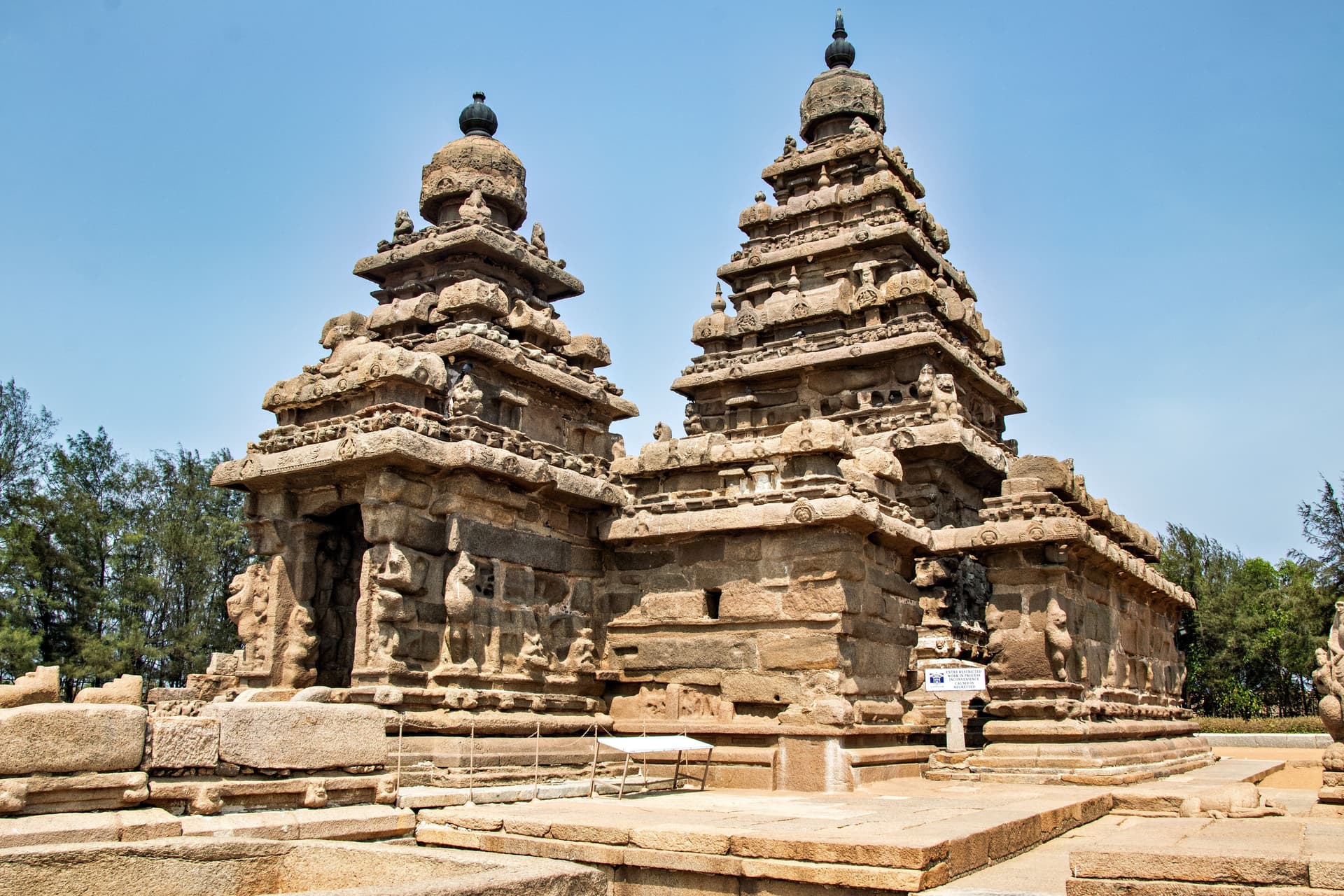
The site comprises several distinct clusters. The Shore Temple (8th century) stands facing the ocean, its two Dravidian towers of grey granite having resisted the waves for over a thousand years. The Pancha Rathas ("five chariots") are five monolithic sanctuaries carved from a single rock block, each illustrating a different architectural style. The bas-relief of the Descent of the Ganges — or the Penance of Arjuna — is among the world's largest rock-cut bas-reliefs, sculpted across two natural rocks.
History and Context
Mahabalipuram was the principal port of the Pallava kingdom, whose capital was Kanchipuram. King Narasimhavarman I (630–668 CE), nicknamed Mamalla, gave his name to the city. Pallava artisans developed an architectural style here that influenced all of Southeast Asia. The site was inscribed by UNESCO in 1984. The 2004 tsunami revealed additional underwater structures off the coast.
Highlights of Your Visit
The Shore Temple
Built under Rajasimha (early 8th century), this temple dedicated to Shiva and Vishnu is among the oldest stone temples in Tamil Nadu. Marine erosion has softened its contours, lending it an organic silhouette. The sunrise over the ocean from this point is particularly striking.
The Pancha Rathas
These five monoliths, never completed or consecrated, bear the names of the Pandavas and Draupadi. Each ratha experiments with an architectural form: barrel-vaulted, pyramidal, and circular roofs. Carved elephants and lions stand guard over the ensemble.
The Descent of the Ganges
This 27-meter-long by 9-meter-high bas-relief depicts gods, humans, animals, and nagas converging toward a natural fissure symbolizing the Ganges. The narrative density and sculptural finesse make it a unique masterpiece in Indian art.
The Pallava Caves
Around a dozen mandapas (columned halls) dot the hillside, carved into the rock. The Mahishasuramardini cave, with its panel of Durga slaying the buffalo-demon, ranks among the finest examples.
The Beach and Sculptor's Quarter
Mahabalipuram remains a living centre of stone sculpture. Workshops line the main streets: you can watch granite and limestone being carved using techniques transmitted since the Pallava era.
Etiquette and Visiting Rules
Remove your shoes before entering active temples (the Shore Temple in particular).
Photography is generally permitted at ASI sites; check signage at the entrance of each monument.
Avoid touching sculptures: skin oils accelerate erosion.
Dress modestly in active places of worship.
Photography Tips
The Shore Temple photographs best at sunrise: golden raking light contrasts with dark granite and the ocean. The Pancha Rathas are best captured in late afternoon, when shadows accentuate the relief. For the Descent of the Ganges, diffuse light (overcast morning) better reveals sculptural depth without overexposure.
Location and Access
Mahabalipuram lies on the Coromandel Coast, along the Bay of Bengal. The coastal road (East Coast Road) connects the town to Chennai in approximately 1.5 hours depending on traffic. Regular buses depart from Chennai (Koyambedu and Broadway). The town is also accessible from Pondicherry, approximately 100 km to the south. No local airport: Chennai's international airport is the main entry point.
Nearby Attractions
Kanchipuram — ancient Pallava capital approximately 70 km away, renowned for its grand Dravidian temples and silk weaving.
Pondicherry — former French colony approximately 100 km away, with its white quarter, ashrams, and beaches.
Chennai — metropolis 60 km away, the natural starting point for exploring Tamil Nadu.
Crocodile Bank Trust — reptile conservation centre on the coastal road between Chennai and Mahabalipuram.
Frequently asked questions
From November to February, temperatures are moderate and rainfall is rare. Avoid October–November if you're concerned about cyclones: the Coromandel Coast is exposed to the northeast monsoon.
ASI signage is in English and Tamil. A local guide significantly enriches understanding of the sculptures and Pallava iconography, particularly for the Descent of the Ganges and the caves.
It's feasible but packed. Plan an early start from Chennai, Mahabalipuram in the morning, Kanchipuram in the afternoon. A private driver simplifies logistics.
Yes, at virtually all ASI sites. Some active temples may restrict photography inside the sanctuary: check signage at each entrance.
A full day covers the major sites (Shore Temple, Pancha Rathas, Descent of the Ganges, principal caves). Two days allow exploration of sculptor workshops and secondary sites.
Yes, Mahabalipuram offers a range of lodging from budget guesthouses to beachfront hotels. Staying locally allows you to enjoy the sunrise over the Shore Temple.
Want to discover this destination?
Our local advisors design your tailor-made trip.