Lumbini
Lumbini
Lumbini in Nepal is the birthplace of Buddha Siddhartha Gautama, confirmed by Ashoka's Column. This UNESCO World Heritage site brings together the Maya Devi Temple, archaeological remains, and monasteries from around the world.
Lumbini is the birthplace of Buddha Siddhartha Gautama, attested by a column erected by Emperor Ashoka in the 3rd century BCE. Listed as a UNESCO World Heritage site, this major pilgrimage destination attracts Buddhists from around the world. Important note: Lumbini is located in Nepal, not India — while the Indian border is nearby, the site itself is Nepali territory.
Practical information at a glance
- Entry: paid entrance fee to access the sacred zone (rates to be confirmed on-site)
- Dress code: modest attire mandatory in temples and the sacred zone
- Recommended duration: half a day to a full day depending on the number of temples visited
- Access: Bhairahawa Airport (Gautam Buddha Airport) is the nearest; buses and taxis connect Indian border cities such as Gorakhpur
- Rules: silence and respect required in the sacred garden zone; shoes must be removed in certain temples
What you'll see
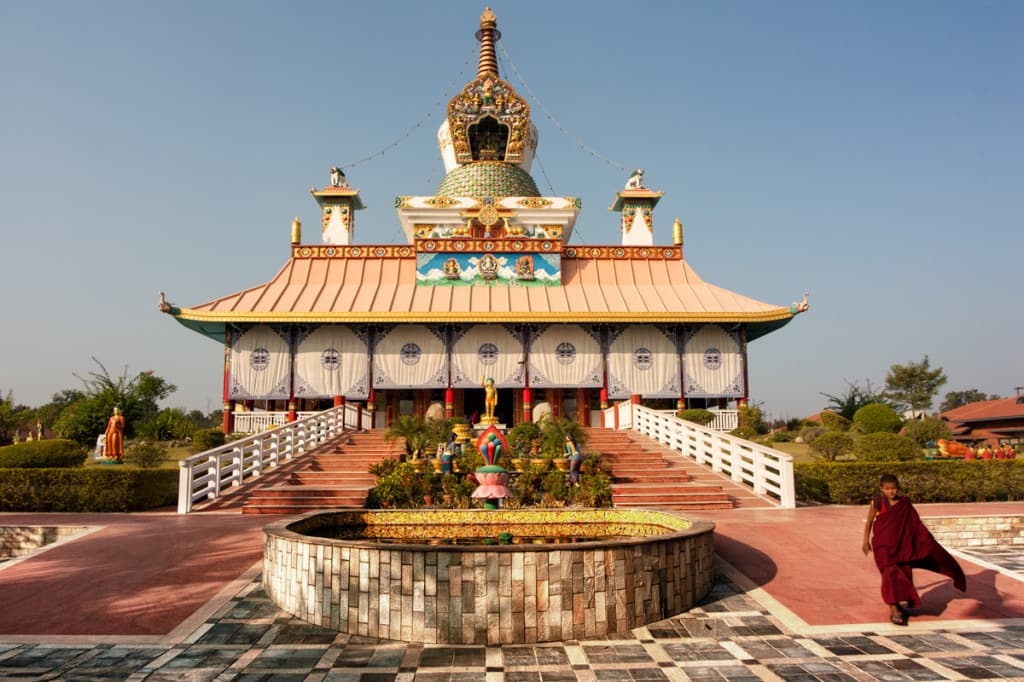
The site is organized around a central axis bordered by monasteries built by Buddhist nations from around the world. The central sacred zone concentrates the oldest archaeological remains. The garden is traversed by a canal and dotted with stupas, gardens, and temples featuring highly varied architectural styles — Burmese, Thai, Japanese, Korean, and Tibetan.
History and context
According to Buddhist texts, Queen Maya Devi gave birth to Siddhartha Gautama here around 563 BCE. The site fell into obscurity for centuries before being rediscovered in 1896 thanks to Ashoka's Column. UNESCO inscribed it as a World Heritage site in 1997. Since then, an extensive master plan has structured the site's development into monastic zones and a central sacred zone.
Highlights of your visit
The Maya Devi Temple
The heart of the site, this temple houses the stone marking the presumed birthplace of the Buddha, as well as ancient bas-reliefs depicting the birth. Archaeological excavations have uncovered structures dating back to the 6th century BCE.
Ashoka's Column
Erected around 249 BCE, this sandstone column bears an inscription in Pali confirming that Emperor Ashoka visited Lumbini and identified it as the Buddha's birthplace. It is one of the rare direct epigraphic testimonies from this period.
The sacred Puskarini Pond
According to tradition, Queen Maya Devi bathed in this pond before the Buddha's birth. It is surrounded by well-maintained gardens and remains a place of reflection for pilgrims.
The international monasteries zone
Two zones — east (Theravada tradition) and west (Mahayana/Vajrayana tradition) — host dozens of monasteries funded by countries such as Myanmar, Thailand, Japan, China, and France. Each building reflects the religious architecture of its country of origin.
Etiquette and visiting rules
- Remove your shoes before entering the Maya Devi Temple and most monasteries.
- Dress modestly: shoulders and knees covered.
- Speak quietly in the central sacred zone.
- Do not touch archaeological remains.
- Some monasteries have their own access rules — check at the entrance of each one.
Photography tips
Morning light is ideal for photographing the Maya Devi Temple and Ashoka's Column before the pilgrims arrive. The international monasteries offer colorful facades in late afternoon light. Photography is generally permitted outside temples; inside, check the prohibition signs specific to each location.
Location and access
Lumbini is located in the Terai Plain in southwestern Nepal, a few kilometers from the Indian border. The border towns of Sonauli (Indian side) and Belahiya (Nepali side) constitute the main crossing point from India. From Gorakhpur (Uttar Pradesh), buses and taxis reach the border, then Lumbini. Bhairahawa Airport (Gautam Buddha Airport) offers flights from Kathmandu and a few international destinations.
Nearby attractions
- Varanasi — Hindu holy city on the Ganges, accessible from Gorakhpur, a natural stopover on a Buddhist circuit.
- Sarnath — site of the Buddha's first sermon, near Varanasi, with an archaeological museum and ancient stupas.
- Kushinagar — site of the Buddha's parinirvana, in Uttar Pradesh, with the Great Parinirvana Temple and its recumbent statue.
- Kapilavastu — ancient capital of the Shakya kingdom, near Lumbini, with archaeological remains related to the Buddha's youth.
Want to discover this destination?
Our local advisors design your tailor-made trip.