Dhankar Gompa
Dhankar Gompa
A Tibetan Buddhist fortress-monastery perched at 3,800 m in the Spiti Valley, Dhankar Gompa combines ancient frescoes, royal ruins and breathtaking views over the confluence of the Spiti and Pin rivers.
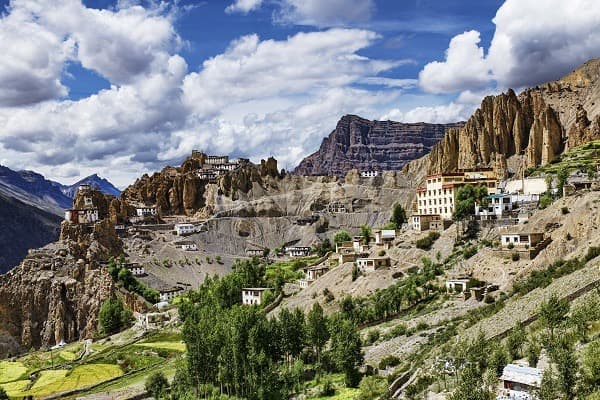
Perched at over 3,800 meters altitude on a vertiginous rocky spur, Dhankar Gompa overlooks the confluence of the Spiti and Pin rivers in the Spiti Valley, Himachal Pradesh. Founded more than a thousand years ago, this Tibetan Buddhist complex serves as fortress, monastery and former royal palace. Its extreme isolation and architecture fused with the rock make it one of the most singular sites in Spiti.
Quick Practical Guide
- Access: Dhankar village accessible from Kaza (approximately 33 km) via mountain road; travel by jeep or local bus
- Dress code: covered clothing mandatory (shoulders and knees covered); remove shoes before entering prayer halls
- Recommended duration: 2 to 3 hours for the monastery and village; half a day if you hike up to Dhankar Lake
- Altitude: approximately 3,894 m — prior acclimatization recommended
- Visiting season: accessible mainly from May to October; the road is often closed in winter
What to See
The monastery comprises several stacked temples, the oldest containing murals and Buddhist statues dating back several centuries. The main hall preserves a statue of Vairocana surrounded by bodhisattvas. The ruins of the former fortress adjoin the active buildings, still occupied by a community of monks from the Sakya order. The panorama over the enclosed valley and ochre cliffs is breathtaking.
History and Context
Dhankar was the capital of the Spiti kingdom for several centuries. The gompa served simultaneously as royal residence, prison and place of worship. The site appears on the World Monuments Fund's list of the hundred most threatened monuments worldwide, due to accelerated erosion of its rocky foundations. A new monastery was built below to house the monks and preserve religious activities.
Visit Highlights
Ancient Frescoes
The murals in the main hall, with their still-vibrant natural pigments, depict tantric deities and scenes from the Buddha's life. Their state of preservation is fragile; natural light filtered through small windows enhances their mysterious character.
Dhankar Lake
A hike of approximately one hour from the monastery leads to Dhankar glacial lake, at nearly 4,100 meters. The trail follows mineral ridges with plunging views over the Spiti-Pin confluence. The lake itself, framed by barren mountains, offers a striking contrast with the surrounding desert landscape.
The Confluence Viewpoint
From the fortress ruins, the view encompasses the junction of the Spiti and Pin rivers, terraced villages and stratified cliffs. It is one of Spiti's most characteristic panoramas, particularly striking in late afternoon when raking light colors the rock faces.
Etiquette and Visiting Rules
- Remove your shoes before entering prayer halls.
- Dress in a covered manner (shoulders and knees).
- Circumambulate stupas and prayer wheels clockwise.
- Ask permission before photographing monks or ceremonies.
- Keep silence in meditation spaces.
Photography Tips
Morning light is ideal for photographing the monastery facade, still shadowed by the cliffs with the intense high-altitude blue sky in the background. In late afternoon, golden light reveals the texture of earthen walls and rock strata. Photos from the fortress ruins toward the valley are the most spectacular. Photography is generally permitted outside; check restrictions inside temples with the monks. Interior lighting is often dim, so bring a tripod if needed for low-light photography.
Location and Access
Dhankar sits in the Spiti Valley, approximately 33 km from Kaza, the district headquarters. The road is a mountain track passable by jeep or local bus. The village of Dhankar is accessible on foot from the parking area via a short climb. The new monastery, below, is easier to access. Accessibility for people with reduced mobility is very limited due to the steep terrain.
Nearby
- Kaza — the main town in the Spiti Valley, the logistical starting point for exploring the region.
- Tabo Monastery — founded in 996, its frescoes are among the best-preserved examples of Himalayan Buddhist art.
- Key (Ki) Monastery — imposing gompa in amphitheater configuration overlooking the Spiti Valley, near Kaza.
- Kibber Village — one of the world's highest inhabited villages, starting point for treks toward mountain passes.
Photos
Want to discover this destination?
Our local advisors design your tailor-made trip.