Vivekananda Rock Memorial
Vivekananda Rock Memorial
At the confluence of three seas, the Vivekananda Rock Memorial commemorates the meditation of philosopher-monk Swami Vivekananda in 1892. A major spiritual and architectural site at the southern tip of India.
Off the coast of Kanyakumari, at the southern tip of India, two rock formations emerge from the sea where the Indian Ocean, the Arabian Sea, and the Bay of Bengal converge. The Vivekananda Rock Memorial stands on the larger of these islets. Built in 1970 at the spot where philosopher-monk Swami Vivekananda is said to have meditated in 1892, the memorial is both a Hindu pilgrimage site and a remarkable architectural landmark, visited by millions each year.
Practical information at a glance
- Access: Ferry from Kanyakumari landing (a few minutes' journey); ferry tickets purchased on-site.
- Entrance: Paid entry (ferry + memorial entrance fee).
- Dress code: Modest dress required; shoulders and knees must be covered.
- Recommended duration: 1 to 1.5 hours on the rock.
- Closing: The site closes mid-afternoon; check ferry schedules on-site, as they vary by season.
- Accessibility: Limited accessibility due to stairs and ferry journey.
What to see
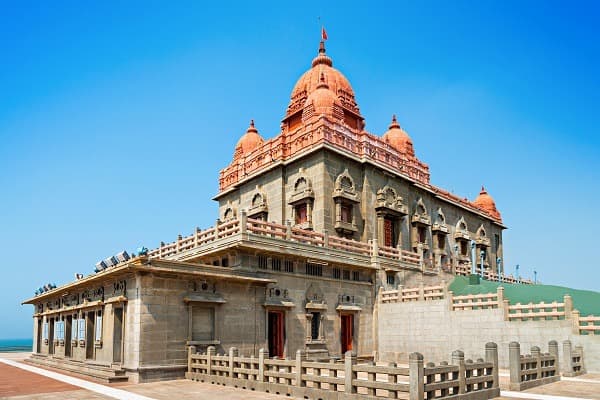
The memorial comprises two main structures: the Vivekananda Mandapam, a meditation hall topped with a dome inspired by Tamil Nadu, Rajasthan, and Bengali architectural styles, and the Shripada Mandapam, a pavilion housing a sacred footprint attributed to the goddess Kanyakumari. The panoramic view of the confluence of the three seas and the Kanyakumari coast is breathtaking.
History and context
In December 1892, Swami Vivekananda swims to the rock and meditates there for three days. This retreat precedes his landmark speech at the World Parliament of Religions in Chicago in 1893. The memorial project, led by Eknath Ranade, mobilized contributions from across India and culminated in the site's inauguration on September 2, 1970. The syncretic architecture intentionally reflects India's cultural unity.
Highlights of your visit
The Vivekananda Mandapam
The central meditation hall houses a bronze statue of Swami Vivekananda. The atmosphere is contemplative; many visitors pause here for a few moments of meditation. The dome, visible from afar along the coast, blends Dravidian motifs with influences from northern India.
The Shripada Mandapam
This adjacent pavilion houses a sacred footprint (shripada). For Hindu pilgrims, it is often the focal point of the visit. Access may require a short wait during peak hours.
The confluence of three seas
From the rock's terraces, the demarcation line between waters of slightly different colors is visible on clear days. Sunrise and sunset offer particularly striking perspectives of this triple horizon.
Etiquette and visiting rules
- Remove your shoes before entering the mandapams.
- Modest dress covering shoulders and knees is mandatory for all.
- Silence is observed in the meditation hall.
- Photography is permitted in outdoor areas; check on-site for rules inside the mandapams.
- Avoid loud behavior: the site remains an active place of worship.
Photography tips
Morning light, just after the ferries open, is gentlest for photographing the memorial from the rock and from shore. Sunset viewed from the rock is spectacular, but check the time of the last return ferry before lingering. For a wide frame including the nearby Thiruvalluvar statue, position yourself on the rock's north-west terrace.
Location and access
The rock lies approximately 500 meters offshore from Kanyakumari's waterfront. The landing is near the Amman temple in the town center. Kanyakumari is accessible by train from Chennai, Madurai, or Thiruvananthapuram, and by bus from major cities in Tamil Nadu and Kerala. The town is small and the landing is easily reachable on foot from most hotels.
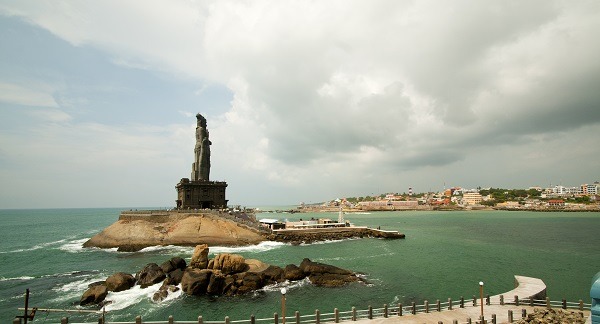
Immediately nearby on the adjacent rock stands the Thiruvalluvar statue, visible from the memorial and accessible by the same ferry.
Nearby attractions
- Thiruvalluvar Statue — Colossal statue of the Tamil poet-philosopher, erected on the neighboring rock, accessible by the same ferry ticket.
- Kanyakumari Amman Temple — Seaside temple dedicated to the virgin goddess, right by the water, a few minutes' walk from the landing.
- Gandhi Mandapam — Memorial where Mahatma Gandhi's ashes were displayed before immersion, designed so that sunlight illuminates the urn on his birthday.
- Kanyakumari Wax Museum — Museum featuring Indian historical and religious figures in wax, a few minutes from the waterfront.
Frequently asked questions
October to March offers the most pleasant weather, with less rain and calmer seas for the ferry crossing. Summer (April–June) is hot and humid; the monsoon (July–September) can disrupt crossings.
Yes. The ferry ticket typically includes access to both rocks. Allow 1.5 to 2 hours to comfortably visit both sites.
Tickets are purchased directly at the landing ticket window. During peak periods (Indian holidays, weekends), queues may form; arrive early in the morning to avoid long waits.
Outdoor areas are freely photographable. Inside the mandapams, rules may vary; follow posted signs and ask staff if unsure.
Access is difficult for people with mobility limitations: the ferry crossing, disembarking on the rock, and numerous stairs make the visit challenging without assistance.
Shoulders and knees must be covered. Wear shoes that are easy to remove, as you will need to take them off before entering the mandapams.
Photos
Interested in this visit?
We can include it in your personalised itinerary.