Shyok River
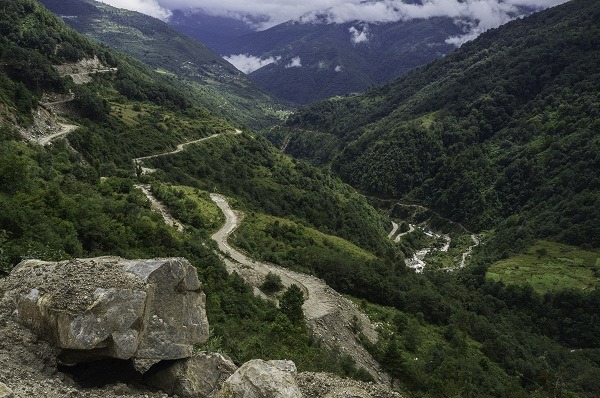
The Shyok cuts through eastern Ladakh between ochre cliffs and turquoise glacial waters. A key access route to Nubra Valley and the village of Turtuk, it unveils some of India's most untamed high-altitude landscapes.
The Shyok is a major tributary of the Indus that flows through eastern Ladakh and the Nubra district. Rising from Karakoram glaciers, it winds between arid gorges in ochre and brick tones before joining the Indus near Skardu (on the Pakistani side). For travelers, the river is best known as the main passage to Nubra Valley and as a spectacular landscape in its own right, with turquoise waters contrasting dramatically against desert mountains.
Quick Facts
- Access: The main road follows the Shyok from Leh via Khardung La or via Agham; the track is partially passable by 4×4 or motorcycle.
- Season: June to September — the road closes in winter due to snow and glacial flooding.
- Recommended duration: The river is best explored en route to Nubra or Pangong; allow half a day to a full day depending on your itinerary.
- Dress code: No specific requirements; bring warm clothes even in summer (high altitude, strong winds).
- Altitude: The river bed ranges from 3,000 to 3,500 m depending on the section; acclimatization is essential.
- Permit: An Inner Line Permit (ILP) is mandatory to access the Nubra/Shyok zone; obtain it in Leh or online.
What You'll See
The Shyok presents a high-altitude desert landscape: eroded cliffs in rust hues, white sand banks, and water of glacial blue-green. Isolated villages — Khalsar, Turtuk, Tyakshi — dot the banks. Vegetation is sparse, limited to poplars and willows around irrigated hamlets. In summer, herds of yaks and pashmina goats cross shallow fords.
History and Context
The Shyok (meaning "river of death" in ancient Turkic) owes its name to sudden floods caused by the rupture of natural glacial dams, a phenomenon known as GLOF (Glacial Lake Outburst Flood). These floods have historically destroyed entire villages. The river also marks a sensitive geographic boundary: its lower course runs alongside the Line of Control with Pakistan, explaining the military presence and access restrictions in certain areas.
Highlights
Khalsar Bridge
This military suspension bridge is the principal crossing point of the Shyok on the Leh–Nubra road. The view from the deck, framed by bare mountains, is striking. It's also a checkpoint where the ILP is verified.
Village of Turtuk
Located downstream on the Shyok bank, Turtuk is one of India's northernmost villages, inhabited by Balti people. Its apricot orchards and stone-paved lanes contrast sharply with the surrounding aridity. Access was only opened to foreign tourists in 2010.
Hunder Dunes
A few kilometers from the Shyok, in Nubra Valley, fine sand dunes harbor Bactrian camels (two-humped). This high-altitude desert landscape, in immediate proximity to the river, is one of Ladakh's most unusual sights.
Photography Tips
Morning light (7am–9am) reveals contrasts between turquoise water and ochre cliffs. Late afternoon brings long shadows that sculpt the gorges. Avoid midday: the light is harsh and bleaches the hues. The most rewarding viewpoints are on heights overlooking the river bed, accessible on foot from the road.
Location and Access
The Shyok flows through Leh district (Ladakh), approximately 100 km north of Leh via the Khardung La road. The track along the river is passable by 4×4, motorcycle, or local bus (irregular service). No direct public transport from Leh; vehicle rental with driver is the most common solution. Accessibility for people with reduced mobility is very limited due to rough terrain and unpaved roads.
Nearby Attractions
- Nubra Valley — fertile valley between two Karakoram ranges, accessible from the Shyok, featuring monasteries and dunes.
- Khardung La Pass — one of the world's highest motorable passes, the essential gateway between Leh and the Shyok.
- Turtuk Village — Balti village on the Shyok's edge, with distinct culture and architecture from the rest of Ladakh.
- Pangong Tso Lake — high-altitude lake with changeable waters, accessible via another route from Leh, often combined in a circuit.
Frequently asked questions
June to September, when the road is clear. In July-August, the river is in spate and landscapes are greenest. By September, waters recede and light becomes softer for photography.
Yes. An Inner Line Permit (ILP) is mandatory for Indian nationals and foreign visitors wishing to access Nubra Valley and the Shyok sector. Obtain it in Leh from the Deputy Commissioner or online.
Rafting on the Shyok is very rare and not regularly organized commercially, due to unpredictable floods and sensitive military zones. The Indus at Leh is the preferred river for rafting activities in Ladakh.
Most travelers incorporate the Shyok into a Leh–Khardung La–Nubra–Turtuk circuit over two to three days. You can extend to Pangong Tso via the Agham-Shyok road, avoiding the return to Leh.
Guesthouses and tent camps exist at Khalsar, Hunder, and Turtuk. Availability is limited; book in advance during peak season (July-August).
Interested in this visit?
We can include it in your personalised itinerary.