Raniji ki Baori (Ratan Daulat / Queen's Stepwell)
Raniji ki Baori, known as Ratan Daulat, is Bundi's largest stepwell. Built in the 17th century, it showcases sculpted galleries depicting deities and elephants across multiple underground levels.
Raniji ki Baori, known locally as Ratan Daulat, is a monumental stepwell nestled in the heart of Bundi, Rajasthan. Constructed in the 17th century under the reign of Queen Nathavati Ji, it stands among the finest examples of medieval hydraulic architecture in Rajasthan. Its sculpted galleries, ornate pillars, and mythological friezes create a site of rare artistic density, still largely untouched by mass tourism.
Practical Information at a Glance
- Entrance : paid for foreign visitors, free or nominal for Indian residents (verify exact rates on-site)
- Recommended duration : 30 to 45 minutes
- Dress code : no strict requirements, but respectful attire is appreciated
- Access : on foot from central Bundi, close to the main bazaar
What to See
The stepwell descends through multiple levels connected by symmetrical staircases. The walls are adorned with sculptures depicting Hindu deities, elephants, apsaras, and floral motifs. Finely carved pillars frame shaded galleries where light filters differently depending on the hour. At the bottom, the circular well reflects the sky between the columns.
History and Context
The stepwell — baori in Hindi — was vital infrastructure in arid Rajasthan: it collected rainwater and allowed access to it even during the dry season. Raniji ki Baori was commissioned by Queen Nathavati Ji in the 17th century. Its popular name, Ratan Daulat, evokes both wealth (daulat) and the preciousness (ratan) of the structure. While Bundi has several stepwells, this remains the largest and best-preserved in the city.
Highlights of Your Visit
The Sculpted Walls
Each carved register narrates fragments of Hindu mythology. Friezes of elephants in low relief at the upper level alternate with panels of deities. The iconographic density rivals that of Bundi's temples, yet in a wholly unique architectural setting.
The Descent to the Well
Descending the stairs to water level (or what remains depending on the season) gives a true sense of the structure's depth. Temperature drops noticeably as you go down, and the acoustics shift perceptibly.
The Shaded Galleries
Niches and alcoves carved into the side walls once served as rest spaces. Some still shelter small votive sculptures.
Photography Tips
Early morning light illuminates the sculpted walls without harsh backlighting. Midday overhead sun creates unflattering shadows on relief details. A wide-angle lens captures the symmetry of the staircases from the upper rim. Avoid flash on sculptures: natural light is sufficient and better preserves the finer details.
Location and Access
Raniji ki Baori stands in Bundi's historic center, just a few minutes' walk from the main bazaar and near Bundi Palace (Garh Palace). The town of Bundi is reachable from Kota (roughly 35 km) or Jaipur (roughly 210 km) by road or rail. Tuk-tuks and rickshaws connect the site from the railway station or bus stand.
Nearby Attractions
- Bundi Palace (Garh Palace) — medieval fortress overlooking the city, renowned for its murals from the Bundi school of painting.
- Taragarh Fort — ruined citadel perched above the palace, offering panoramic views of Bundi and its lakes.
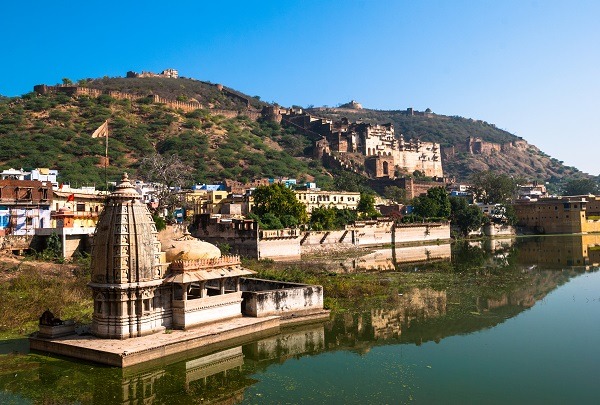
- Nawal Sagar Lake — artificial lake in central Bundi, with a submerged temple visible during dry season.
- Chhatri of 84 Pillars — 18th-century columned cenotaph, a subtle example of Rajasthani funerary architecture.
Interested in this visit?
We can include it in your personalised itinerary.