Phugtal Monastery
Clinging to a cliff face above the Tsarap River gorge, Phugtal Monastery is one of the most isolated and spectacular Buddhist sites in Zanskar, accessible only on foot.
Clinging to a cliff face above the Tsarap River gorge, Phugtal Monastery is one of the rare major Tibetan Buddhist monasteries accessible only on foot. Founded in the 15th century in the Zanskar valley of Ladakh, it is home to an active community of Gelugpa monks. Its honeycomb silhouette, built around a natural cave, makes it one of the most spectacular monastic sites in the Indian Himalayas.
Practical Information at a Glance
- Access: on foot only — approximately 2 to 3 hours' walk from Purne village (or Cha), along a gorge trekking trail.
- Dress code: modest attire required; shoulders and knees must be covered to enter temples.
- Footwear: must be removed before entering prayer halls.
- Recommended duration: allow half a day on site; overnight stays possible at the monastery (basic accommodation for trekkers).
- Season: accessible June to October; roads are closed by snow the rest of the year.
What to See
The monastery cascades down several levels around a natural cave that served as shelter for the first hermits. Within you'll find temples adorned with thangkas and Buddha statues, a library of ancient texts, monks' cells and terraced rooftops offering sweeping views of the Tsarap gorge. The exterior whitewashed walls contrast strikingly with the ochre rock of the cliff face.
History and Context
Phugtal was founded in the 15th century by lama Gangsem Sherap Sampo. Its name literally means "cave-departure" in Tibetan, a direct reference to the natural cavern at the heart of the complex. The site is believed to have been frequented by hermits long before the monastery was constructed. It belongs to the Gelugpa school, the same as the Dalai Lama's. Hungarian traveller Alexander Csoma de Kőrös stayed here in the 19th century and studied Tibetan.
Visit Highlights
The Central Cave
At the heart of the monastery, a natural spring flows from the cave. Monks consider it sacred. The space is dim, heavy with incense and burning yak butter — an atmosphere of authentic devotion, far from mass tourism.
Temples and Their Frescoes
Several prayer halls preserve ancient murals and gilded statues. The main temple houses a large statue of Maitreya, the Buddha of the future. The monks' morning ceremonies are open to respectful visitors.
The Rooftop Terraces
From the upper terraces, the view over the Tsarap gorge and Zanskar mountains is breathtaking. It's also the best vantage point for photographing the entire monastery in context with the cliff face.
The Library
Phugtal maintains a collection of ancient Buddhist texts in Tibetan. Access may be granted upon respectful request to the monks.
Etiquette and Visiting Rules
- Circle around chortens and mani walls in a clockwise direction (the Buddhist direction).
- Do not photograph monks without their explicit permission.
- Speak quietly inside temples; keep phones switched off.
- Do not touch statues, thangkas or ritual objects.
- A voluntary donation to the monastery collection is appreciated.
Photography Tips
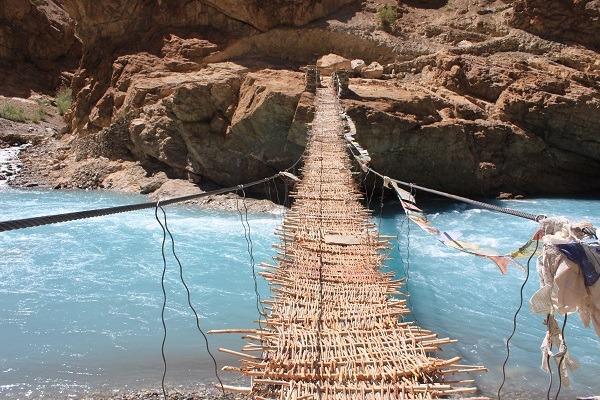
Morning light (between 8 a.m. and 10 a.m.) illuminates the monastery's white façade from the east and reveals the contrast with the cliff face. The angle from the approach trail, before reaching the bridge, offers the most complete overview. In late afternoon, raking light accentuates the rock textures. Photography is permitted in outdoor spaces; always ask permission inside temples.
Location and Access
Phugtal is located in the Zanskar valley, Kargil district, Ladakh. The usual starting point is Purne village, itself accessible from Padum (the Zanskar capital) by rough track. From Padum, allow several hours by jeep to reach Purne, then the approach walk. Padum is connected to Kargil and Leh by road (open in summer) or via the Zanskar trek. There is no road access to the monastery — a condition that safeguards its isolation and authenticity.
Nearby places accessible from Padum: Karsha Monastery, Stongde Monastery.
Nearby
- Karsha Monastery — the largest monastery in Zanskar, perched above the Padum plain, accessible by jeep and on foot.
- Stongde Monastery — an 11th-century Gelugpa monastery overlooking the Zanskar valley from a rocky spur.
- Padum — the administrative capital of Zanskar, a logistics hub for exploring the region.
Frequently asked questions
June to October, when the trails are clear. July and August are the busiest months. September often offers ideal conditions: fewer crowds and clear skies.
Yes, the monastery offers simple accommodation for trekkers (dormitory or basic room). Meals can be shared with the monks. No online booking is available; everything is arranged on arrival.
The trail from Purne is relatively well-marked, but Zanskar terrain is demanding. A local guide is strongly recommended, especially if you combine Phugtal with a longer trek through the gorges.
Shoulders and knees covered to enter temples. Bring easily removable footwear. A shawl or light jacket is useful; altitude makes mornings cool even in summer.
Yes. It naturally fits into the Zanskar Gorge trek or a circuit connecting Padum to Darcha (Himachal Pradesh). Many trekkers include it as a stage between Purne and Kargiak.
Outdoors, yes. Inside temples, always ask the monks for permission. Some halls prohibit photography; respect any posted signs or verbal instructions.
Interested in this visit?
We can include it in your personalised itinerary.