Khusro Bagh
Khusro Bagh
A walled Mughal garden in Prayagraj, Khusro Bagh unites three red sandstone mausoleums from the 17th century dedicated to Prince Khusro and his family. Free entry, serene atmosphere, minutes from the central railway station.
Khusro Bagh is a walled garden from the Mughal era situated in Prayagraj (formerly Allahabad), minutes from the central railway station. It shelters three red sandstone mausoleums erected in the early 17th century for members of the imperial family. Little visited by foreign tourists, this site offers a peaceful immersion into Mughal funerary architecture, away from the city's hustle.
Quick facts at a glance
- Admission: free
- Access: on foot from Prayagraj Junction station (a few minutes)
- Recommended duration: 45 minutes to 1 hour 30 minutes
- Dress code: no strict obligation, but respectful attire is appropriate
What you'll see
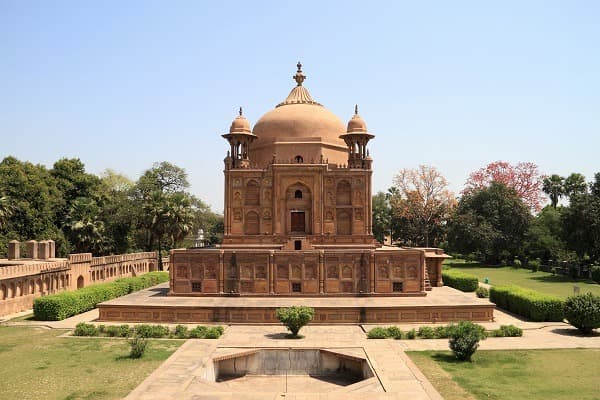
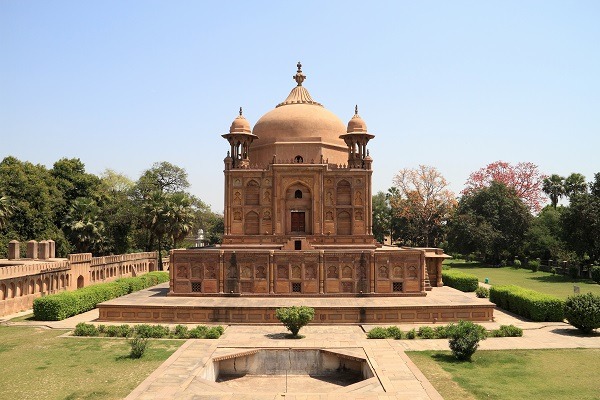
The garden is organised according to the charbagh plan (four gardens divided by walkways), typical of Mughal aesthetics. Three tombs rise within it, constructed in red sandstone with white marble inlays. The facades display carved floral motifs and calligraphic inscriptions. Fruit trees—notably guavas—planted during the Mughal period partly survive.
History and context
The garden was laid out in the early 17th century under Mughal emperor Jahangir. It is associated with Prince Khusro, Jahangir's eldest son, who rebelled against his father in 1606 and was captured. The principal tomb belongs to Khusro himself, who died in 1622. Two other mausoleums house Shah Begum, Khusro's mother, and Nithar Begum, his sister. The ensemble illustrates the dynastic tensions that marked Jahangir's reign.
Highlights of your visit
The tomb of Khusro
The largest of the three mausoleums, rising two storeys, blends red sandstone and white marble. The ogival arches and corner kiosks (chhatris) are characteristic of Mughal transitional style between Akbar and Shah Jahan. The interior houses the prince's cenotaph in a sober, well-preserved chamber.
The tomb of Shah Begum
Built during the queen's lifetime, this mausoleum stands out for its painted interior decoration, more colourful than the other two. Geometric and floral motifs on the ceiling remain legible despite the centuries.
The garden and its ancient trees
Shaded walkways and lawns maintained by the Archaeological Survey of India (ASI) make Khusro Bagh a cherished promenade for locals. Some guava trees are believed to descend from original Mughal plantings.
Photography tips
Morning light is ideal: it illuminates the red sandstone facades without backlighting. The carved details of the arches photograph well in late morning. The tomb interiors are dim; a tripod or high ISO sensitivity is useful. Photography is permitted throughout the site.
Location and access
Khusro Bagh lies in central Prayagraj, immediately near Prayagraj Junction station, one of India's largest railway stations. The site is accessible on foot from the station or by rickshaw from downtown. Parking is available at the main entrance. Wheelchair access is limited owing to gravel pathways and steps leading to the tombs.
Nearby attractions
- Fort of Allahabad — 16th-century Mughal fortress built by Akbar at the confluence of the Ganges and Yamuna rivers.
- Triveni Sangam — sacred confluence of the Ganges, Yamuna, and the mythical Saraswati, a major Hindu pilgrimage site.
- Anand Bhavan — ancestral home of the Nehru family, converted into a national museum.
- Swaraj Bhavan — former Nehru residence, now a museum dedicated to the independence movement's history.
Frequently asked questions
Admission is free for all visitors.
Between 45 minutes and 1 hour 30 minutes is sufficient to explore the three tombs and garden at a leisurely pace.
Yes. Its proximity to the station makes it a natural stop before or after a train journey. Triveni Sangam and Anand Bhavan can be visited on the same day.
Yes, photography is permitted throughout the site, including inside the mausoleums.
The dry and cool season, October to March, is most pleasant. Summers in Prayagraj are extremely hot and humid.
Photos
Interested in this visit?
We can include it in your personalised itinerary.