Khajuraho Temples – Western Group
Khajuraho Temples – Western Group
The western group of Khajuraho concentrates the largest temples of the UNESCO site: Kandariya Mahadeva, Lakshman, mithuna sculptures and ocre sandstone friezes from the 10th century.
In the heart of Madhya Pradesh, the temples of Khajuraho's western group form the nucleus of the UNESCO World Heritage site. Built between the 9th and 11th centuries by the Chandela dynasty, they are celebrated for their erotic friezes but also for the precision and density of their ocre sandstone sculpture. Here stand the largest and best-preserved monuments of the entire Khajuraho complex.
Essential Information at a Glance
- Admission : fee-based; differentiated rates for Indian residents and foreign visitors (Archaeological Survey of India)
- Duration : 2 to 3 hours to explore the entire western group
- Dress code : no strict requirement, but modest attire is recommended
- Access : the site is within walking distance of central Khajuraho; auto-rickshaws and bicycles available throughout town
- Sound and Light : evening performances held on-site (check schedules locally)
What You'll See
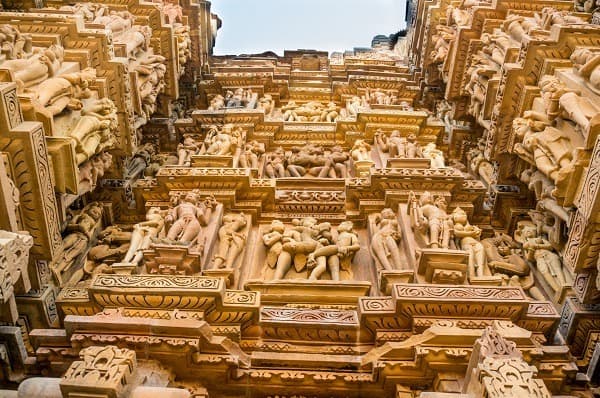
The western group comprises around a dozen temples within a landscaped park. The Kandariya Mahadeva temple is the most impressive: its shikhara tower reaches approximately 30 metres and its walls are covered with more than 800 sculptures. The Lakshman temple, dedicated to Vishnu, and the Devi Jagadambi temple complete the major trio. Each structure follows a cruciform plan with an inner sanctum (garbhagriha) and an entrance portico (mandapa).
History and Context
The Chandela dynasty ruled the Bundelkhand region from the 9th to the 13th century. The temples were erected at the height of their power, between approximately 950 and 1050. Following the Chandela decline, the site fell into obscurity and was gradually reclaimed by forest, which actually preserved it from destruction. A British officer, T.S. Burt, rediscovered it in 1838. UNESCO inscribed it as a World Heritage site in 1986.
Highlights of Your Visit
The Kandariya Mahadeva
The site's largest temple, it illustrates Hindu cosmology: the central tower symbolizes Mount Meru. Its stacked friezes alternate between deities, apsaras, intertwined couples (mithuna) and court scenes. The interior houses a Shiva lingam.
The Mithuna Sculptures
Erotic representations cover only about 10% of the total sculptured surface. They are interpreted as a celebration of fertility, a symbolic passage between the profane world and the sacred sanctuary. The remaining friezes depict processions, warriors, animals and scenes of daily life.
The Lakshman Temple
Dedicated to Vishnu, this 10th-century temple is among the few to retain its complete layout with four subsidiary temples at the corners. Its plinth (jagati) is particularly rich in narrative bas-reliefs.
The Sound and Light Performance
In the evening, the temples are illuminated and a narration traces the history of the Chandela. The nocturnal atmosphere transforms how you read the sculptures. Check on-site for show times and available languages.
Photography Tips
Golden morning light (shortly after opening) is ideal: it brings out the relief of the ocre sandstone sculptures without harsh shadows. At midday, frontal light flattens detail. Consider a macro lens or zoom for high-positioned friezes. Photography is permitted in the park; check restrictions inside the sanctuaries.
Location and Access
The western group is located in central Khajuraho, a few hundred metres from the main square. Khajuraho Airport (civilian) serves Delhi and Varanasi with regular flights. By train, Khajuraho station connects to Mahoba, a railway hub on the Delhi–Chennai line. Buses link Khajuraho to Jhansi and Satna. The site is accessible on foot from most central hotels.
Nearby Attractions
- Eastern group of Khajuraho — more intimate Jain and Hindu temples, a few kilometres east.
- Southern group of Khajuraho — two isolated temples including the Duladeo, with later-period sculptures.
- Khajuraho Archaeological Museum — sculptures recovered from the site, helpful for understanding iconography before your visit.
- Panna National Park — tiger reserve approximately 45 km away, combinable as a day excursion.
Frequently asked questions
October to March offers dry weather and pleasant temperatures. Summer (April–June) is very hot; the monsoon (July–September) makes travel more challenging but the site remains open.
No strict dress code is enforced at the archaeological park entrance. Modest, covered clothing remains advisable out of respect for the sacred nature of the sanctuaries.
Yes, if you start early. Allow 2 to 3 hours for the western group, then 1 hour for the eastern group. The southern group is quicker to visit. A bicycle or auto-rickshaw facilitates movement between sites.
Photography is generally allowed in the outdoor park. Inside the sanctuaries, restrictions may apply; check signage at each temple entrance.
It offers a narrative interpretation of Chandela history and a different visual experience from a daytime visit. Quality varies depending on the language of the available performance; inquire at the ticket office.
Direct flights connect Khajuraho to Delhi and Varanasi. By train, the combination of Mahoba station plus bus or taxi is most common from Delhi. From Varanasi, a train to Satna followed by bus or taxi is a frequent option.
Interested in this visit?
We can include it in your personalised itinerary.