Sawai Madhopur
Sawai Madhopur
Sawai Madhopur, in Rajasthan, is the essential base for safaris in Ranthambore National Park, renowned for its Bengal tigers and medieval UNESCO-listed fort.
Sawai Madhopur is a town in Rajasthan, roughly 160 km southeast of Jaipur. It owes its global reputation to Ranthambore National Park, one of India's finest destinations for observing Bengal tigers in the wild. The town also serves as the launching point for visits to Ranthambore Fort, listed as a UNESCO World Heritage site as part of the group of Rajasthan's forts.
Quick facts at a glance
- Access: well-served railway station from Jaipur, Delhi and Mumbai; Jaipur–Sawai Madhopur train journey approximately 2 hours.
- Recommended duration: 2 to 3 nights to combine safaris and fort visits.
- Ranthambore safaris: mandatory online booking via the official Indian forest portal; limited spots, book several weeks in advance during peak season.
- Best time: October to June (the park generally closes from July to September for the monsoon).
- Attire: neutral colours (khaki, green, beige) recommended for safaris; avoid white and bright colours.
What you'll see
Ranthambore National Park spans approximately 1,334 km² of dry forest, lakes and rocky ravines. Safaris in jeeps or canters (open trucks) traverse ten numbered zones. Zones 1 to 5, around Padam Talao, Malik Talao and Raj Bagh lakes, are the most frequented and most productive for tiger spotting.
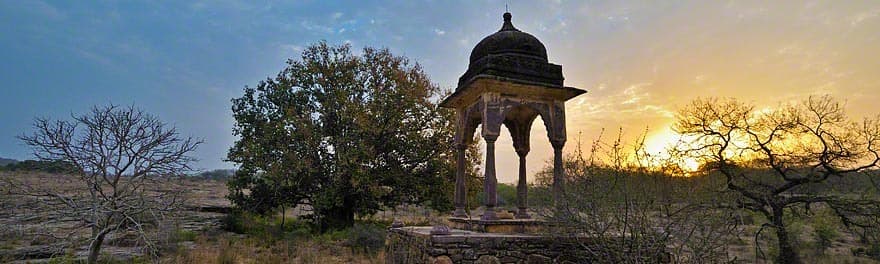
Beyond tigers, the park is home to leopards, striped hyenas, marsh crocodiles, pythons, and a rich birdlife of over 300 species. The medieval Ranthambore Fort dominates the forest from a rocky outcrop and offers a breathtaking panorama over the canopy.
History and context
Sawai Madhopur was founded in the 18th century by maharaja Sawai Madho Singh I of Jaipur. Ranthambore Fort itself dates back to the 10th century; it was successively held by the Chahamanas, Delhi sultans, the Mughals, and then the Jaipur Rajputs. The national park was established in 1955 as a hunting reserve, before joining Project Tiger in 1973, one of India's earliest.
Highlights of your visit
Sunrise safari
The morning safari, departing before dawn, offers the best chances of spotting wildlife. Tigers are active early on, often visible near watering holes. The golden light of the first hours is ideal for wildlife photography.
Ranthambore Fort
Accessible on foot from within the park (with a guide), the fort houses a highly revered Ganesh temple. Palace ruins, stepwells and temples dot the ascent. The view over the forest and lakes from the ramparts is remarkable.
The park's lakes
Padam Talao is the park's largest lake. In the dry season (April–June), animals congregate there to drink, making wildlife sightings particularly spectacular. Blooming water lilies add to the visual appeal.
Trinesvara Mahadeva Temple
This Shaivite temple located in town attracts local pilgrims. It offers an interesting cultural counterpoint to the safaris, rooted in Sawai Madhopur's daily life.
Photography tips
Prioritise a telephoto lens (400 mm minimum) for wildlife. Morning safaris offer warm, raking light; evening safaris, golden light as the sun sets. Avoid flash, which is prohibited in the park. Zones 3 and 5 are renowned for photographic encounters near the lakes.
Location and access
Sawai Madhopur lies in the district of the same name, in southeastern Rajasthan. The railway station is centrally located and well-connected. The nearest airport is Jaipur's. Most accommodation (lodges and hotels) clusters along the road to the park, a few kilometres from the town centre.
From Jaipur, National Highway 52 allows you to reach the town by car in approximately 3 hours. Many travellers include Sawai Madhopur in a Rajasthan circuit combining Jaipur and Agra.
In the surrounding area
- Jaipur — Rajasthan's capital, with the Hawa Mahal, City Palace and Amber Fort, approximately 2 hours by train.
- Agra — The Taj Mahal and Agra Fort, accessible by train from Sawai Madhopur.
- Bundi — Authentic Rajput town with a fort and remarkable stepwells, approximately 2 hours to the southwest.
- Kota — Industrial and cultural city on the Chambal, with a palace-museum and ghats, approximately 1 hour to the south.
Frequently asked questions
October to June. The dry season (April–June) maximises chances of seeing tigers at watering holes, but heat is intense. Winter (November–February) offers pleasant weather. The park generally closes during the monsoon (July–September).
Bookings are made online via the official Rajasthan forest management portal. Spots are limited per zone and time slot. During peak season, it is advisable to book several weeks in advance.
Opt for neutral colours: khaki, olive green, beige or grey. Avoid white and bright colours which may disturb wildlife. A hat and light jacket are useful in the morning, even in warm seasons.
The fort lies within the national park. Access is therefore arranged as part of an official safari, accompanied by an approved guide. It is not possible to visit independently.
Two to three nights allow for two or three safaris (morning and evening) and a fort visit. A single night is possible but leaves little margin if a safari yields disappointing sightings.
Yes. The town is well-connected by train to Jaipur, Agra and Kota. It fits naturally into a circuit combining the Golden Triangle (Delhi–Agra–Jaipur) with a nature stop in Rajasthan.
Photos
Want to discover this destination?
Our local advisors design your tailor-made trip.