Khardung La
Khardung La
Khardung La, at approximately 5,359 m elevation in Ladakh, is one of the world's highest motorable mountain passes. Prayer flags, panoramic views of the Karakoram, and gateway to Nubra Valley.
Khardung La is a high mountain pass located in Ladakh, north of Leh. Perched at approximately 5,359 meters elevation, it stands as one of the world's highest motorable mountain passes accessible by vehicle. The road crossing it connects Leh to Nubra Valley, opening access to the sand dunes of Hunder and remote monasteries in northern Ladakh.
Practical Information at a Glance
- Elevation: approximately 5,359 m (signage at the pass indicates 5,602 m, a figure disputed by GPS surveys).
- Access: road open to motorized vehicles and cyclists; an Inner Line Permit (ILP) is mandatory for foreign nationals and Indian citizens from outside Ladakh.
- Open season: generally May to November; closed in winter due to snowfall.
- Recommended time on-site: 30 to 60 minutes — altitude sickness can occur rapidly at this elevation.
- Attire: warm clothing essential even in summer; wind and cold are intense at the summit.
- Accessibility: not suitable for people with reduced mobility — winding mountain road, difficult conditions.
What You'll See
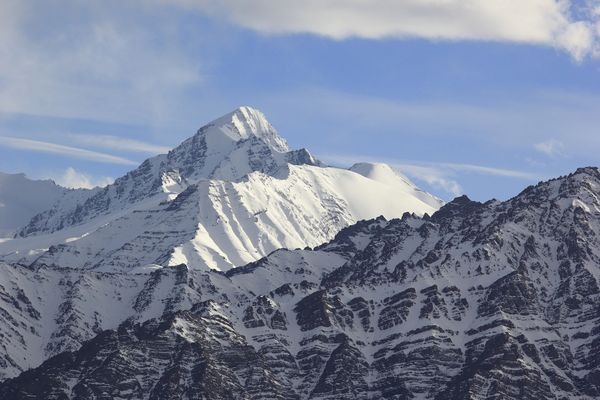
At the summit, a small Indian military outpost stands beside a Buddhist temple adorned with multicolored prayer flags. The flags flutter constantly in the wind, creating an atmosphere both austere and spiritual. On clear days, the panorama extends across the snow-capped ridges of the Karakoram and the arid valleys of Ladakh.
History and Context
Khardung La has been used for centuries as a caravan route linking Leh to the Nubra and Turkestan regions. The current motorable road was constructed by the Border Roads Organisation (BRO) of the Indian Army, primarily for strategic and logistical reasons. The pass remains under military administration; traffic is regulated.
Highlights of Your Visit
The Karakoram Panorama
On clear days, the Karakoram peaks stand out sharply on the horizon. Early morning light offers the best visibility before clouds accumulate by midday.
Prayer Flags and the Temple
Hundreds of Tibetan prayer flags encircle the summit. The small Buddhist temple allows for a brief meditative pause, provided you respect the silence and devotion of passing pilgrims.
Cycling the Pass
Khardung La is a legendary milestone for cyclists from around the world. The ascent from Leh represents an extreme physical challenge due to altitude and gradient. Many cyclists have their notebooks stamped at the summit as proof of their achievement.
Photography Tips
Light is optimal early in the morning, before clouds roll in. Photograph the prayer flags against Ladakh's intense blue sky. Avoid pointing your camera at military installations — it is strictly forbidden and can result in equipment confiscation. Bring a spare battery: the cold rapidly drains devices.
Location and Access
Khardung La lies approximately 40 km north of Leh, Ladakh's capital. The road departs from central Leh and climbs in tight switchbacks through the village of Khardung. Most visitors reach it by shared taxi or motorcycle from Leh. The journey takes approximately 1.5 to 2 hours depending on road conditions and military traffic. No regular public transport serves the pass.
The Inner Line Permit (ILP) is issued in Leh by the competent authorities, typically the same day or the day before.
Nearby Attractions
- Nubra Valley — accessible beyond the pass, this desert valley is home to sand dunes, Bactrian camels, and perched monasteries.
- Leh — the essential starting point, featuring its royal palace, bazaar, and numerous nearby monasteries.
- Diskit Monastery — the largest monastery in Nubra Valley, dominated by a giant statue of Maitreya.
- Thiksey Monastery — on the return route to Leh, one of Ladakh's most impressive monastic complexes.
Frequently asked questions
The pass is accessible from May to November. June to September offer the best weather conditions. Outside this window, snow and ice make the road dangerous or impassable.
Yes. An Inner Line Permit (ILP) is mandatory for all visitors, both foreign nationals and Indian citizens not residing in Ladakh. It can be obtained in Leh from local authorities, often the same day.
Yes, at over 5,000 m, acute mountain sickness can affect anyone. It is advisable to spend at least two nights in Leh to acclimatize before ascending to the pass. Climb slowly, stay hydrated, and descend immediately if you experience severe symptoms.
Photography is permitted for landscapes, prayer flags, and the temple. However, it is strictly forbidden to photograph military installations and personnel.
Between 30 and 60 minutes is sufficient. Spending longer at this altitude without prior acclimatization increases the risk of altitude sickness. Most visitors stop for photos and depart quickly.
Yes, it's actually the classic itinerary. Most travelers cross Khardung La to reach Nubra Valley, where they spend one or two nights before returning to Leh via the same pass.
Photos
Want to discover this destination?
Our local advisors design your tailor-made trip.