Sri Bihariji Temple (Mandawa)
Dedicated to Krishna in the heart of Mandawa, the Sri Bihariji Temple blends Vaishnava spirituality with frescoes typical of Shekhawati. An authentic stop between painted havelis.
In the heart of Mandawa, a small caravan town in Shekhawati, the Sri Bihariji Temple is dedicated to Bihari—a local form of Krishna. Framed by the painted havelis that give the region its reputation, it serves as a spiritual anchor for locals and a natural stop for travelers exploring this district of exceptional frescoes.
Practical Information at a Glance
- Admission: free for visitors (donations welcome)
- Dress code: covered clothing required, shoulders and knees covered
- Footwear: shoes to be removed before entering the sanctuary
- Recommended duration: 20 to 30 minutes
What to See
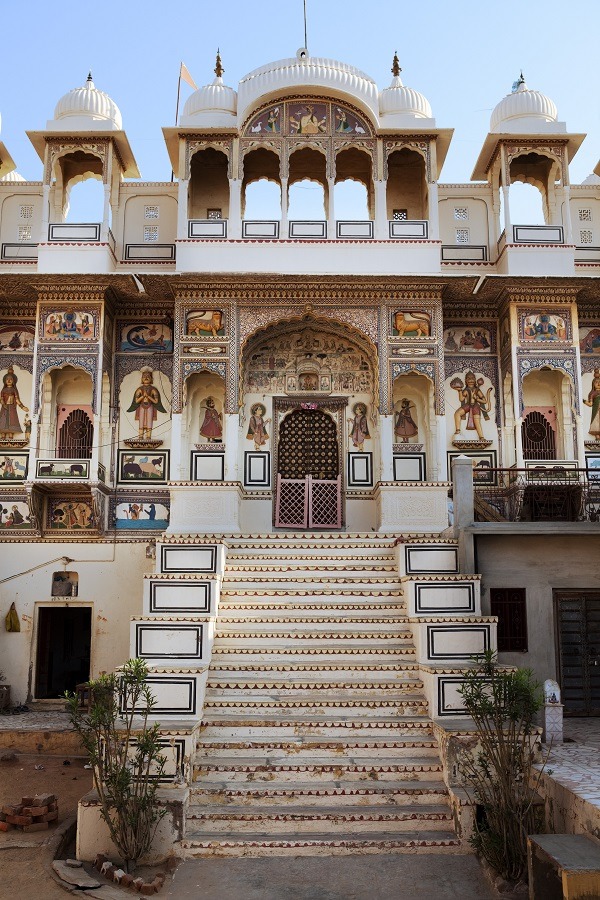
The temple displays typical architecture of Vaishnavite places of worship in Rajasthan: an ornate façade, an open central courtyard, and a central sanctuary housing a statue of Bihari (Krishna). The walls bear painted motifs in the Shekhawati tradition, visually extending the aesthetic of the neighboring havelis. The atmosphere is that of a vibrant neighborhood temple, marked by daily aarti ceremonies.
History and Context
Mandawa developed in the 18th century as a major trading hub on the caravan route connecting Central Asia to India. Families of marwari merchants financed temples and havelis, covering their walls with narrative frescoes blending Hindu mythology, court scenes, and European motifs. The Sri Bihariji Temple is part of this tradition of local religious patronage.
Highlights of Your Visit
The Morning Aarti
The morning offering ceremony brings together locals from the neighborhood. Bells, incense, and chanting create a contemplative atmosphere, quite different from the tourist bustle of the surrounding havelis.
The Exterior Frescoes
Observe the façade and courtyard walls: the paintings depict episodes from Krishna's life, characteristic of the Shekhawati style with their mineral colors and crisp outlines.
Etiquette and Visiting Rules
- Remove your shoes at the entrance to the sanctuary.
- Dress in a covered manner (shoulders, knees).
- Speak in low tones, especially during ceremonies.
- Ask permission before photographing devotees or the priest.
Photography Tips
Morning light is ideal for photographing the painted façade without harsh shadows. Frame from the street to include the urban context of Mandawa. Inside, check with the priest whether photography is permitted in the sanctuary.
Location and Access
The temple is located in central Mandawa, in immediate proximity to the fort and the main havelis. Mandawa is accessible from Jhunjhunu (approximately 30 km) or from Jaipur (approximately 180 km) by road. Regular buses and taxis connect the town to major centers in Rajasthan. Central Mandawa is easily explored on foot.
Nearby Attractions
- Mandawa Fort — an 18th-century fortress converted into a hotel, visible from almost everywhere in town.
- Haveli Gulab Rai Ladia — one of Mandawa's best-preserved havelis, with frescoes of exceptional finesse.
- Haveli Murmuria — frescoes blending mythological scenes and colonial motifs, a stone's throw from the center.
- Fatehpur Shekhawati — a neighboring Shekhawati town renowned for the density and quality of its painted havelis.
Frequently asked questions
Admission is free. Donations (flowers, fruits, a few rupees) are welcome but never required.
Shoulders and knees covered for both men and women. A shawl or sarong tucked in your daypack is sufficient if you're visiting multiple sites during the day.
The façade and outer courtyard can be photographed freely. For the interior of the sanctuary, ask the priest's permission.
October to March offers manageable temperatures and favorable light for photographing frescoes. Avoid summer months (April–June) when temperatures regularly exceed 40°C (104°F).
Yes, the temple is in the heart of the historic center. Half a day is enough to visit the temple, the main havelis, and the fort on foot.
Interested in this visit?
We can include it in your personalised itinerary.