Konark Sun Temple
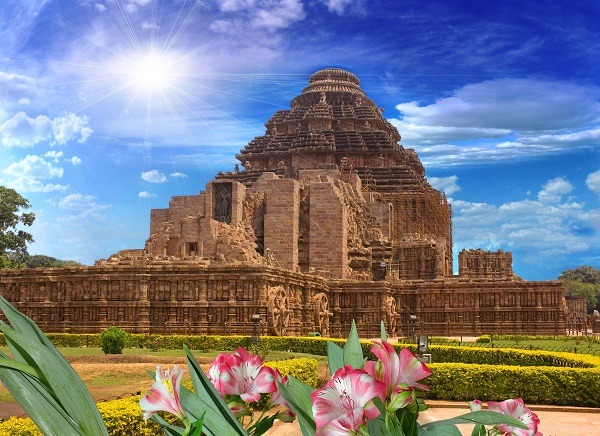
Built in the 13th century in the form of a solar chariot, the Konark Sun Temple is a major monument of medieval India, inscribed on the UNESCO World Heritage List, adorned with exceptional sculptures.
The Konark Sun Temple stands on the coast of the Bay of Bengal, in the state of Odisha. Constructed in the 13th century, it takes the form of a colossal chariot drawn by seven horses, dedicated to the sun god Surya. Inscribed on the UNESCO World Heritage List, it represents the pinnacle of Kalinga architecture and remains one of the most remarkable monuments of medieval India.
Practical Information at a Glance
- Admission: Paid; different rates for Indian visitors and foreign nationals (Archaeological Survey of India)
- Closure days: Open daily, sunrise to sunset
- Recommended duration: 2 to 3 hours to explore the site in detail
- Dress code: No strict requirement, but modest clothing is recommended
- Access: Buses and taxis from Puri (approximately 35 km) and Bhubaneswar (approximately 65 km)
- Accessibility for visitors with reduced mobility: Terrain partially accessible; some areas have uneven paving
What to See
The temple comprises two main structures: the Jagamohana (assembly hall), still standing, and the Deul (sanctum tower), collapsed for centuries. Twenty-four carved wheels, symbolizing the hours of the day, adorn the base. Three statues of Surya in green chlorite mark the eastern, northern, and southern facades.
Friezes cover the entire monument: court scenes, elephant processions, erotic motifs comparable to those at Khajuraho, and depictions of medieval daily life. The precision of the carvings in Khondalite sandstone commands the admiration of specialists and visitors alike.
History and Context
The temple was erected around 1250 under the reign of King Narasimhadeva I of the Eastern Ganga dynasty. Its construction mobilized thousands of artisans over several decades. The main tower likely collapsed between the 16th and 17th centuries—the exact causes remain debated: earthquakes, lightning, or foundation instability.
Portuguese navigators called it the "Black Pagoda," as it served as a maritime landmark. The Jagamohana was consolidated and filled with sand by the British in the 19th century to prevent its collapse—an intervention that preserved the structure but rendered the interior inaccessible.
Highlights of Your Visit
The Solar Wheels
The twenty-four carved wheels, each approximately three meters in diameter, function as sundials. The spokes and intermediate rays allow the time to be read with precision according to the shadow cast. It is the most photographed element of the site.
The Three Statues of Surya
Each statue represents Surya at a different time of day—morning, noon, evening—oriented to capture the corresponding light. The eastern statue, the best preserved, wears boots and ornaments characteristic of late Kalinga style.
The Konark Archaeological Museum
Located at the entrance to the site, this museum managed by the ASI houses sculptures recovered during excavations: fragments from the collapsed tower, green chlorite pieces, architectural elements. A preliminary visit helps you understand the original scale of the monument.
The Konark Dance Festival
Each year in December, the Konark Dance Festival takes place outdoors in front of the temple. Classical dancers performing Odissi, Bharatanatyam, and other styles perform with the monument as a backdrop—an experience that anchors the place in living culture.
Photography Tips
Early morning light (shortly after opening) is ideal for the eastern facades and solar wheels, which receive raking light. In late afternoon, the western facade takes on golden hues. Avoid midday: harsh light flattens the sculpted reliefs.
Drones are prohibited without prior authorization from the ASI. Photography is permitted within the outer grounds; check restrictions at the entrance for interior areas.
Location and Access
Konark is located on the coast of Odisha, approximately 35 km northeast of Puri and approximately 65 km southeast of Bhubaneswar. Regular buses connect Puri to Konark; taxis and auto-rickshaws are available from both cities. The road partly runs along the coast and passes through casuarina forest.
The nearest airport is Bhubaneswar (Biju Patnaik International Airport). Guided tours combining Puri, Konark, and Bhubaneswar are offered by local agencies—the "Golden Triangle of Odisha."
Nearby Attractions
- Jagannath Temple, Puri — one of the four sacred dhams of Hinduism, accessible to Hindus only.
- Puri Beach — lively beach on the Bay of Bengal, renowned for its sand sculptures.
- Temples of Bhubaneswar — the "city of temples" concentrates hundreds of Kalinga sanctuaries, including the Lingaraj.
- Chilika Lake — Asia's largest coastal lagoon, home to Irrawaddy dolphins and flamingos in winter.
Frequently asked questions
The dry season, from October to March, offers the best conditions: pleasant temperatures and clear skies. December coincides with the Konark Dance Festival. Avoid the monsoon (June-September): humid heat and frequent rains.
The Jagamohana (assembly hall) was filled with sand in the 19th century to stabilize it: the interior is not accessible. The visit is entirely outdoors, around and on the base of the monument.
The Konark Sun Temple is an archaeological site, not an active place of worship. No specific clothing is required, but modest and covered attire is recommended out of respect for the place.
Allow 2 to 3 hours to explore the main monument, the archaeological museum, and surrounding gardens. Half a day is sufficient if coming from Puri; a full day allows you to combine the visit with Konark Beach.
Yes, this is the most common itinerary. Leave Puri early for Konark (approximately 45 minutes by taxi), visit the temple in the morning, then return to Puri in the afternoon for the Jagannath Temple and beach.
No, without prior authorization from the Archaeological Survey of India. Ground-level photography is permitted within the outer grounds. Check at the entrance for any restrictions in certain areas.
Interested in this visit?
We can include it in your personalised itinerary.