Simhachalam Temple
Simhachalam Temple
Perched on a hilltop north of Visakhapatnam, Simhachalam Temple is dedicated to Varaha Lakshmi Narasimha. Its medieval Kalinga architecture, sandalwood-draped deity, and annual festival make it one of Andhra Pradesh's most significant pilgrimage destinations.
Perched on Simhachalam hill, roughly fifteen kilometers north of Visakhapatnam, this Hindu temple is dedicated to Varaha Lakshmi Narasimha — a composite form of Vishnu, part man and part lion. Built in the Kalinga style, it draws pilgrims from across Andhra Pradesh and ranks among the most revered Vaishnava worship sites in southeastern India.
Practical information at a glance
- Access: local buses from Visakhapatnam (Simhachalam stop); taxis and auto-rickshaws available from the city center.
- Dress code: traditional attire required — dhoti for men, sari or salwar kameez for women.
- Footwear: must be removed before entering the sacred grounds.
- Recommended duration: 1 to 2 hours for a complete visit.
- Cameras: restrictions inside the main sanctuary — inquire on-site.
What to see
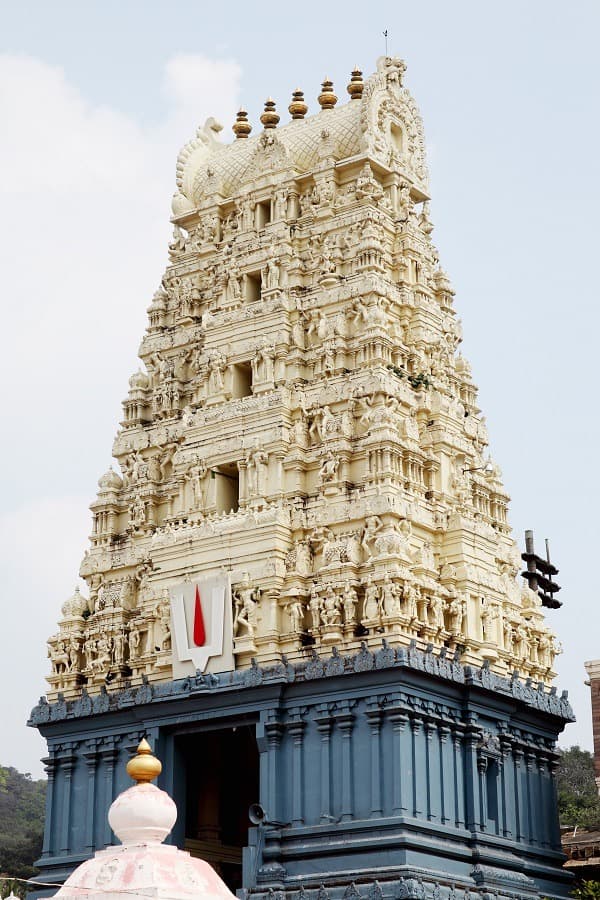
The temple showcases characteristic Kalinga architecture: a finely carved shikhara (pyramidal tower), mandapas (columned halls) adorned with mythological friezes, and an imposing entrance gopuram. The main deity, Varaha Lakshmi Narasimha, is covered in sandalwood paste (chandana) nearly year-round — revealed in its true sculptured form only once annually during the Chandanotsavam festival.
History and context
Temple inscriptions date back to the 11th century, during the Eastern Ganga dynasty. Successive rulers — Chalukyas, Gajapatis, and later Vijayanagara kings — contributed to its expansion and embellishment. The site is referenced in several Puranic texts as one of 32 sacred places of Vishnu across India.
Highlights of your visit
The sandalwood-draped deity
The tradition of chandana lepa — coating the statue in sandalwood paste to "cool" it — is unique to this temple. The thick layer gives the deity a smooth, almost abstract silhouette, contrasting sharply with the intricate carvings throughout the rest of the sanctuary.
The Chandanotsavam festival
Each year during Akshaya Tritiya (April-May), the sandalwood paste is removed and the deity appears in its original sculpted form for a few hours. Thousands of pilgrims converge for this exceptional event.
Kalinga sculptures
Columns and exterior walls are covered in bas-reliefs depicting scenes from the Ramayana, Mahabharata, and Puranas. The meticulous detail — dancers' postures, facial expressions — speaks to the craftsmanship of medieval artisans.
Etiquette and visiting rules
- Traditional dress is strictly required; rental counters for dhotis and saris are usually available at the entrance.
- Remove your shoes before crossing into the main sacred area.
- Avoid leather items (belts, bags) in the inner sanctuary.
- Maintain silence in the garbhagriha (inner sanctum).
- Photography is prohibited or severely restricted inside — respect all signage.
Photography tips
Morning light is ideal for photographing the gopuram and exterior sculptures, before crowds build. The mandapa friezes work well for close-ups in diffused light. Photography is generally off-limits inside the sanctuary — do not attempt to circumvent this rule.
Location and access
The temple sits on Simhachalam hill in northern Visakhapatnam's outskirts. Regular local buses connect the city center to the foot of the hill. Steps lead upward to the temple, or a road provides vehicle access to the main entrance. Wheelchair accessibility is limited due to sloped terrain and staircases.
Nearby attractions
- Rushikonda Beach — one of Visakhapatnam's most popular beaches, a few kilometers south.
- Indira Gandhi Zoo — large zoological park in the city, beloved by families.
- INS Kursura Submarine Museum — decommissioned submarine converted into a museum on Ramakrishna Beach.
- Kailasagiri — elevated park offering panoramic views over Visakhapatnam Bay.
Photos
Interested in this visit?
We can include it in your personalised itinerary.