Leh Palace
Perched on a rocky spur above Leh's old bazaar, the royal palace of Ladakh rises nine stories high. Buddhist frescoes, the royal chapel, and sweeping views of the Indus Valley make it an essential stop in Ladakh.
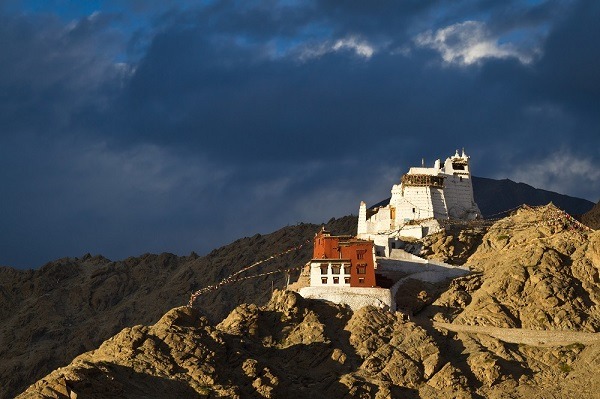
Perched on a rocky spur dominating the old city of Leh, the royal palace of Ladakh rises nine stories of stone and timber masonry. Built in the 17th century by the Namgyal dynasty, its silhouette echoes the Potala in Lhasa. Today partially in ruins, it remains Leh's emblematic monument and offers breathtaking views across the Indus Valley and the snow-capped peaks of the Karakoram.
Quick Facts
- Entrance: Paid admission (site managed by the Archaeological Survey of India)
- Suggested duration: 1 to 1.5 hours
- Dress code: Respectful attire recommended; some rooms are active places of worship
- Access: On foot from Leh's main bazaar, steep paved path about 15–20 minutes
- Accessibility: Very limited due to steep inclines and interior stairs
What to See
The structure comprises nine levels, with the upper stories best preserved. Interior rooms reveal Buddhist frescoes, statues, and ancient thangkas. A royal chapel still houses ritual objects. From the summit terraces, views sweep across Leh's white-washed roofs, the Indus Valley, and—on clear days—the glaciers of Stok Kangri.
History and Context
The palace was erected in the early 17th century under King Sengge Namgyal of Ladakh. Designed as a royal residence and administrative center, it was abandoned in the 19th century following Ladakh's invasion by the Kashmiri Dogra. The Archaeological Survey of India has conducted consolidation work for decades to arrest the degradation of the walls.
Highlights of Your Visit
The Royal Chapel
At the palace's heart, this prayer room preserves murals and Buddhist statues from the Namgyal era. The atmosphere is contemplative; monks sometimes tend the butter lamps.
The Panoramic Terraces
The rooftop terraces of the upper stories offer the finest vantage over Leh. You can make out Tsemo Fort above, the bazaar below, and distant snow-crested ridges of the Zanskar and Karakoram ranges.
Frescoes and Thangkas
Several rooms preserve murals in natural pigments depicting Tibetan deities. Though some are partially faded, their artistic quality remains remarkable for a structure of this age.
Etiquette and Visiting Rules
- Remove your shoes before entering the royal chapel.
- Do not touch frescoes or statues.
- Speak softly in worship spaces.
- Ask permission before photographing monks or ceremonies.
Photography Tips
Morning light (early after opening) is ideal: it illuminates the western facade and avoids backlighting. Late afternoon casts a golden glow on the ochre walls, especially striking from the bazaar below. Indoors, light is dim; a tripod or high ISO sensitivity helps capture the frescoes. Photography is generally permitted in common areas, but verify restrictions in the chapel.
Location and Access
The palace stands directly above Leh's old bazaar in the city's historic heart. Access is on foot via a paved path from the main bazaar district. The climb takes roughly 15 to 20 minutes and is steep; wear sturdy shoes. The Tsemo Fort and Namgyal Tsemo Temple sit on the same ridge, accessible by continuing upward.
Nearby Attractions
- Tsemo Fort — Medieval fortress overlooking the palace, reached in about 20 minutes' walk from the palace.
- Namgyal Tsemo Temple — 15th-century Buddhist temple housing an imposing Maitreya statue, just beside the fort.
- Jama Masjid of Leh — Grand 17th-century Mughal mosque, visible from the palace terraces, in the bazaar.
- Shey Monastery — Former summer palace of the Namgyal kings with a gilt copper Buddha statue, about 15 kilometers southeast of Leh.
- Thiksey Monastery — Large terraced monastic complex echoing the Potala, roughly 20 km from Leh.
Frequently asked questions
The ideal season runs from May to September, when Ladakh's roads are open and skies clear. July and August attract the most visitors. Outside this window, intense cold and snow-covered roads make access difficult.
Allow 1 to 1.5 hours to explore the accessible rooms, chapel, and panoramic terraces. Add 30 to 40 minutes if you continue to Tsemo Fort on the same ridge.
Respectful attire is recommended. In the royal chapel, remove your shoes. Avoid very short shorts or overly light clothing out of respect for the active worship spaces.
Yes. Tsemo Fort and Namgyal Tsemo Temple are accessible on foot from the palace by continuing upward. Jama Masjid sits in the bazaar below. A half-day covers all three sites.
It is generally permitted in common areas and on terraces. In the royal chapel, check restrictions on-site; certain zones or ritual objects may be off-limits for photography.
The climb from the bazaar is steep and paved, taking about 15 to 20 minutes. At Leh's altitude of roughly 3,500 meters, the effort may be felt more acutely. Wear good shoes and ascend slowly if arriving from lower elevations.
Interested in this visit?
We can include it in your personalised itinerary.