Nathmal Ji Ki Haveli
Nathmal Ji Ki Haveli
Once the residence of the Prime Minister of the Maharaja of Jaisalmer, Nathmal Ji Ki Haveli blends Rajasthani and Islamic architecture and houses original murals.
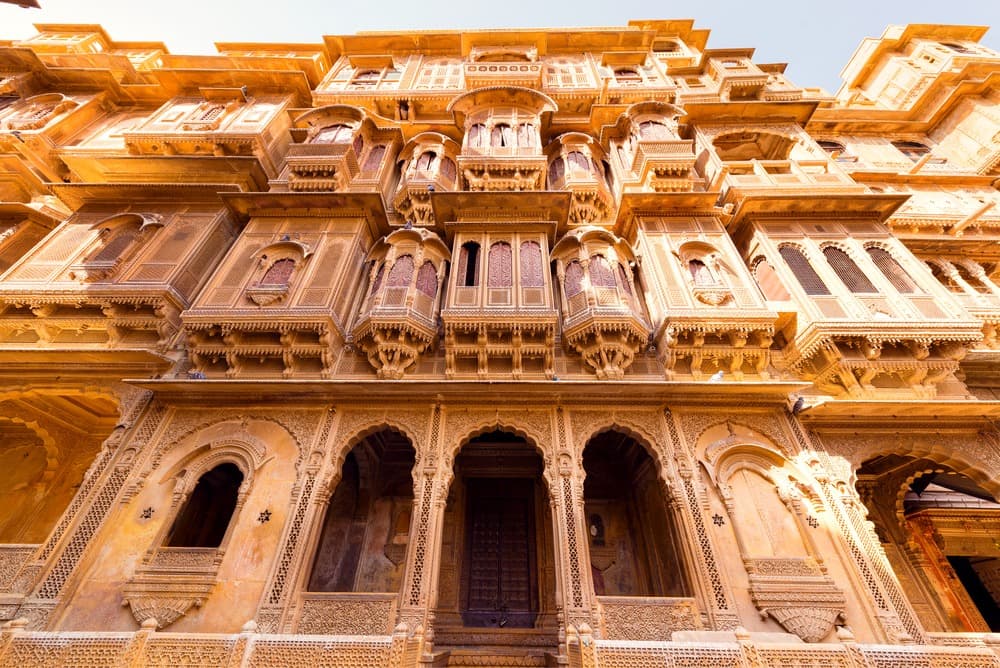
Nathmal Ji Ki Haveli is a historic mansion located in the heart of Jaisalmer, in Rajasthan. Built in the late 19th century as a residence for the Prime Minister of the maharaja, it stands out for the fusion of Rajasthani and Islamic architectural traditions, and for the murals that adorn its interior rooms.
Why visit Nathmal Ji Ki Haveli
This haveli — a term designating a grand traditional mansion in northern India — offers several points of interest for the traveler passing through Jaisalmer:
- A finely carved yellow sandstone façade, framed by two life-size elephant statues that mark the main entrance.
- An architectural blend characteristic of 19th-century Rajasthan, where Hindu and Islamic influences coexist within the same building.
- Original interior paintings, some depicting modern objects of the time (cars, fans) and revealing the artisans' view of the world of their era.
- A living dimension: part of the haveli is still inhabited by descendants of the family, making it a place of continuity rather than a frozen museum.
History of the haveli
Nathmal Ji Ki Haveli was built toward the end of the 19th century by two brothers, Hathu and Lulu, who divided the work between the two wings of the building. According to local tradition, each worked on his side without close consultation with the other, which explains the slight asymmetries still visible today between the two halves of the façade.
The edifice served as a residence for Diwan Nathmal Ji Mohta, Prime Minister of the Maharaja of Jaisalmer, whose name it bears. Today, the haveli is partly inhabited by descendants of the family, which limits access to certain rooms but maintains the place in a form of continuous use since its construction.
What to see
The façade and guardian elephants
Two life-size yellow sandstone elephant statues frame the main entrance. The façade itself is worked like stone lacework, with projecting balconies (jharokhas), finely pierced openings and carved friezes that recall the mastery of Rajasthani stonemasons.
The interior paintings
Inside, walls and pillars are decorated with paintings depicting horses, cattle, floral motifs and scenes of daily life. Some compositions, attributed to the two builder brothers, incorporate objects that did not belong to local culture at the time of construction: automobiles, fans, locomotives. These representations testify to the artisans' curiosity about the technical innovations of the 19th century.
The blending of styles
The haveli combines Rajasthani elements (overhanging jharokhas, sandstone carving) and Islamic ones (horseshoe arches, geometric motifs). This synthesis was common in princely Rajasthan, where Hindu patrons regularly commissioned artisans trained in Islamic traditions.
Practical information
Nathmal Ji Ki Haveli is open for visits daily during daylight hours. Exact opening hours vary by season and occupancy by the resident family; inquire on site or with your guide. Admission is generally free or at a modest rate, sometimes accompanied by a tip for the caretaker who opens the accessible rooms.
Allow 30 minutes to 1 hour for a visit, longer if you take time to examine the interior paintings in detail. Late afternoon light particularly enhances the golden tone of the sandstone.
When to visit
The best time to visit Jaisalmer and its haveli extends from October to March. During these months, desert temperatures remain manageable during the day (20-30 °C) and cool at night. From April to June, temperatures regularly exceed 40 °C and make visits challenging; the monsoon from July to September is more moderate in Jaisalmer than elsewhere in India, but remains a less comfortable period.
February hosts the Desert Festival, which provides a good opportunity to combine cultural visits with traditional events.
How to get there
The haveli is located in the old town, near Jaisalmer Fort. From the center, it is easily accessible on foot or by rickshaw.
- By train: Jaisalmer railway station is about 2 km from the center and connected to Delhi, Jaipur, Jodhpur and Bikaner by regular trains, including several overnight services.
- By air: Jodhpur airport, about 285 km away, is the nearest airport served by domestic flights (Delhi, Mumbai, Udaipur). A smaller airport exists in Jaisalmer itself, with seasonal connections.
- By road: Jaisalmer is connected to Jodhpur (5-6 hours), Bikaner and Jaipur by a good road network. Public buses, private coaches and long-distance taxis provide connections.
Nearby
Jaisalmer has several remarkable havelis that are worth combining during a single day of visiting:
- Patwon Ki Haveli, a complex of five adjoining mansions built by a merchant family, considered one of the largest haveli complexes in Rajasthan.
- Salim Singh Ki Haveli, recognizable by its peacock-shaped roof and 38 carved balconies.
- Jaisalmer Fort (Sonar Quila), a still-inhabited fortress that dominates the town.
To plan your stay in the region more broadly, consult the complete guide to Jaisalmer.
Frequently asked questions
Frequently asked questions
Plan your trip
Nathmal Ji Ki Haveli fits naturally into a Rajasthan circuit combining Jaisalmer, Jodhpur, Udaipur and Jaipur. To build a custom itinerary including the havelis, the Thar Desert and other princely cities, consult our travel suggestions for India.
Interested in this visit?
We can include it in your personalised itinerary.