Nalanda
Nalanda
Nalanda is home to the ruins of one of antiquity's greatest Buddhist universities, inscribed on UNESCO's World Heritage List. Red-brick temples, stupas and monastic cells bear witness to an intellectual center of radiance spanning seven centuries.
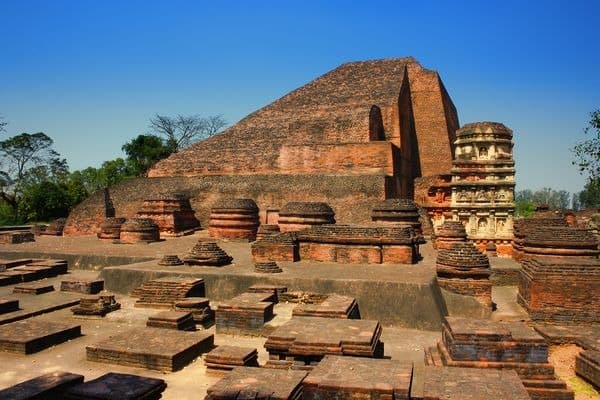
Nalanda, in the state of Bihar, is home to the ruins of one of antiquity's greatest Buddhist monastic universities. Founded in the 5th century, it attracted thousands of students from Central Asia, China and Southeast Asia. Inscribed on UNESCO's World Heritage List in 2016, the site reveals today temples, stupas and red-brick monastic cells—witnesses to an intellectual center that radiated for nearly seven centuries.
Practical Information at a Glance
- Entrance: paid admission (differential rates for Indian residents and foreigners); combined ticket available with adjacent museum
- Recommended duration: 2 to 3 hours for the archaeological site + museum
- Access: the nearest city with rail station is Rajgir (approximately 15 km away); Patna, capital of Bihar, is approximately 90 km away
- Dress code: no strict obligation, but neat attire is recommended
- Accessibility: terrain is partly uneven; some pathways are passable, but the ruins themselves remain difficult to access by wheelchair
What You'll See
The archaeological site spans several hectares. You'll find rows of monastic cells (viharas), multi-level temples, votive stupas and interior courtyards. The characteristic red brick of Bihar gives the ensemble a striking visual coherence. The Nalanda Archaeological Museum, just at the entrance, houses stone and bronze sculptures, seals and everyday objects unearthed during excavations.
History and Context
Nalanda was founded under the Gupta dynasty, probably in the 5th century CE. At its height, it accommodated several thousand monk-students and a monumental library. The Chinese pilgrim Xuanzang stayed there in the 7th century and left a detailed account. The university was destroyed during invasions in the late 12th century. Systematic excavations began under the Archaeological Survey of India in the 19th century.
Highlights of Your Visit
The Great Vihara No. 1
The site's largest monastery, with its cells arranged around a central courtyard, gives the best sense of communal life organization. The niches that once sheltered statues remain visible in the walls.
The Main Temple (Sariputta Stupa)
This multi-tiered structure, successively enlarged over the centuries, illustrates the "Russian doll" construction practice typical of Buddhist architecture in the region. The different phases of construction are clearly distinguishable.
The Archaeological Museum
Small but dense, it showcases major pieces: Buddhist bronzes, stone images of Buddha and bodhisattvas, and seals bearing the institution's name. Essential before or after your site visit.
Photography Tips
Morning light (early after opening) is ideal: the raking sun on red brick brings out the relief of the walls. At midday, harsh light flattens volumes. Bring a wide-angle lens to capture the extent of the monastic courtyards. Photography is allowed on the site; check restrictions inside the museum.
Location and Access
Nalanda is located in the district of the same name, in Bihar. The town of Rajgir, approximately 15 km away, is the most convenient logistical base: it has rail and road stations and several accommodations. From Patna (approximately 90 km), buses and taxis serve the site. Nalanda fits naturally into a Bihar circuit combining Rajgir, Bodh Gaya and Patna.
Nearby Attractions
- Rajgir — ancient capital of the kingdom of Magadha, site of sacred Buddhist and Jain hills, approximately 15 km away.
- Bodh Gaya — site of Buddha's Enlightenment under the Bodhi tree, approximately 100 km away; central stop for any Buddhist circuit in Bihar.
- Patna — capital of Bihar, with the Patna Museum housing remarkable Maurya and Gupta collections.
- Vaishali — major Buddhist and Jain site, associated with Buddha's final days, accessible from Patna.
Frequently asked questions
The dry season, from October to March, offers pleasant temperatures. Avoid the monsoon (July-September): the terrain becomes muddy and certain areas of the site may be partially flooded.
No strict religious requirement, but neat attire is appropriate. Wear comfortable shoes: the ground is uneven and distances are substantial.
Yes, the two sites are approximately 15 km apart. Starting early, plan your morning for Nalanda (site + museum) and afternoon for Rajgir. A private vehicle greatly facilitates logistics.
Photography is generally permitted on the archaeological site. Inside the museum, restrictions may apply; ask at the entrance.
Allow 2 to 3 hours to explore the archaeological site and museum at a leisurely pace. A local guide enhances your understanding of the ruins and helps identify different construction phases.
Yes, Bodh Gaya is approximately 100 km away. The route passes through Gaya and Rajgir. Most travelers cover this distance by private vehicle as part of a Bihar circuit.
Photos
Want to discover this destination?
Our local advisors design your tailor-made trip.