Mysore Palace
Mysore Palace
Residence of the Wadiyar maharajas, Mysore Palace blends Indo-Saracenic architecture, gilded state rooms, and spectacular illuminations each Sunday evening. An unmissable monument in Karnataka.
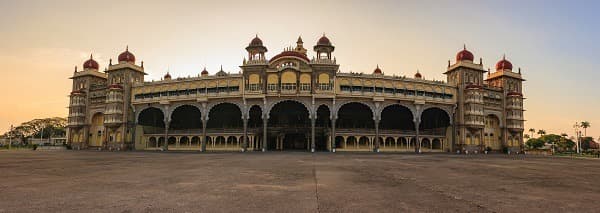
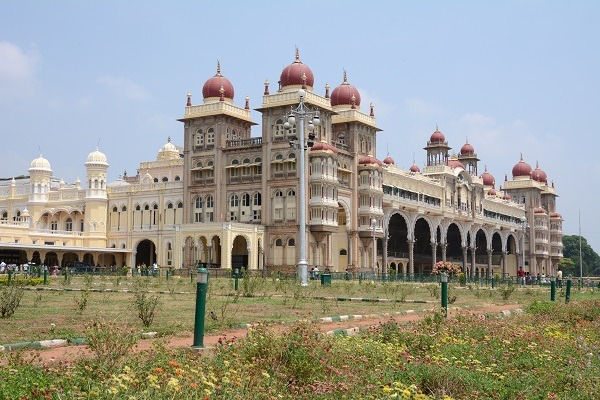
Mysore Palace — officially Amba Vilas Palace — has dominated the heart of Mysuru since the early twentieth century. Official residence of the maharajas of the Wadiyar dynasty, it blends Indo-Saracenic architecture, neogothic details, and Rajput touches across a grey granite façade crowned with pink marble domes. Each Sunday evening and during the Dasara festival, thousands of lights illuminate the building, transforming the night into a rare architectural spectacle.
Practical Information at a Glance
- Admission: Paid entry (separate rates for Indian and foreign visitors); separate ticket for costume and armour exhibition
- Suggested Duration: 1.5 to 2 hours for the interior; allow more time during Sunday evening illuminations
- Dress Code: Formal attire required; shoulders and knees must be covered
- Footwear: Must be removed before entering interior rooms
- Photography: Photography is prohibited inside the palace; permitted in gardens
- Accessibility: Partial wheelchair access; some rooms remain difficult to access by wheelchair
What You'll See
The interior displays a succession of state rooms: the Durbar Hall (throne room) with its gold-adorned cast iron columns, the Kalyana Mantapa (royal wedding hall) and its multicoloured stained glass, and the painting gallery illustrating the Dasara processions. The solid gold throne, displayed during the festival, is one of the most photographed pieces in South India.
History and Context
A wooden palace has occupied this site since the fourteenth century. Following a fire in 1897, Maharaja Krishnaraja Wadiyar IV commissioned a new building from British architect Henry Irwin. Completed in 1912, the current building is the fourth palace constructed on this land. The Wadiyar family still resides in a private wing; the rest has been open to the public since 1940.
Highlights of Your Visit
The Durbar Hall
The ceremonial heart of the palace, this columned hall houses the gold and ivory throne of the Wadiyars. The hand-painted ceilings and Bohemian glass chandeliers bear witness to the splendour of the court in the early twentieth century.
The Kalyana Mantapa
The royal wedding hall impresses with its stained glass windows imported from Scotland and its ceramic tile flooring. The filtered light creates a particularly striking atmosphere at mid-morning.
Sunday Evening Illuminations
Each Sunday between 7 p.m. and approximately 7:45 p.m., nearly 100,000 lights illuminate simultaneously across the façade. The effect is spectacular from the esplanade facing the palace. During Dasara (October), illumination occurs daily.
The Gardens and Esplanade
The gardens surrounding the palace offer an unobstructed view of the façades and domes. Here takes place the elephant procession of the Dasara festival, one of Karnataka's most important cultural events.
Etiquette and Visiting Rules
- Remove your shoes before entering interior rooms; shoe storage is available at the entrance.
- Photography is strictly prohibited inside; security staff monitor compliance with this rule.
- Dress modestly: shoulders and knees must be covered for both men and women.
- Avoid loud group visits in the state rooms; the site remains a partially inhabited royal residence.
Photography Tips
The façade is best photographed early morning, before the crowds arrive, with raking light that brings out sculptural details. On Sunday evenings, position yourself on the esplanade facing the main entrance to capture the full illumination. A tripod is useful for night shots. The side gardens offer less-crowded angles on the pink marble domes.
Location and Access
The palace is located in central Mysuru, a short walk from Devaraja Market. Mysuru Railway Station is approximately 1.5 km away. Auto-rickshaws and taxis serve the site from throughout the city. English-speaking guided tours are available through local partner agencies of Nomadays. The esplanade is wheelchair accessible; the palace interior is partially accessible.
Nearby Attractions
- Devaraja Market — bustling covered market a short walk away, ideal for spices, flowers and silks.
- Chamundi Hill — pilgrimage site overlooking Mysuru, featuring the Chamundeshwari temple and the statue of the demon Mahishasura.
- Mysore Zoo — one of India's oldest zoos, adjacent to the palace, renowned for its conservation programmes.
- Jaganmohan Palace — former royal ballroom converted into an art gallery, a few hundred metres away.
Frequently asked questions
No. Photography is prohibited in all interior rooms. It is permitted in the gardens and on the exterior esplanade.
October to March offers pleasant conditions during the dry season. The Dasara festival (October) is the most festive time, with daily illuminations and an elephant procession, though visitor numbers are highest.
Yes, shoes must be removed before accessing interior rooms. Storage facilities are available at the main entrance.
Yes, illuminations take place each Sunday evening, as well as on national holidays and throughout the Dasara festival in October.
Yes. Chamundi Hill is located a few kilometres south of the palace. An auto-rickshaw or taxi allows you to combine both sites in one day with ease.
Allow 1.5 to 2 hours to tour the main rooms and gardens. If you wish to see the evening illuminations, plan to return at the end of the day.
Photos
Interested in this visit?
We can include it in your personalised itinerary.