Spituk Monastery
Eight kilometres from Leh, Spituk Monastery commands the Indus Valley from a rocky hillside. Ritual masks, a Kali chapel, and the Gustor festival in January make it a dense, living Buddhist site.
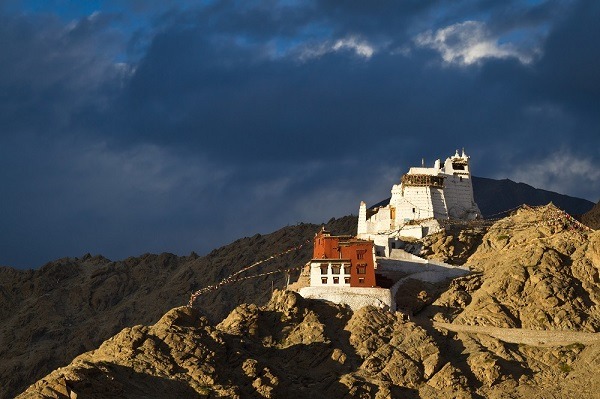
Perched on a rocky hilltop a few kilometres west of Leh, Spituk Monastery overlooks the Indus Valley and the airport plains. Founded in the 11th century, this Gelugpa gompa is home to an active community of Tibetan Buddhist monks. Its terraced architecture, collections of ritual masks, and Kali statue make it a richly layered site, far removed from the bustle of the town centre.
Practical information at a glance
- Entrance: paid (modest entry fee; rates to be confirmed on site)
- Access: paved road from Leh, approximately 8 km west on NH1
- Transport: taxi from Leh or bicycle; no regular direct bus service
- Recommended duration: 1 to 2 hours
- Dress code: shoulders and knees must be covered; shoes removed before entering prayer halls
- Accessibility for people with reduced mobility: limited — steep stairs to reach upper levels
What to see
The monastery comprises several temples terraced up the hillside. The main temple houses large Buddha statues and ancient thangkas. One hall displays a collection of masks used in cham dances. At the summit, a chapel dedicated to Kali conceals its statue behind a veil—it is unveiled only once a year during the Spituk festival.
History and context
Spituk means "exemplary" in Tibetan. The site was first occupied in the 11th century by Od-de, a monk from Tibet. The present monastery was restructured and affiliated with the Gelugpa order—the same school as the Dalai Lama—around the 15th century. Today it depends on the Likir seat and is home to around fifty resident monks.
Highlights of the visit
The Kali Chapel
Accessible at the summit of the hill, this chapel houses an imposing statue of Mahakali surrounded by offerings and yak butter. The veil covering it throughout the year is removed only during Spituk's annual festival in January according to the Tibetan lunar calendar.
The ritual mask collection
One hall of the monastery displays papier-mâché and metal masks used in cham dances. These masks represent protective deities and demons; their iconography is directly linked to the Tibetan tantric pantheon.
The Spituk Festival (Gustor)
Each January, Spituk's Gustor attracts hundreds of pilgrims and visitors. The monks perform masked cham dances in the monastery courtyard. It is one of the few winter festivals accessible in Leh, alongside Losar.
Views over the Indus Valley
From the monastery roof, the panorama sweeps across the Indus, Leh airport's plains, and the snow-capped crests of Stok Kangri. Morning light is particularly crisp on the mountains.
Etiquette and visiting rules
- Remove your shoes before entering each prayer hall.
- Dress modestly: shoulders and knees covered.
- Circumambulate stupas and mani walls clockwise.
- Do not touch statues or thangkas.
- Ask permission before photographing monks or ceremonies.
- Maintain silence in prayer halls, especially if monks are conducting rituals.
Photography tips
Morning light (before 10 a.m.) is ideal: it illuminates the monastery's white façade and the mountains in the background without backlighting. From the roof, frame the Indus with the Zanskar peaks. Inside, light is low—a fast lens is useful. Photography is generally permitted in courtyards and on roofs; check restrictions room by room.
Location and access
Spituk is located approximately 8 km west of central Leh on the national highway NH1 towards Srinagar. The taxi journey from Leh takes about twenty minutes. The monastery is often combined with Phyang Monastery (further west) or incorporated into an Indus Valley circuit including Likir and Alchi. Access for people with reduced mobility is difficult beyond the entrance courtyard.
In the vicinity
- Leh Palace — former nine-storey royal residence overlooking old Leh, approximately 8 km to the east.
- Phyang Monastery — Drikung Kagyu gompa perched on a hilltop, about twenty kilometres to the west.
- Likir Monastery — Gelugpa site with a large golden Buddha statue, on the Srinagar road.
- Indus-Zanskar Confluence — spectacular meeting point of two rivers with contrasting water colours, at Nimmu.
Frequently asked questions
From May to September, the road is clear and weather stable. In January, the Gustor festival is a reason to visit despite Leh's intense winter cold.
Yes. Shoulders and knees must be covered. Wear shoes that are easy to remove, as you will take them off at the entrance to each prayer hall.
Yes. Spituk, Phyang, and Likir are aligned on NH1 heading west. A day taxi from Leh allows you to visit all three comfortably.
It is generally allowed in courtyards and on roofs. Inside the halls, ask the resident monk for permission; some chapels forbid it.
Allow one to two hours to explore the different levels, prayer halls, and enjoy the view from the roof.
Spituk's Gustor is held in January according to the Tibetan lunar calendar. Exact dates vary each year; check with your local operator before planning.
Interested in this visit?
We can include it in your personalised itinerary.