Man Mahal
A 16th-century royal palace erected by Raja Man Singh I on the ghats of Pushkar, the Man Mahal blends Rajasthani architecture with a spiritual setting overlooking the sacred lake.
The Man Mahal is a historic palace built on the ghats of Pushkar, overlooking the sacred lake. Erected by Raja Man Singh I of Amber in the 16th century, it served as a residence for royal pilgrims from Rajasthan who came to perform their devotions. Today converted into a heritage hotel managed by RTDC, it remains one of the rare examples of Mughal-Rajasthani palatial architecture directly situated on the shores of Pushkar.
Practical Information at a Glance
- Access: situated on the main ghats, accessible on foot from Pushkar bazaar in a few minutes.
- Dress code: modest attire recommended near the sacred ghats.
- Suggested duration: 20 to 30 minutes for the exterior and lake views.
What You'll See
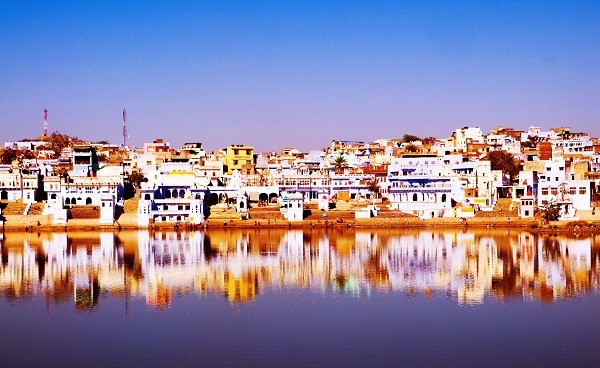
The façade of Man Mahal faces directly onto Pushkar lake and its bustling ghats. The architecture blends pink sandstone arcades, jharokhas (projecting balconies) and tiered terraces typical of Rajasthani style. From the upper levels, the view encompasses the lake, white ghats and surrounding hills dotted with temples.
History and Context
Man Singh I, general of Emperor Akbar and Raja of Amber, had this palace built in the late 16th century. As Pushkar was one of North India's most important Hindu pilgrimages, Rajasthani sovereigns maintained residences there for their ritual stays. The building has stood through centuries before being integrated into the Rajasthan Tourism Development Corporation's public hotel network.
Highlights of Your Visit
The Façade Over the Ghats
The alignment of the palace facing the lake offers a rare perspective: a 16th-century royal structure in direct dialogue with pilgrimage ghats. The morning activity of devotees by the water enhances the contrast between palatial architecture and daily religious life.
Views from the Terraces
The upper terraces allow you to observe the lake as a whole, the arid hills of Rajasthan and, during the Pushkar fair (Kartik Purnima), the exceptional bustle of the shores.
Photography Tips
Morning light is ideal for photographing the façade, the palace's reflection in the lake and the activity on the ghats. In late afternoon, golden light enhances the pink sandstone of the building. Show discretion during religious ceremonies on nearby ghats.
Etiquette and Visiting Rules
The ghats of Pushkar are sacred spaces. Consuming meat, alcohol or eggs is forbidden throughout the entire city. Avoid photographing pilgrims in prayer without their consent. Remove your shoes if you descend onto the ghats.
Location and Access
Man Mahal is situated on the main ghats of Pushkar, a few minutes' walk from the central bazaar. Pushkar is accessible from Ajmer by road (approximately 15 km), itself connected by train to Jaipur and Delhi. No train serves Pushkar directly.
Nearby
- Brahma Temple — one of the very rare temples dedicated to Brahma in India, a few minutes' walk away.
- Pushkar Lake — sacred lake surrounded by ghats and temples, the spiritual heart of the city.
- Savitri Temple — perched on the hill overlooking Pushkar, accessible on foot or by cable car.
- Ajmer Sharif Dargah — a major Sufi shrine in Ajmer, about thirty kilometers away.
Frequently asked questions
The building operates as an RTDC hotel. Access to the interior is primarily reserved for guests. The façade and surroundings on the ghats remain freely visible.
October to March offers pleasant weather. The Pushkar fair (Kartik Purnima, typically in November) is the most lively time, though also the busiest.
Yes, both sites are a few minutes' walk from each other. Half a day is enough to explore the ghats, Man Mahal and Brahma Temple.
Pushkar is a sacred city: attire covering shoulders and knees is recommended. On the ghats, remove your shoes if you approach prayer areas.
The most common route passes through Ajmer (approximately 2.5 hours from Jaipur). From Ajmer, Pushkar is about twenty minutes by taxi or local bus.
Interested in this visit?
We can include it in your personalised itinerary.