Ooty Lake
Ooty Lake
An artificial lake created in 1824 by John Sullivan, Ooty Lake is the landmark of the Nilgiri hill station, in the heart of Tamil Nadu.
Ooty Lake is an artificial body of water covering 26 hectares, situated at approximately 2,240 metres altitude in the heart of the Nilgiri Hills (the Blue Mountains), in the state of Tamil Nadu. Created in the early 19th century by the British, it is today one of the landmarks of the Ooty hill station in southern Inde.
Why visit Ooty Lake
The lake offers a refreshing setting at over 2,000 metres altitude, away from the heat of the Indian plains. It combines several attractions: a testament to the British colonial past, accessible water activities (rowboats, pedal boats), and a central location for exploring the Nilgiris, partially classified as a UNESCO World Heritage site through the adjacent biosphere reserve.
The immediate surroundings lend themselves to a short visit, lasting around one to two hours, which you can combine with nearby botanical gardens or a tea estate stop in the surrounding plantations.
History of the lake
Ooty Lake was created in 1824 by Lieutenant John Sullivan, then collector of Coimbatore and a major figure in the British development of the region. It is an artificial lake, formed by the construction of a dam on a local Nilgiri watercourse that later joins the Nagapattinam river basin.
Originally intended to supply the town with water, the body of water soon became a popular promenade for British residents seeking to escape the heat of the plains. In 1973, the site was taken over by the Tamil Nadu Tourism Department, which has since managed its development. The lake's surface area has diminished over time to reach its current 26 hectares.
What to see and do
Boat rides
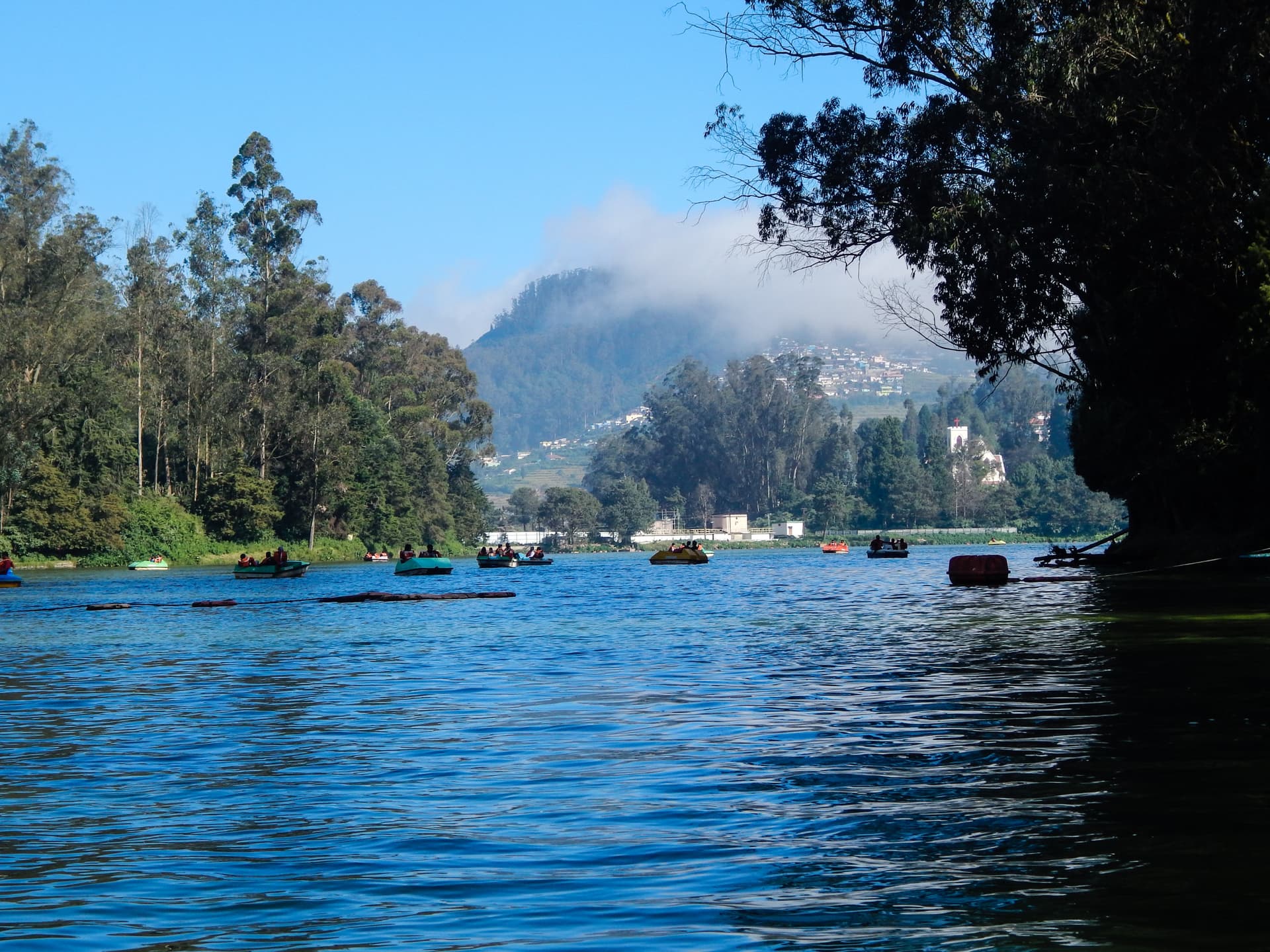
The main activity remains a trip on the water. The boat house offers rowboats, pedal boats and motorboats operated by the Tamil Nadu Tourism Development Corporation. Trips generally last between 20 and 30 minutes, offering clear views of the wooded hills surrounding the lake.
The boat house and its surroundings
The boat house houses a canteen, a few shops selling local products (eucalyptus oil, woven Nilgiri shawls) and a small children's park with pony rides and a mini-train. It is the main entry point to the site.
Neighbouring gardens
A short distance away is the Government Rose Garden, one of India's largest, featuring several thousand varieties of roses on the slopes of Elk Hill. The Government Botanical Gardens, another Ooty must-see, complete a nature-focused visit.
Flora and fauna
The shores are lined with pines, eucalyptus and tea plantations. The surroundings are home to birds, squirrels and butterflies; sambars and nilgai can be spotted higher up in the surrounding forests. The region is also the historic territory of the Toda, an indigenous tribal community of the Nilgiris recognised for their craftsmanship and distinctive oval-hut architecture.
Historic sites nearby
Stone House, one of the first buildings constructed in Ooty by John Sullivan in 1822, bears witness to the colonial past of the station. The Tea Factory, higher up in the hills, offers a guided tour of the Nilgiri tea manufacturing process, from picking to packaging, with a tasting at the end of the tour.
Practical information
Ooty Lake is open to the public daily, generally during daylight hours. Admission is charged, with different rates for Indian and foreign visitors, and supplements for parking, cameras and water activities. Budget moderate rates for entry and boat rides; bring cash in rupees, as card payments are not always available.
The site can be crowded on weekends, public holidays and during Indian school holidays. An early morning visit guarantees favourable lighting and shorter queues for the boat house.
When to visit
The best times to visit Ooty span April to June and September to November, when temperatures remain mild and skies are relatively clear. The south-west monsoon in July and August brings sustained rainfall which can make mountain roads difficult and limit water activities. The months of December to February are cool, sometimes cold in the morning, with temperatures occasionally dropping near freezing at night.
How to reach Ooty Lake
The lake is located at the western edge of Ooty town, accessible on foot from the centre or by rickshaw.
- By air: the nearest airport is Coimbatore, approximately 88 km away. Buses and taxis provide connections to Ooty (3 to 4 hours of winding roads).
- By train: the Nilgiri Mountain Railway, a UNESCO World Heritage site, connects Mettupalayam (approximately 81 km away) to Ooty. The journey takes 4 to 5 hours through the hills and is an experience in itself.
- By bus or car: regular services operate from Coimbatore, Mysore, Bangalore and several towns in Kerala and Karnataka.
More to see in Inde
If you are interested in highland scenery and lakes, extend your stay with other evocative sites across the subcontinent:
- Amar Sagar Lake, in the Thar Desert
- Alchi Monastery, a Buddhist gem in Ladakh
- Anjengo Fort, a colonial stronghold in Kerala
- State Museum of Bhopal, for the art of Madhya Pradesh
Frequently asked questions
Frequently asked questions
One to two hours are sufficient to tour the site, enjoy a boat ride and stroll around the boat house. Allow half a day if you combine it with the botanical gardens or Government Rose Garden.
No, admission is charged with different rates for Indian and foreign visitors. Supplements apply for parking, cameras and water activities.
Choose April-June and September-November, when the climate is mild and stable. Avoid July-August, the monsoon season with heavy rainfall.
Yes, the boat house managed by the tourism authorities offers rowboats, pedal boats (2 or 4 seater) and motorboats. Trips usually last 20 to 30 minutes.
Yes, this historic UNESCO-listed railway connects Mettupalayam to Ooty in 4 to 5 hours, through the hills. The journey is an attraction in its own right.
Planning your trip to Inde
Ooty Lake naturally fits into a tour dedicated to southern Inde, between the tea plantations of the Nilgiris, the temples of Tamil Nadu and the backwaters of Kerala. To build a tailor-made itinerary including this stop, consult our tours in Inde.
Interested in this visit?
We can include it in your personalised itinerary.