Kumbakonam
Kumbakonam
Kumbakonam, set in the Kaveri delta, is the spiritual heart of Tamil Nadu: Chola temples, the sacred Mahamaham Tank, and workshops for bronze and silk make this town a major stop on South India's temple circuit.
Kumbakonam is a town in Tamil Nadu, nestled in the fertile Kaveri delta, about 40 km east of Thanjavur. Nicknamed "the city of temples," it concentrates an exceptional density of Dravidian sanctuaries, sacred ghats, and vibrant Brahmanical traditions. A spiritual and cultural crossroads of the Tamil country, it attracts pilgrims and travelers seeking an authentic South India, far from mass tourism routes.
Practical Information at a Glance
- Access: Well-connected railway station from Chennai (approx. 5–6 hours), Thanjavur, and Trichy; regular buses from neighboring towns.
- Dress code: Clothing covering shoulders and knees is mandatory in all temples; certain sanctuaries prohibit non-Hindus from entering the inner shrine.
- Footwear: Must be removed before entering any temple.
- Recommended duration: 1 to 2 days to cover the main temples and Mahamaham Tank.
- Best time to visit: October to March (dry season, comfortable temperatures); the Mahamaham festival, held every 12 years, draws millions of pilgrims.
What to See
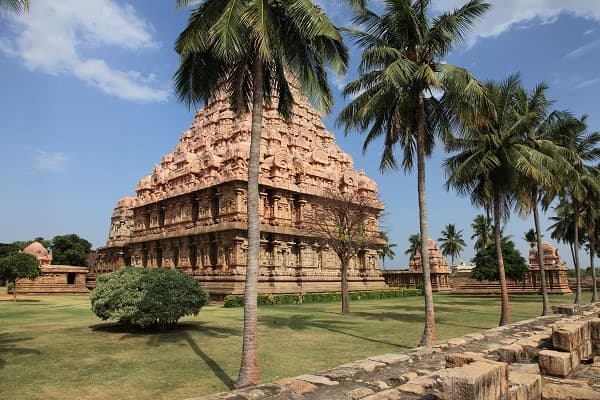
The town has more than twenty major temples, several dating from the Chola era. The Mahamaham Tank, a vast sacred reservoir surrounded by sixteen small sanctuaries, forms the ritual heart of the city. The gopurams (ornamental gateway towers) covered in polychrome sculptures dominate narrow lanes. Silk and bronze workshops, living artisanal heritage, line the old quarters.
History and Context
Kumbakonam flourished under the Chola, Vijayanagara, and Nayak dynasties between the 9th and 17th centuries. The Cholas made it a major religious and commercial center of the Kaveri delta. The town takes its name from legend: Shiva is said to have stopped here a pot (kumbha) containing the seeds of creation, swept away by the cosmic deluge. This mythical origin establishes its status as one of Tamil Nadu's oldest pilgrimage sites.
Highlights of a Visit
Adi Kumbeswarar Temple
Dedicated to Shiva, this is the city's largest temple and gives the town its name. Its principal gopuram rises across multiple levels adorned with narrative sculptures. The enclosure houses several secondary sanctuaries and a ritual tank animated each morning by puja ceremonies.
Sarangapani Temple
One of 108 Divya Desams (sacred Vaishnava sites), recognizable by its imposing Vijayanagara-style gopuram. The interior architecture, with its sculpted columns and mandapas, illustrates the refinement of later Dravidian art.
Ramaswamy Temple
Built under the Nayaks, this temple stands out for its wall frescoes depicting scenes from the Ramayana, among Tamil Nadu's best-preserved classical Tamil paintings. A must-visit for those interested in classical Tamil art.
Mahamaham Tank
This large sacred reservoir is the convergence point of pilgrimages. Every 12 years, at the Mahamaham festival, millions of devotees bathe here to purify their sins. Outside festival time, the atmosphere remains meditative, marked by the inhabitants' morning ablutions.
Quarter of Bronze Workers and Weavers
Kumbakonam is renowned for its silks and bronzes cast using the lost-wax technique, an inheritance from the Cholas. Several family workshops welcome visitors and allow observation of work in progress.
Temple Etiquette and Rules
- Remove shoes and socks before entering the temple enclosure.
- Dress modestly: shoulders and knees must be covered; sarongs are sometimes provided at the entrance.
- In many temples, the inner sanctum (garbhagriha) is reserved for Hindus.
- Avoid photographing puja ceremonies without discretion; some temples prohibit cameras inside.
- Speak softly and avoid inappropriate gestures in places of worship.
Photography Tips
The golden morning light (6–8 a.m.) beautifully illuminates the gopurams and reflections on the Mahamaham Tank. The lanes around the Adi Kumbeswarar Temple offer framings with flower vendors and devotees in traditional dress. Check photo restrictions at each temple before bringing out your camera.
Location and Access
Kumbakonam lies in Thanjavur district, at the heart of the Kaveri delta. The railway station connects the town to Thanjavur (approx. 40 km west) and Chidambaram (approx. 60 km northeast). Local buses and auto-rickshaws make it easy to move between temples in town. Accessibility for persons with reduced mobility remains limited in old temples with uneven stone floors.
Nearby Attractions
- Thanjavur — The grand Brihadeeswara Temple, a UNESCO-listed Chola masterpiece, about 40 km away.
- Darasuram — The Airavatesvara Temple, another UNESCO-listed Chola jewel, just a few kilometers from Kumbakonam.
- Gangaikonda Cholapuram — Former Chola capital and monumental temple, about 35 km to the north.
- Chidambaram — The famous Nataraja Temple, home to the god of cosmic dance, about 60 km away.
- Tranquebar (Tharangambadi) — Former Danish trading post on the Coromandel coast, about 60 km east.
Frequently asked questions
The dry season from October to March offers pleasant temperatures. Avoid May–June, which are very hot and humid. The Mahamaham festival (every 12 years) is an exceptional spiritual event, but crowds are substantial.
Access to the outer enclosures is generally open to all. The inner sanctum of most temples is reserved for Hindus. Inquire at the entrance of each temple.
Yes, the two towns are about 40 km apart. A well-organized day allows you to visit Thanjavur's grand temple in the morning and Kumbakonam's main temples in the afternoon, or vice versa.
Wear clothing covering shoulders and knees. Bring light socks: stone floors can become hot during the day. Some temples provide sarongs at the entrance.
One day is sufficient for the main temples and Mahamaham Tank. Two days allow you to explore artisanal workshops, secondary temples, and nearby sites like Darasuram.
Rules vary by temple. Some allow photos in outer courtyards but not inside the sanctum. Always ask permission on site and avoid photographing puja ceremonies without discretion.
Photos
Want to discover this destination?
Our local advisors design your tailor-made trip.