Calico Museum of Textiles
Calico Museum of Textiles
In Ahmedabad, the Calico Museum preserves one of the world's most extensive collections of Indian textiles, from Mughal fabrics to contemporary regional embroideries.
The Calico Museum of Textiles in Ahmedabad houses one of the world's most important collections of Indian textiles, from Mughal court fabrics to contemporary regional embroideries. Located within a heritage estate in the Shahibaug quarter, it combines rigorous museum practice, reconstructed Gujarati architecture, and strict conservation policies that make it a reference point for scholars and travelers interested in craftsmanship alike.
Why visit the Calico Museum
The museum brings together several centuries of Indian textile expertise within an exceptional architectural setting. The visit appeals to those seeking to understand the role of fabric in Indian history: court textiles, religious fabrics, regional embroideries, and painted cloths. Beyond its collections, the institution stands out for its educational mission: it has influenced the curriculum of the National Institute of Design (NID) in Ahmedabad and remains an academic reference for the study of traditional techniques.
Admission is free but strictly regulated: only two guided tours are offered daily, with limited spaces. This constraint ensures an in-depth experience and proper preservation of the pieces.
Museum history
The Calico Museum of Textiles was founded in 1949 by Gautam and Gira Sarabhai, siblings from a prominent Ahmedabad industrial family. The city has been a textile hub since the 15th century. The idea stemmed from a suggestion by Ananda Coomaraswamy, an art historian, who encouraged Gautam Sarabhai to establish an institution devoted to textiles. The museum was inaugurated by Jawaharlal Nehru, India's first Prime Minister.
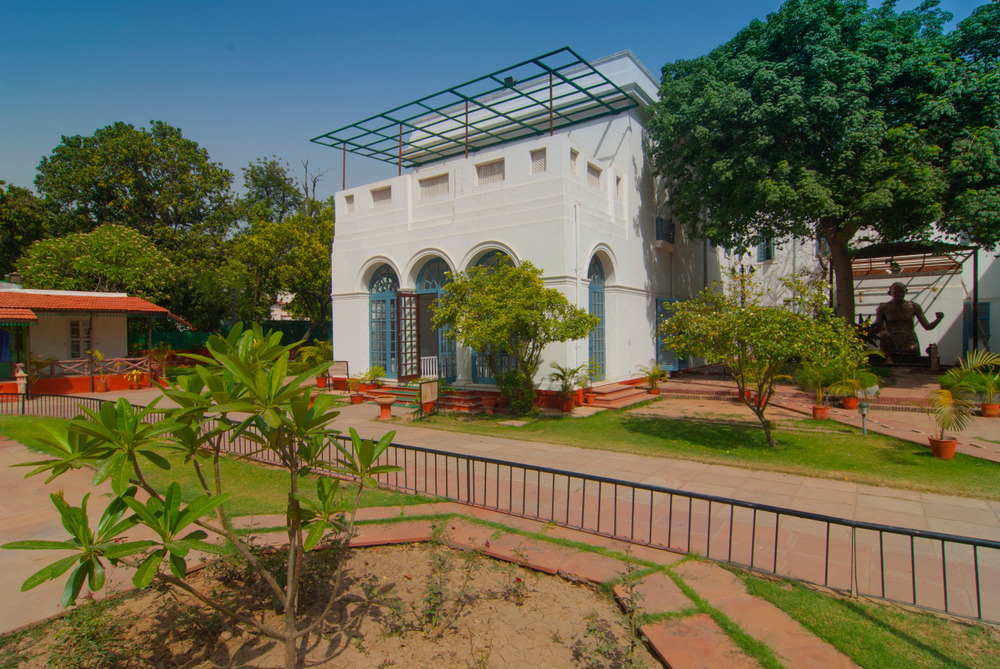
Originally housed in the Calico Mills, an emblematic industrial complex of the Sarabhai family, the museum relocated in 1982 to The Retreat estate in Shahibaug. The site includes the Sarabhai-ni-Haveli, a residence designed in the 1930s by Surendranath Kar, an architect trained at Shantiniketan.
From the 1950s onward, the institution refocused its activities on artisanal textiles. A publishing program was launched in the 1960s under the joint direction of John Irwin (Victoria and Albert Museum, London) and Dr. Alfred Bühler (Museum of Ethnography, Basel). In 1971, the Calico became an independent institution dedicated to research, documentation, and conservation.
What to see in the collections
The collections span nearly five centuries of Indian textile production, complemented by related art objects.
Court textiles and royal pieces
- Kashmiri shawls, some examples requiring up to three years of work.
- Double-ikat Patola from Gujarat, a technique requiring the individual dyeing of nearly 100,000 threads before weaving.
- Mughal court garments dated from the 15th to 19th century.
- Mughal carpets once owned by sovereigns such as Akbar and Aurangzeb.
- Royal tent in gold brocade attributed to Shah Jahan.
Regional embroideries and weaves
- Phulkaris from Punjab, embroideries with floral motifs.
- Brocades from Benares woven with gold and silver threads.
- Bandhani from Gujarat, tie-dye achieved through binding.
- Mashru, a fabric blending silk and cotton.
- Hand-painted Kalamkaris depicting mythological scenes.
- Balushar, Paithani, and Kanchipuram saris, representing major weaving traditions.
Religious textiles and associated pieces
- Pichwais, painted hangings illustrating the life of Krishna.
- Jain manuscripts on palm leaves.
- Textiles related to the Vallabha Sampradaya sect.
- Temple garments and hangings.
The museum also displays miniature paintings, bronzes from South India, Jain sculptures, and antique furnishings. Worth noting: fragments of Indian textiles discovered in Egypt, testimony to ancient textile trade routes.
The site's architecture
The complex is divided into two ensembles. The Haveli houses religious textiles, miniatures, South Indian bronzes, and Jain art in an intimate interior space. The Chauk, organized around an interior courtyard, presents royal tents, ceremonial carpets, and court costumes. The carved wooden façades surrounding the Chauk come from old havelis rescued from demolition and reassembled on-site.
Practical information
Admission is free but advance registration is mandatory, with a request to be made well before your visit (ideally several weeks in advance, as demand far exceeds available spots). Two guided tours are organized each weekday: one in the morning focused on the Haveli galleries (religious textiles, miniatures), and one in the afternoon dedicated to the Chauk (royal tents, carpets, religious art). Spaces are strictly limited and the museum is closed Mondays and public holidays. A weekly garden tour may also be available—check the time slot with the institution.
A few key rules:
- Photography and video are prohibited throughout all galleries.
- Bags, cameras, and mobile phones must be left at the entrance in a secure locker.
- Young children are not permitted (age limit set by the institution).
- The historic building is not wheelchair accessible: narrow passages, uneven floors, multiple levels.
- Library access is limited to guided tour hours.
Allow approximately two hours for each guided tour. Wear comfortable clothing for walking and be prepared to leave personal items at the entrance.
Nearby attractions
Ahmedabad, a UNESCO World Heritage site, deserves several days of exploration: fortified old city, sultanate mosques, Gandhi's ashram at Sabarmati, step-wells on the periphery. To further explore Indian museums, other institutions complement this visit well, such as the State Museum in Bhopal, which offers a panorama of art and archaeology from Madhya Pradesh.
Consult our complete Ahmedabad guide to plan the rest of your stay.
How to get there
The museum is located in the Shahibaug quarter, north of Ahmedabad's historic center. From the old city center or railway station, expect about twenty minutes by taxi or auto-rickshaw depending on traffic. Ride-sharing apps work well in Ahmedabad and remain the simplest option. Sardar Vallabhbhai Patel Airport is approximately 10 km away. Arrive at least fifteen minutes before your confirmed tour time: the access gate closes as soon as the guided tour begins.
Frequently asked questions
Frequently asked questions
Yes, admission is free. However, advance registration is mandatory and spaces are very limited per guided tour. It is recommended to book well in advance.
No. Photography and video are strictly prohibited in all galleries. Phones, cameras, and bags must be left at the entrance in a secure space.
The historic building is not wheelchair accessible. The galleries include multiple levels, narrow passages, and uneven floors.
Each guided tour lasts approximately two hours. Since the morning and afternoon galleries are separate, plan on two separate visits for a comprehensive overview of the collections.
An age limit is enforced to preserve the collections. Young children are not admitted to guided tours: check the current policy when submitting your registration request.
Prepare your trip to India
The Calico Museum is a significant stop on a cultural itinerary through Gujarat or a major northern India circuit. To integrate this visit into a bespoke journey, consult our travels in India designed with local specialists.
Interested in this visit?
We can include it in your personalised itinerary.