Bijli Mahadev
Bijli Mahadev
Hindu temple perched at 2,460 m in Kullu Valley, accessible via a 3 km trek through forest. Shiva legends, ritual lightning and Himalayan panorama.
Bijli Mahadev is a Hindu temple perched at 2,460 meters altitude in Himachal Pradesh, northern India. Located near the village of Kashawri in Kullu Valley, it is reached after a 3-kilometer hiking trail through a forest of pines and cedars. The site combines religious significance, Himalayan panorama and a singular atmospheric phenomenon: according to local tradition, lightning regularly strikes the temple's lingam, which is then reconstructed by the priest.
Why visit Bijli Mahadev
The temple offers three complementary points of interest. First, it is a living place of worship dedicated to Shiva, frequented by pilgrims from the valley. Second, it is a rare vantage point over the confluence of Kullu and Parvati valleys, with the snowcapped chains of Pir Panjal and Dhauladhar in the background. Third, it is a moderately difficult hike through a Himalayan conifer forest, accessible to most visitors in reasonable fitness. The name of the temple itself summarizes its singularity: Bijli means "lightning" in Hindi. The 18-meter wooden mast rising above the sanctuary acts as a natural lightning rod, and each strike triggers a reconstruction ritual.
History and legends
The current building dates from the 20th century, but the site is cited as an ancient place of worship in Kullu Valley tradition. Two legends are passed down locally.
The first tells of Shiva defeating the demon Jalandhara with a trident strike, saving Kullu Valley from submersion. A variant mentions the demon Kulanta, who came from the village of Mathan in Lahaul-Spiti. Taking the form of a massive serpent, Kulanta sought to drown all life; Shiva is said to have vanquished him to protect the inhabitants.
According to local tradition, roughly every twelve years, lightning strikes the temple's lingam and shatters it into fragments. The priest reconstructs it using a ritual mixture composed of clarified butter (chopad), legume flour and cereals. The faithful see in this cycle of destruction and regeneration a manifestation of Shiva's blessing, echoing the Hindu cycle of life and death.
What to see on site
Kath-Kuni architecture
The temple adopts the Kath-Kuni style, typical of the mountainous regions of northern India. This technique alternates layers of wood and stone to better resist frequent earthquakes in the region. The woodwork and carved lintels testify to local artisanal craftsmanship. The main sanctuary houses the lingam, around which worship is organized. Above the building, the 18-meter wooden mast is visible for several kilometers and constitutes the focal point for lightning.
The Himalayan panorama
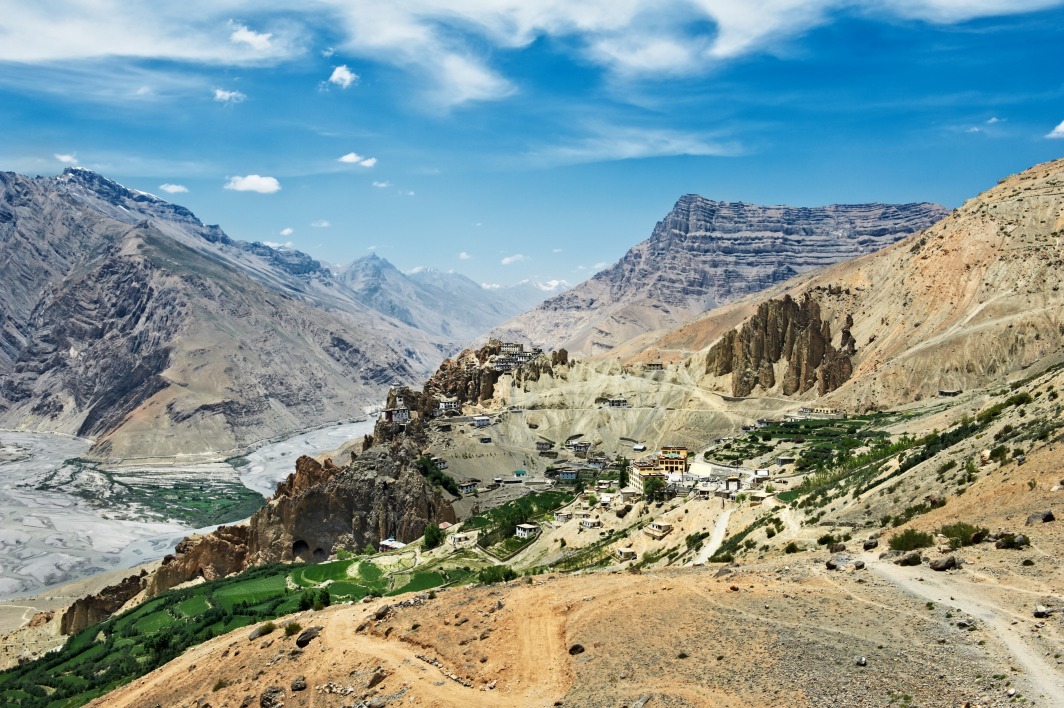
From the temple esplanade, the view spans Kullu and Parvati valleys, as well as the snow-capped peaks of the Pir Panjal and Dhauladhar ranges on clear days. Early morning hours are often shrouded in mist, and late afternoon light brings out the relief.
The Maha Shivratri festival
The temple experiences particularly high attendance during the Maha Shivratri festival, a major celebration dedicated to Shiva. If you travel during this period, expect dense crowds and a marked ritual atmosphere.
The access trek
The temple is reached only on foot. From the last road point, you must account for a trail of approximately 3 kilometers, punctuated by stone steps and gradually ascending sections. The hike traverses a forest of pines and cedars and typically takes between 1 and 2 hours depending on pace. The elevation gain is steady but not extreme; good shoes and water are sufficient. At 2,460 meters, the altitude remains moderate but may be felt if you arrive directly from the plains.
Practical information
- Attire: hiking shoes, covering clothing to enter the sanctuary
- Photography: permitted outside, check with the priest inside
- Offerings: small donations welcome, flowers and incense available locally
- Hours: open during the day, variable by season and rituals — check with your accommodation
When to go
The best periods for hiking are April to June and September to November. Temperatures are pleasant and trails are passable. In summer, the monsoon makes the path slippery. In winter, snow may cover the trail and complicate access.
How to get there
The trek starting point is located about twenty kilometers from Kullu and is accessible by taxi or private car from Kullu, Manali or Naggar. Allow approximately 1 hour of driving from Kullu on mountain hairpins. No direct public transport serves the starting point: the simplest solution is to hire a taxi for the day including waiting time and return. From Manali, expect approximately 2.5 hours of travel time.
Nearby attractions
Kullu Valley
Nicknamed the "Valley of the Gods,
Interested in this visit?
We can include it in your personalised itinerary.